
By W. M. Keck Observatory August 8, 2025
Collected at: https://scitechdaily.com/how-can-we-make-sense-of-this-strange-infinity-galaxy-stuns-scientists/
Astronomers may have caught a supermassive black hole in the act of forming inside a uniquely shaped galaxy.
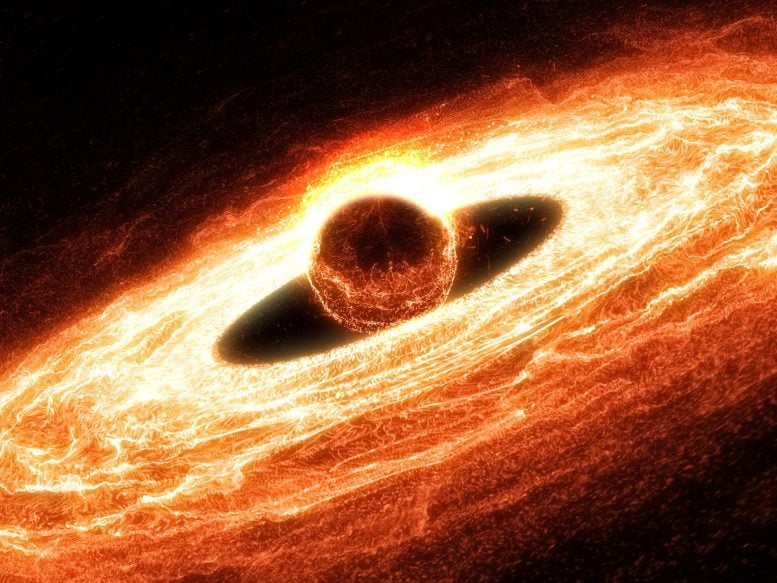
Astronomers working with the W. M. Keck Observatory on Maunakea, Hawaiʻi Island have identified a rare and unusual galaxy they’ve dubbed the “Infinity” galaxy. This intriguing object appears to have formed when two galaxies collided, creating a shape that closely resembles the infinity symbol. Nestled at the center, surrounded by a cloud of gas, may be something truly extraordinary: a newly formed supermassive black hole.
What makes this discovery especially significant is not just the galaxy’s unique appearance, but the deeper insights it may offer. It could point to an entirely new way that supermassive black holes come into being. The find also sheds light on a long-standing mystery in astronomy: how some black holes in the early universe managed to grow so large, so fast. Scientists believe this may be the first time we’ve directly observed a supermassive black hole in the earliest moments of its formation.
“We think we’re witnessing the birth of a supermassive black hole — something that has never been seen before,” said Pieter van Dokkum, professor of astronomy and physics at Yale University and lead author of the new study. “This is as close to a smoking gun as we’re likely ever going to get.”
The study, led by Yale University, was recently published in The Astrophysical Journal Letters.
A Galactic Oddity with a Central Mystery
“Everything is unusual about this galaxy,” he said. “Not only does it look very strange, but it also has this supermassive black hole that’s accreting a lot of material. The biggest surprise of all was that the black hole was not located inside either of the two nuclei of the merging galaxies, but in the middle. We asked ourselves: how can we make sense of this?”
Van Dokkum and astronomer Gabriel Brammer of the University of Copenhagen made the initial discovery while studying images from the COSMOS-Web survey, which is part of the data archives of NASA’s James Webb Space Telescope.

Follow-up observations of the Webb data were conducted using data from the National Radio Astronomy Observatory’s Very Large Array, the Chandra X-ray Observatory, and Keck Observatory, which allowed the team to make several key observations critical for the object’s interpretation.
Using Keck’s Low-Resolution Imaging Spectrometer (LRIS), van Dokkum and the team were able to obtain the spectra that provided essential measurements, including the distance to the Infinity galaxy, the location of the newly formed black hole, and the mass of the black hole: about a million times the mass of the sun, and similar to the mass of the black hole at the center of our Milky Way.
“This is a prime example of the crucial role Keck Observatory plays in following up on unusual objects spotted in JWST images,” said van Dokkum. “Thanks to the flexibility of Keck’s observing model—where astronomers can decide in real time what to observe—we’re able to act quickly and pursue high-risk, high-reward targets that other observatories, with fixed programs, simply can’t. The Keck/Yale partnership has been absolutely critical for this and many other discoveries, and this discovery pipeline will only grow stronger with the advent of Roman and the next generation of powerful Keck instruments.”
Black Hole Formation: A Tale of Two Seed Theories
Finding a black hole that is not located in the nucleus of a massive galaxy is, in itself, unusual. To then discover that the black hole had only just formed is unprecedented.
The finding also has implications for recent debates about the formation of black holes in the early universe.
One explanation, known as the “light seeds” theory, proposes that black holes began as the remnants of massive stars that collapsed and exploded. Over time, these smaller black holes gradually merged, eventually forming supermassive black holes. However, this process is thought to take a significant amount of time. The challenge with this idea is that the James Webb Space Telescope has already detected supermassive black holes at a stage in the universe’s history that seems too early for the light seed model to account for.
This leaves an alternative, called the “heavy seeds” theory. According to this idea, massive black holes can emerge all at once from the direct collapse of enormous gas clouds. The difficulty with this theory lies in the fact that such collapsing gas clouds typically give rise to stars, not black holes.
Van Dokkum said the Infinity galaxy may show how extreme conditions — including those in the early universe suggested by the “heavy seeds” theory — could lead to the creation of a black hole.
“In this case, two disk galaxies collided, forming the ring structures of stars that we see,” van Dokkum said. “During the collision, the gas within these two galaxies shocked and compressed. This compression might just be enough to form a dense knot that then collapsed into a black hole.
“While such collisions are rare events, similarly extreme gas densities are thought to have been quite common at early cosmic epochs, when galaxies began forming,” he added.
Van Dokkum and his colleagues stressed that additional research is needed to confirm the findings and what they portend for black hole formation.
“One thing we’d like to do is get closer to the black hole, to see what the gas is doing in its immediate vicinity,” van Dokkum said. “Later this fall, we will use Keck Observatory’s adaptive optics to conduct this research.”
“Apart from that,” adds van Dokkum, “the ball is in the theorists’ court! We need computer models that simulate the extreme conditions during the collision, to see if – in the simulations – a black hole forms. In a galaxy unimaginably far from Earth, the universe just made a black hole. And in doing so, it handed us a clue about how our own Milky Way was born.”
Reference: “The ∞ Galaxy: A Candidate Direct-collapse Supermassive Black Hole between Two Massive, Ringed Nuclei” by Pieter van Dokkum, Gabriel Brammer, Josephine F. W. Baggen, Michael A. Keim, Priyamvada Natarajan and Imad Pasha, 15 July 2025, The Astrophysical Journal Letters.
DOI: 10.3847/2041-8213/addcfe
Leave a Reply