
August 5, 2025 by Tara Friesen, NASA
Collected at: https://phys.org/news/2025-08-spacecraft-autonomy-enable-future-satellite.html
Astronauts living and working on the moon and Mars will rely on satellites to provide services like navigation, weather, and communications relays. While managing complex missions, automating satellite communications will allow explorers to focus on critical tasks instead of manually operating satellites.
Long-duration space missions will require teaming between systems on Earth and other planets. Satellites orbiting the moon, Mars, or other distant areas face communications delays with ground operators which could limit the efficiency of their missions.
The solution lies within the Distributed Spacecraft Autonomy (DSA) project, led by NASA’s Ames Research Center in California’s Silicon Valley, which tests how shared autonomy across distributed spacecraft missions makes spacecraft swarms more capable of self-sufficient research and maintenance by making decisions and adapting to changes with less human intervention.
Adding autonomy to satellites makes them capable of providing services without waiting for commands from ground operators. Distributing the autonomy across multiple satellites, operating like a swarm, gives the spacecraft a “shared brain” to accomplish goals they couldn’t achieve alone.
The DSA software, built by NASA researchers, provides the swarm with a task list, and shares each spacecraft’s distinct perspective—what it can observe, what its priorities are—and integrates those perspectives into the best plan of action for the whole swarm. That plan is supported by decision trees and mathematical models that help the swarm decide what action to take after a command is completed, how to respond to a change, or address a problem.
Sharing the workload
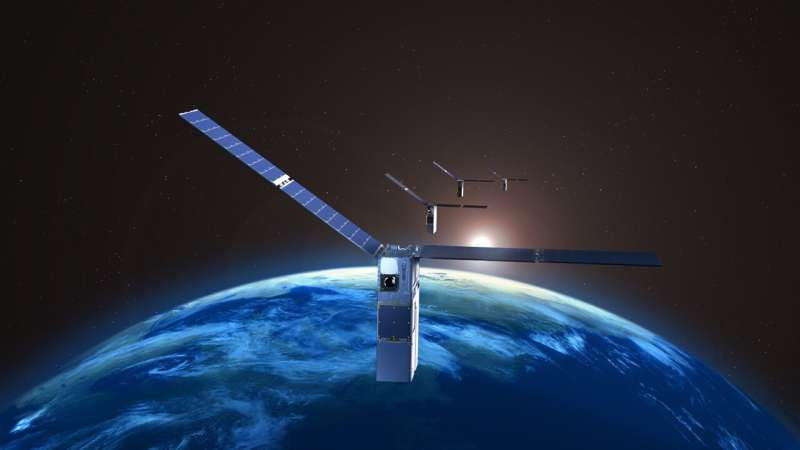
The first in-space demonstration of DSA began onboard the Starling spacecraft swarm, a group of four small satellites, demonstrating various swarm technologies. Operating since July 2023, the Starling mission continues providing a testing and validation platform for autonomous swarm operations. The swarm first used DSA to optimize scientific observations, deciding what to observe without pre-programmed instructions. These autonomous observations led to measurements that could have been missed if an operator had to individually instruct each satellite.
The Starling swarm measured the electron content of plasma between each spacecraft and GPS satellites to capture rapidly changing phenomena in Earth’s ionosphere—where Earth’s atmosphere meets space. The DSA software allowed the swarm to independently decide what to study and how to spread the workload across the four spacecraft.
Because each Starling spacecraft operates as an independent member within the swarm, if one swarm member was unable to accomplish its work, the other three swarm members could react and complete the mission’s goals.
The Starling 1.0 demonstration achieved several firsts, including the first fully distributed autonomous operation of multiple spacecraft, the first use of space-to-space communications to autonomously share status information between multiple spacecraft, the first demonstration of fully distributed reactive operations onboard multiple spacecraft, the first use of a general-purpose automated reasoning system onboard a spacecraft, and the first use of fully distributed automated planning onboard multiple spacecraft. These achievements laid the groundwork for Starling 1.5+, an ongoing continuation of the satellite swarm’s mission using DSA.
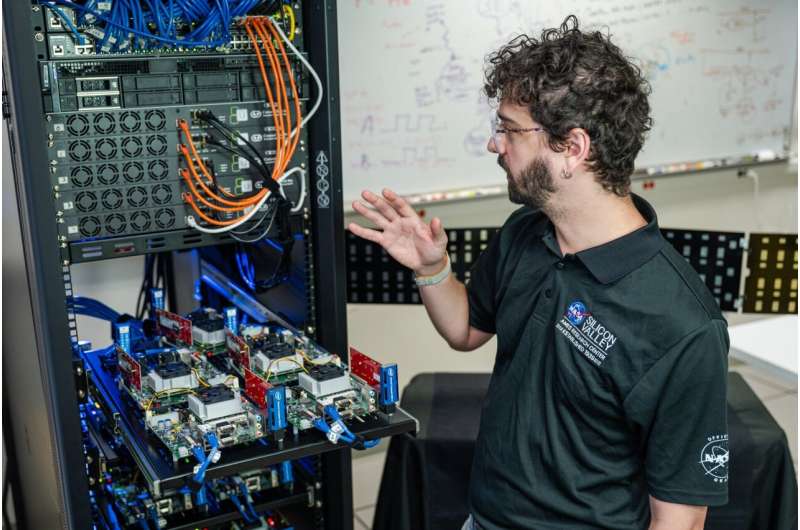
Advanced testing of DSA onboard Starling shows that distributed autonomy in spacecraft swarms can improve efficiencies while reducing the workload on human operators. Credit: NASA / Daniel Rutter
A helping hand in orbit
After DSA’s successful demonstration on Starling 1.0, the team began exploring additional opportunities to use the software to support satellite swarm health and efficiency. Continued testing of DSA on Starling’s extended mission included PLEXIL (Plan Execution Interchange Language), a NASA-developed programming language designed for reliable and flexible automation of complex spacecraft operations.
Onboard Starling, the PLEXIL application demonstrated autonomous maintenance, allowing the swarm to manage normal spacecraft operations, correct issues, or distribute software updates across individual spacecraft.
Enhanced autonomy makes swarm operation in deep space feasible—instead of requiring spacecraft to communicate back and forth between their distant location and Earth, which can take minutes or hours depending on distance, the PLEXIL-enabled DSA software gives the swarm the ability to make decisions collaboratively to optimize their mission and reduce workloads.
Simulated lunar swarming
To understand the scalability of DSA, the team used ground-based flight computers to simulate a lunar swarm of virtual small spacecraft. The computers simulated a swarm that provides position, navigation, and timing services on the moon, similar to GPS services on Earth, which rely on a network of satellites to pinpoint locations.
The DSA team ran nearly one hundred tests over two years, demonstrating swarms of different sizes at high and low lunar orbits. The lessons learned from those early tests laid the groundwork for additional scalability studies. The second round of testing, set to begin in 2026, will demonstrate even larger swarms, using flight computers that could later go into orbit with DSA software onboard.
The future of spacecraft swarms
Orbital and simulated tests of DSA are a launchpad to increased use of distributed autonomy across spacecraft swarms. Developing and proving these technologies increases efficiency, decreases costs, and enhances NASA’s capabilities opening the door to autonomous spacecraft swarms supporting missions to the moon, Mars, and beyond.


Leave a Reply