
By University of Illinois Grainger College of Engineering August 1, 2025
Collected at: https://scitechdaily.com/earths-gravity-might-be-warping-quantum-mechanics-say-physicists/
Scientists propose a groundbreaking experiment using quantum computers and atomic clocks to test whether gravity alters the fundamental rules of quantum theory.
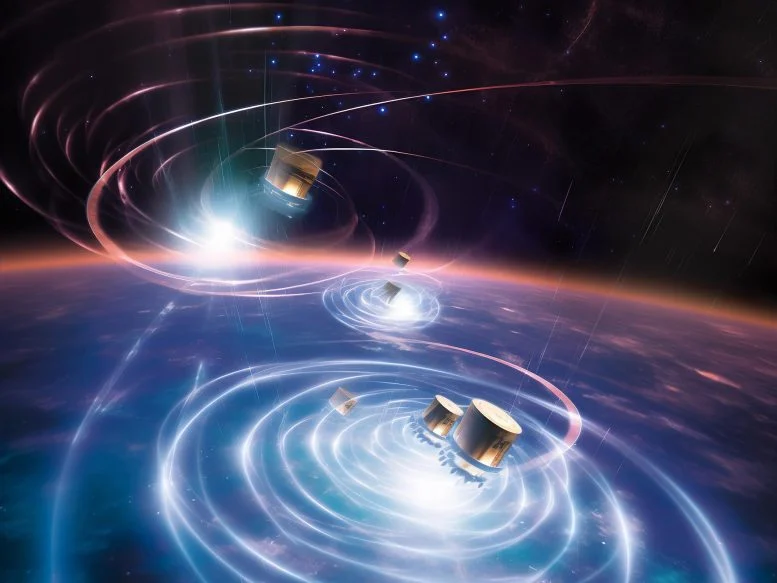
A recent study featured in the journal PRX Quantum reveals how a network of quantum computers equipped with optical clocks can be used to investigate how gravity influences quantum systems.
The researchers found that placing three quantum computers at different elevations, even with just a 1-kilometer difference in height, allows Earth’s curved gravitational field to measurably affect the quantum states shared among them. Their work outlines how this setup could offer the first direct evidence that conventional quantum theory may need to be revised to incorporate the principles of general relativity.
“There is an extensive body of theoretical work suggesting that what we currently accept as quantum theory needs to be modified to account for general relativity, and we have devised an experiment to explore one aspect of this deviation from conventional quantum theory,” said Jacob Covey, a physics professor in The Grainger College of Engineering at the University of Illinois Urbana-Champaign and the study’s lead author. “The strength of our procedure is that it relies on quantum information protocols that have been or will soon be demonstrated, so it is, in principle, relatively straightforward to implement.”
The authors’ work was featured in the American Physical Society magazine Physics and covered in a Viewpoint article.
Gravitational Time Dilation Meets Quantum Mechanics
The effects of general relativity – the modern theory of gravity which posits that space and time are curved by the presence of mass – are expected to manifest in quantum systems through the phenomenon of gravitational time dilation, in which clocks at different locations in a gravitational field “tick” at different rates. While the effect is prominent around ultra-dense objects such as black holes and neutron stars, it is quite subtle here on Earth, where gravity is comparatively weak.
“It was necessary to use the incredibly high precision of quantum metrology with optical atomic clocks to first explore the time dilation near Earth,” Covey said. “However, no experiment has directly observed the effect of spacetime curvature on quantum mechanics itself.”

Past theoretical work has suggested that curvature in space and time alters a fundamental tenet of accepted quantum theory called the Born rule, a principle based on the linearity of quantum theory, allowing the theory’s abstract mathematics to be translated into experimental predictions. However, observing alterations to the rule is a tricky task, as they would only appear in quantum systems with a certain level of intrinsic nonlinearity.
“One of the Born rule’s predictions is how multiple quantum sources combine and interfere with each other,” Covey said. “In a collection of three quantum sources, the rule says that only pairwise interference – 1 and 2, 1 and 3, and 2 and 3 – are needed to describe the full system. If gravity altered the rule, then there would be a term where all three – 1, 2, and 3 – interfere simultaneously. Testing this scenario necessarily requires a system with three sources that span a sufficiently large nonlinearity to provide a discernible observable. This, in turn, requires the most precise sensors humans have ever made, optical atomic clocks, and elevation separations of kilometers. Hence, the three-node quantum network of optical atomic processor clocks.”
W-States and Quantum Teleportation as Experimental Tools
The study’s authors designed an experiment to test this prediction using so-called “W-states” – three-part quantum systems integral to many protocols in quantum computing and communication. Current quantum technology has the means to create W-states on physically separated computers using the operation of quantum teleportation. Exploiting this fact, the researchers demonstrated that gravitational time dilation would cause W-state components to display specific interference patterns, making it clear how Born rule violations would appear in experimental data.
According to Covey, the new protocol is feasible to implement using distributed quantum computing technology, in which quantum “nodes” are connected by special quantum networks. Illinois is participating in the construction of such a network organized by the Q-NEXT Department of Energy quantum center connecting the University of Chicago and Argonne National Laboratory. Fermilab and other locations in the Chicago metro area may be added later, and elevation differences of nearly one kilometer could be achieved using a combination of underground labs at Fermilab (in which drop-tower atomic clock experiments are already performed) and the tall buildings of Chicago.
Reference: “Probing Curved Spacetime with a Distributed Atomic Processor Clock” by Jacob P. Covey, Igor Pikovski and Johannes Borregaard, 21 July 2025, PRX Quantum.
DOI: 10.1103/q188-b1cr

Leave a Reply