
By The University of Hong Kong August 1, 2025
Collected at: https://scitechdaily.com/it-shouldnt-exist-astronomers-discover-a-planet-orbiting-the-wrong-way/
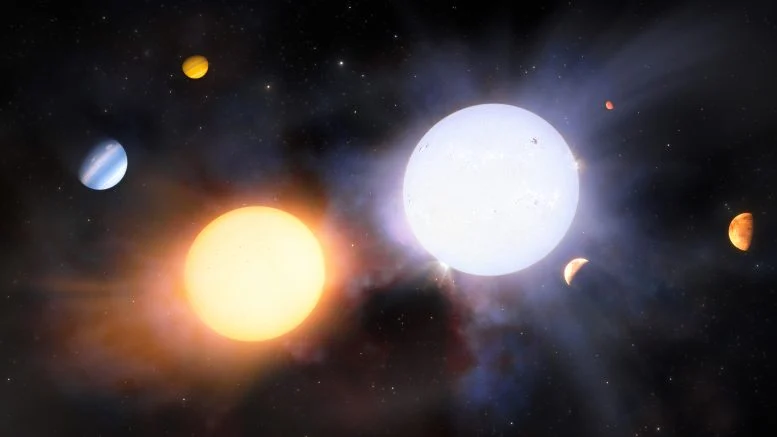
Astronomers have confirmed the existence of a rare, retrograde-orbiting planet in a tight binary star system.
Most stars throughout the Universe are part of binary or multiple star systems. In these systems, a nearby companion star can make it difficult for planets to form and remain in stable orbits around just one of the stars.
A research team made up of international astrophysicists, led by Professor Man Hoi Lee from the University of Hong Kong’s Department of Earth Sciences and Department of Physics, along with MPhil student Ho Wan Cheng, has confirmed a highly unusual planetary discovery.
They identified a planet orbiting in the opposite direction of its binary stars’ movement, known as a retrograde orbit, within the nu Octantis (nu Octantis) binary system. Their work also sheds light on how the evolution of binary stars may have influenced the planet’s origin. These results have been published in the journal Nature.
The nu Octantis system contains two closely bound stars. The primary star, nu Oct A, is a subgiant with approximately 1.6 times the mass of the Sun. Its companion, nu Oct B, has roughly half the Sun’s mass. Together, the two stars complete an orbit around each other every 1,050 days.
Evidence for a potential planet in this system first emerged in 2004, when Dr David Ramm—now a co-author of the recent study—was conducting his PhD research at the University of Canterbury in New Zealand. He detected an unusual pattern in the radial velocity data (which tracks a star’s motion toward or away from Earth), suggesting the presence of a planet.

This signal was consistent with the presence of a Jovian planet of about twice the mass of Jupiter orbiting around the primary star, nu Oct A, with a period of about 400 days. However, the existence of this planet has been controversial because its orbit would be so wide that it could only remain stable if it were retrograde and moved in the opposite direction to the orbit of the binary. There were no observational precedents for such a planet and strong theoretical grounds against its formation.
Confirming a Planet Against the Odds
To settle the debate, the research team obtained new high-precision radial velocity observations using the European Southern Observatory (ESO)’s HARPS spectrograph, which confirmed the existence of the planet signal. “We performed an analysis of the new and archival radial velocity data spanning 18 years and found stable fits that require the planetary orbit to be retrograde and nearly in the same plane as the binary orbit,” said Mr Ho Wan Cheng, the first author of the paper.
Another key focus of the new study was the determination of the nature of the secondary star nu Oct B. The mass of nu Oct B suggests that it could be either a low-mass main-sequence star or a white dwarf. All stars spend most of their lives on the main sequence, generating energy through nuclear fusion of hydrogen to helium in their core. After a star has exhausted its nuclear fuel, its core collapses into a stellar remnant, which would be a white dwarf if the star’s initial mass is less than several times that of the Sun. A white dwarf has a mass comparable to that of the Sun packed in an Earth-sized volume.
To identify which type of star nu Oct B is, the research team used the adaptive optics imaging instrument SPHERE at ESO’s Very Large Telescope to observe the system. The fact that nu Oct B was not detected in these observations indicated that it must be a very faint white dwarf. This suggests that the binary system has evolved significantly since its formation, as nu Oct B has already ejected most of its mass and entered the final stage of its stellar evolution.
Tracing the System’s History
The research team looked into the possible primordial configurations of the binary — that is, the initial masses of the two stars and the initial orbit of the binary. “We found that the system is about 2.9 billion years old and that nu Oct B was initially about 2.4 times the mass of the Sun and evolved to a white dwarf about 2 billion years ago,” said Cheng. “Our analysis showed that the planet could not have formed around nu Oct A at the same time as the stars.”
The discovery that nu Oct B is a white dwarf opens new possibilities for how the retrograde planet may have originated. “When nu Oct B evolved into a white dwarf about 2 billion years ago, the planet could have formed in a retrograde disc of material around nu Oct A accreted from the mass ejected by nu Oct B, or it could be captured from a prograde orbit around the binary into a retrograde orbit around nu Oct A,” explained Professor Man Hoi Lee.
“We might be witnessing the first compelling case of a second-generation planet; either captured, or formed from material expelled by nu Oct B, which lost more than 75% of its primordial mass to become a white dwarf,” added Dr Trifon Trifonov of Zentrum für Astronomie der Universität Heidelberg in Germany and Sofia University St. Kliment Ohridski in Bulgaria and a co-author of the paper.
“The key to this exciting discovery was the use of several complementary methods to characterize the system in its entirety,” said PD Dr Sabine Reffert of Zentrum für Astronomie der Universität Heidelberg and another co-author of the paper.
As astronomers continue to search for planets in different environments, this study highlights that planets in tight binary systems with evolved stellar components could offer unique insights into the formation and evolution of planets.
Reference: “A retrograde planet in a tight binary star system with a white dwarf” by Ho Wan Cheng, Trifon Trifonov, Man Hoi Lee, Faustine Cantalloube, Sabine Reffert, David Ramm and Andreas Quirrenbach, 21 May 2025, Nature.
DOI: 10.1038/s41586-025-09006-x
This research uses two facilities operated by the European Southern Observatory (ESO), namely the High Accuracy Radial Velocity Planet Searcher (HARPS) spectrograph at the ESO La Silla 3.6-metre telescope and the Spectro-Polarimetric High-contrast Exoplanet Research (SPHERE) instrument at the Very Large Telescope.

Leave a Reply