
By Amit Malewar 10 Jul, 2025
Collected at: https://www.techexplorist.com/cold-clouds-inside-milky-way-fiery-breath/100161/
Deep in the heart of our galaxy, the Milky Way is exhaling, and those cosmic breaths aren’t gentle. From the Galactic Center, a powerful wind blasts hot gas into the surrounding halo, sending mass and energy swirling through space. This flow helps regulate the galaxy’s life cycle, shaping how stars and matter evolve across billions of years.
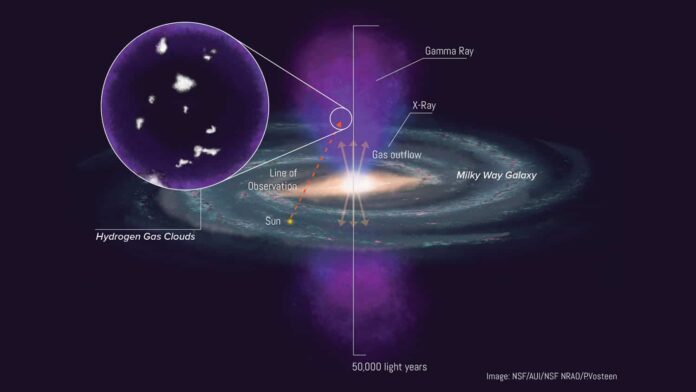
Imagine two colossal balloons of plasma, each stretching 25,000 light-years above and below the galaxy’s plane. These are the Fermi Bubbles, glowing with energy from gamma rays down to radio waves. And their even bigger siblings, the X-ray-rich eROSITA bubbles, extend the spectacle.
Back in 2010, scientists spotted something shocking: a pair of gigantic, glowing lobes of gas bursting from the Milky Way’s center. These were the Fermi Bubbles, discovered with gamma-ray vision, and they weren’t subtle. Their origin? Still debated. But one thing’s clear: it was sudden, fierce, and explosive, like a galactic volcano going off.
Now, thanks to the Green Bank Telescope, researchers have zoomed in closer than ever. With double the sensitivity of earlier surveys, researchers mapped the bubbles’ gas makeup and measured how fast it’s hurtling through space. These sharper details are helping decode the drama that unfolded deep in the galaxy’s core, clues to a mysterious moment when the Milky Way let out a cosmic roar.
The heart of the Milky Way is bursting with heat, Fermi bubbles, giant clouds of superhot gas, blazing at around 1 million degrees Kelvin. But recent observations have turned up a cosmic twist: nestled inside these fiery lobes are pockets of cold, dense gas.
Using sensitive measurements, researchers spotted clouds of neutral hydrogen, each thousands of times the mass of our Sun, floating 12,000 light-years above the galaxy’s core. Their chilly presence inside such extreme conditions is a shock to scientists, and it’s rewriting theories about how these bubbles formed.
Turns out, the Fermi bubbles might be much younger than we thought. And these embedded cold clouds? They may be relics of a quieter past or clues to a more complex eruption story than we’ve ever imagined.
Andrew Fox, ESA-AURA astronomer at the Space Telescope Science Institute and coauthor of the paper, said, “These clouds of neutral hydrogen are cold, relative to the rest of the Fermi bubble.”
“They’re around 10,000 degrees Kelvin, so cooler than their surroundings by at least a factor of 100. Finding those clouds within the Fermi bubble is like finding ice cubes in a volcano.”
Inside the blazing heart of the Milky Way’s Fermi bubbles, where gas soars at over a million degrees Kelvin, scientists have spotted a strange anomaly: dense, cold clouds of hydrogen quietly drifting through the chaos. This discovery is puzzling because, in theory, those clouds should’ve been torn apart by the heat and speed of the nuclear wind long ago.
Computer simulations suggest that cooler gas like this can only survive a few million years in such extreme conditions. That’s a big clue. It tells scientists that the Fermi bubbles themselves are younger than previously thought, likely under 10 million years old. If they were older, the cold clouds would’ve already vanished.
“What makes this discovery even more remarkable is its synergy with ultraviolet observations from the Hubble Space Telescope (HST),” Bordoloi says. “The clouds lie along a sightline previously observed with HST, which detected highly ionized multiphase gas, ranging in temperatures from a million to 100,000 Kelvin, which is what you’d expect to see if a cold gas is getting evaporated.”
The team was also able to calculate the speed at which the gases are moving, which further confirmed the age.
“These gases are moving around a million miles per hour, which also marks the Fermi bubbles as a recent development,” Bordoloi says. “These clouds weren’t here when dinosaurs roamed Earth. In cosmic time scales, a million years is the blink of an eye.”
“We believe that these cold clouds were swept up from the Milky Way’s center and carried aloft by the very hot wind that formed the Fermi bubbles,” says Jay Lockman, an astronomer at the Green Bank Observatory and coauthor of the paper. “Just as you can’t see the motion of the wind on Earth unless there are clouds to track it, we can’t see the hot wind from the Milky Way but can detect radio emission from the cold clouds it carries along.”
This discovery challenges current understanding of how cold clouds can survive the extreme energetic environment of the Galactic Center, placing strong empirical constraints on how outflows interact with their surroundings. The findings provide a crucial benchmark for simulations of galactic feedback and evolution, reshaping our view of how energy and matter cycle through galaxies.
Journal Reference
- Rongmon Bordoloi, Andrew J. Fox, and Felix J. Lockman. et al. A New High-latitude HI i Cloud Complex Entrained in the Northern Fermi Bubble. The Astrophysical Journal Letters. DOI 10.3847/2041-8213/addd16
Leave a Reply