
By Amit Malewar 9 Jul, 2025
Collected at: https://www.techexplorist.com/earth-giant-void-new-clues-big-bang-sound/100149/
Nearly a century ago, Edwin Hubble made a discovery that rocked our understanding of the cosmos: the universe is expanding. To describe how fast it’s stretching, he introduced a number now famous in astronomy, the Hubble constant.
Think of it as the universe’s speedometer. By measuring how far away galaxies are and how quickly they’re racing away from us, scientists can estimate the universe’s expansion rate.
But here’s where things get weird.
When astronomers look deep into the early universe, using light that has traveled billions of years to reach us, they get one value for the Hubble constant. But when they measure galaxies closer to home, in the more recent universe, they get a faster rate.
This mismatch is known as the Hubble tension, and it’s not just a rounding error. Cosmology is currently in a crisis due to the Hubble tension.

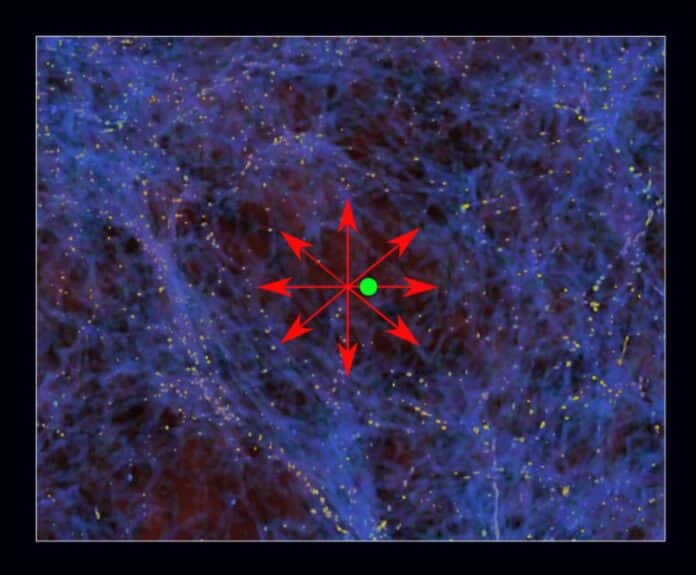
A potential solution to this inconsistency is that the Milky Way, Earth included, is floating inside a vast, invisible hole in space. Not a black hole, but a cosmic void: a region of the universe with far less matter than average. It sounds like science fiction, but according to new research presented at the Royal Astronomical Society’s National Astronomy Meeting (NAM) in Durham, it might just be true.
This would cause gravity to pull matter toward the denser regions outside the void, making the void itself gradually emptier over time. As this happens, objects inside the void, like galaxies, appear to move away from us faster than they would if the void didn’t exist. This creates the illusion that the universe is expanding more quickly in our local area.
For the local void theory to work, Earth and our solar system would need to be near the center of a massive bubble in space, about a billion light-years wide and about 20% less dense than the average universe.
Galaxy counts support this idea: our local region has fewer galaxies than the surrounding areas. But the idea of such a huge, underdense region is controversial because it doesn’t fit well with the standard cosmological model, which says matter should be more evenly spread out on large scales.
Dr. Indranil Banik presented new data at NAM 2025 showing that baryon acoustic oscillations (BAOs), ancient sound waves from the early universe, also support the void theory. These waves froze in place when the universe cooled and now act like a cosmic ruler to measure how space has expanded.
He said, “A local void slightly distorts the relation between the BAO angular scale and the redshift, because the velocities induced by a local void and its gravitational effect slightly increase the redshift on top of that due to cosmic expansion.”
“By considering all available BAO measurements over the last 20 years, we showed that a void model is about one hundred million times more likely than a void-free model with parameters designed to fit the CMB observations taken by the Planck satellite, the so-called homogeneous Planck cosmology.”
Researchers will now test the void theory using cosmic chronometers. This includes observation of ancient galaxies that no longer form stars. By studying the light from these galaxies, scientists can estimate their ages.
Combining their ages with the galaxy’s redshift could reveal how much the universe had expanded while light from the galaxy was travelling towards us, shedding light on the universe’s expansion history.
The talk ‘Theoretical and observational approaches to the Hubble tension‘ takes place at NAM at 14:15 BST on Wednesday, 9 July 2025, in room OCW017.
Leave a Reply