
June 25, 2025 by Jeff Shepard
Collected at: https://www.eeworldonline.com/how-you-can-use-smart-design-to-enhance-rare-earths-recycling/
Rare earth elements (REEs) are important for society because they enhance the performance of a wide range of green energy, industrial, medical, aerospace, and consumer devices. They are rare because, while not uncommon, they are widely dispersed in the Earth’s crust and not generally found in high concentrations.
That makes their extraction difficult and expensive. Additionally, the REEs, especially the lanthanides, are often found together in the same ore and share many similar chemical properties, making it challenging to separate them during refining.
Those challenges extend to recycling. Smart product design can significantly enhance REE recycling by incorporating design for disassembly, modular design, and minimizing material variety.
Circularity and design for disassembly
In addition to optimizing production efficiency and mass customization, Industry 4.0 is increasingly focused on supporting a circular economy. Smart design is key and encompasses designing for manufacturing, assembly, disassembly, and other factors, such as additive manufacturing (Figure 1). There’s a growing awareness of the importance of design for disassembly (DfD).

The International Organization for Standardization (ISO) has issued several standards related to sustainability and a circular economy. A key standard related to recycling is ISO 59014, which provides a standardized approach to ensure the sustainability and traceability of secondary materials recovery.
DfD makes devices easier to repair, upgrade, and recycle. It helps optimize REE recycling and compliance with ISO 59014. The concept of DfD has been extended to design for assembly and disassembly (DfAD).
There are two common processes for disassembly, destructive disassembly and non-destructive disassembly. Destructive disassembly focuses on materials recovery and recycling, whereas non-destructive disassembly concentrates on the repair or recovery of components or sub-assemblies.
REE recycling
Several technologies are currently used for REE recycling. They include hydrometallurgy (dissolving alloys in acids), pyrometallurgy (high temperature processes), liquid-liquid extraction (separating REEs using solvents), and direct recycling (disassembly and reuse of components). More environmentally friendly methods at various stages of development include bacterial acid leaching and copper salt leaching (Figure 2).

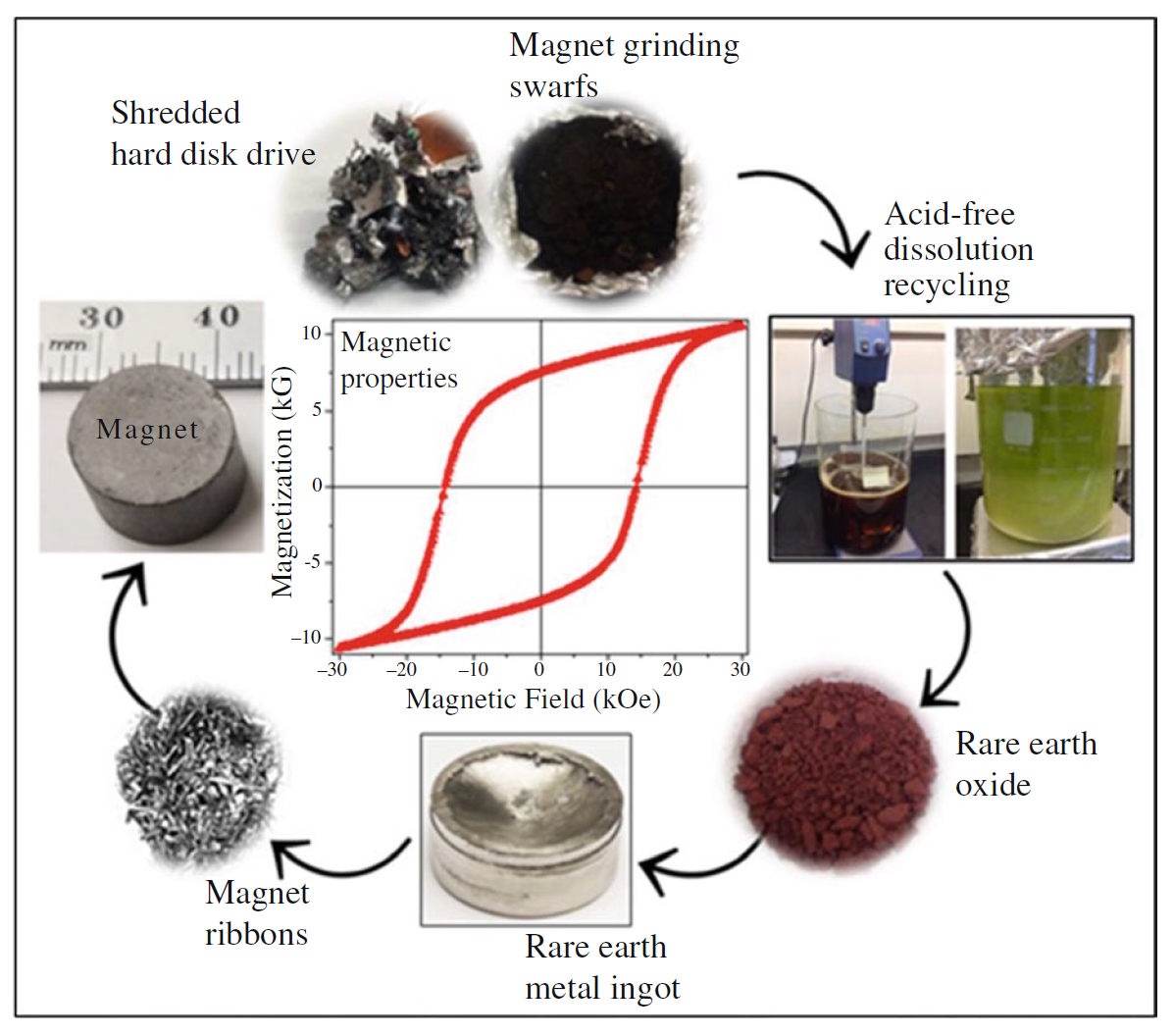
Acid-free dissolution recycling of HDD magnets
Certain bacteria produce organic acids that are used to dissolve REEs for recycling. Those organic acids are less environmentally damaging than the strong acids traditionally used, but a new acid-free dissolution method has been developed based on copper salt leaching.
A pilot plant has been built that uses copper salt leaching for recycling hard disk drives (HDDs). The plant has been used to recycle about 50,000 pounds of shredded end-of-life HDDs, mounting caddies, and other materials. In addition to REEs, the process can extract and recycle metals like gold, copper, aluminum, and steel. Improved HDD designs, optimized for recycling, could enhance the economics of this approach.
Careful segregation of components enabled the plant to recycle about 80% of the feedstock mass. Additionally, based on life cycle analysis, the process yields approximately a 95% reduction in greenhouse gas emissions compared to conventional REE mining and processing.
Copper salt leaching is particularly useful for isolating rare earth elements from materials such as magnet scrap or magnet swarf (Figure 3). However, it can be less efficient for recycling certain types of REE-containing materials, and it can still produce toxic waste streams and emissions that must be treated.

Summary
Smart design, like DfD and DfAD, supports a circular economy, including the recycling of rare earths. ISO 59014 provides a standardized approach to ensure the sustainability and traceability of secondary materials recovery and can be an important tool for quantifying the results of smart product design. Smart design extends beyond product design and production, encompassing the use of the most environmentally friendly and cost-effective approaches for rare earths recycling, including emerging techniques such as copper salt leaching.
Leave a Reply