
By Elizabeth A. Thomson, Quaise Energy June 14, 2025
Collected at: https://scitechdaily.com/this-drill-could-replace-fossil-fuels-forever/
Quaise Energy is pioneering millimeter-wave drilling to access deep geothermal heat and provide clean, scalable energy globally.
Quaise Energy has taken a major step forward by demonstrating its new drilling technology on a full-scale oil rig just outside Houston. The company, founded only seven years ago, is now working to show that clean, renewable geothermal energy has the potential to power the world, according to CEO and co-founder Carlos Araque.
“Geothermal energy is available everywhere on massive scales,” said Araque. “If you take all fossil, all nuclear, and all other forms of renewable energy combined, they’re not even a millionth of a millionth of the thermal stores of energy below the Earth’s surface.” “It’s mind-boggling, and to get it, we only have to go down two to twelve miles. That’s how close we are to infinite clean energy no matter where you are in the world.”
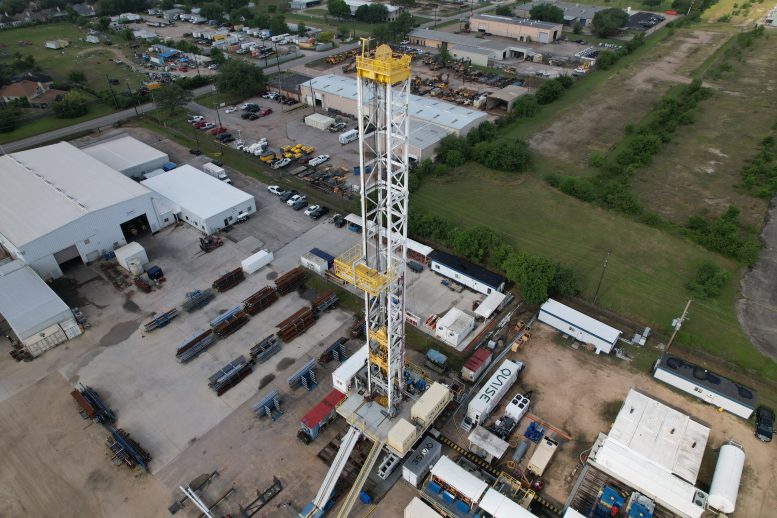
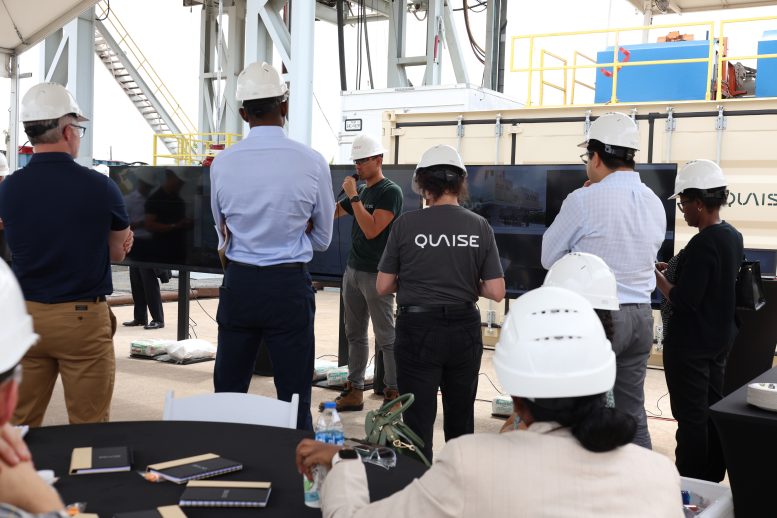
Araque spoke on May 21 during the first public demonstration of the company’s drilling technology at a full-scale oil rig owned by Nabors, one of the largest oil and gas drilling companies in the world. About 50 people attended the event, including reporters, potential investors, and prospective Quaise customers. Among them were William Restrepo, CFO of Nabors and a member of Quaise’s board, and Lauren Boyd, director of the Geothermal Technologies Office at the U.S. Department of Energy.
Superhot, Superdeep
Geothermal energy—the heat beneath our feet—has existed for a long time, but it contributes very little to today’s overall energy supply. “That’s because the true geothermal resource, the one that matters, is not very accessible. Getting to it is beyond the economic reach of the conventional tool set of oil and gas,” said Araque.
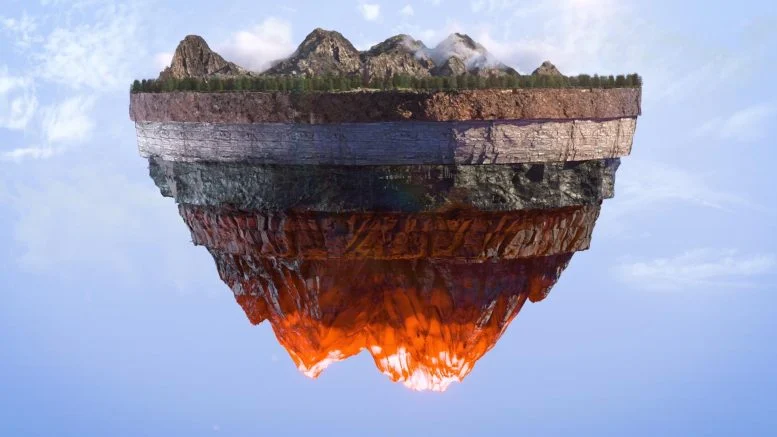
The largest source of geothermal energy lies about two to 12 miles beneath the Earth’s surface, where the rock is so hot that if water could be pumped there, it would become supercritical—a steam-like phase unfamiliar to most people. (More familiar phases include liquid water, ice, and vapor.) Supercritical water can carry five to ten times more energy than regular hot water, making it an extremely efficient energy source if it could be brought to the surface and used to power turbines that generate electricity.
Currently, these deep resources are out of reach, except in rare places like Iceland where they lie closer to the surface. The main barrier is drilling. Conventional oil and gas drills cannot withstand the extreme temperatures and pressures found miles underground without costs rising dramatically with depth.
Quaise is developing an alternative approach that replaces mechanical drill bits with millimeter-wave energy, which is similar to the microwaves used in kitchens. These waves melt and then vaporize rock, allowing for the creation of increasingly deep boreholes.
Steady Progress
The May demonstration at the Nabors facility marks the latest step in what Araque describes as an aggressive timeline to validate Quaise’s drilling technology. His long-term vision is to create a renewable energy source that can compete directly with oil and gas. “This is not a company built to develop a cool drilling gadget. We aim to become a geothermal developer. Our product is not a drill bit. Our product is clean heat and energy that is abundant, reliable, and affordable on a global scale,” Araque said.
The core concept behind Quaise’s drilling method was developed at MIT over some 15 years. Researchers there proved that millimeter waves could drill through basalt, a rock type that, along with granite, makes up most of the deep subsurface. The gyrotron device that generates these millimeter waves isn’t new—it has been used for about 70 years in nuclear fusion research.
Building on that foundation, Quaise has been refining the technology to reach greater depths. At MIT, the original holes were only two inches wide and two inches deep. Earlier this year, engineers at Quaise’s Houston facility drilled a hole four inches wide and 10 feet deep.
Andres Calabressi, Head of Manufacturing at Quaise, emceed the Quaise demonstration with a microphone to communicate over the steady rumble of powerful equipment. He explained that beginning in March, the company lowered columns of granite about nine inches in diameter into a conventionally drilled hole under the rig. Together, those columns made a core some 80 feet long that sits inside a metal casing. The latter is outfitted with ports to monitor parameters like heat and pressure, data that allow the team to test recipes for optimal drilling.
The Quaise engineers then integrated the millimeter-wave technology with the rig. In the May 21 demo, they shot millimeter waves into the granite column, deepening a hole four inches in diameter that they’d already drilled to ten feet. (The next week, the team successfully drilled to 30 feet for the first time; the next goal on this phase of the work is 40 feet.)
During the demonstration, Calabressi was flanked by three large flat screens showing different dimensions of the work. One tracked key parameters like rock temperature, while another showed a video close-up of the millimeter waves melting rock. (The latter was taken previously in the Quaise lab since those interactions were not visible at the Nabors rig.)
Araque noted that the demo was “full scale in size, but not in power.” The gyrotron involved produced 100 kilowatts of power. “That’s a tenth of the power that will be commercially relevant, and is roughly equivalent to the power of the car you drove to this demonstration.”
Next month, Quaise expects the delivery of a much larger gyrotron capable of producing one megawatt of power. “That is commercially relevant. We aim to get it to the field over the next two years,” Araque said.
In the meantime, the company is preparing for another demonstration planned for July in Marble Falls, Texas. There, the team aims to drill multiple holes 130 meters (about 425 feet) deep into an actual granite outcrop for the first time. Henry Phan is Vice President of Engineering at Quaise. He explained that the Marble Falls rig will be smaller, “allowing us to be more nimble in terms of moving from one hole to another.”
Additional Advances
Quaise has also been tackling other scientific and engineering challenges associated with harvesting the energy from superhot, superdeep rock. Trenton Cladouhos, vice president of geothermal resource development at Quaise, described several of those challenges and advances toward solving them in a talk the day before the Quaise demo at the Geothermal Transition Summit North America in Houston.
Cladouhos said that Quaise is working with vendors and universities “to push them to consider higher and higher temperatures.” For example, last year a team at the Ecole Polytechnique Fédéral de Lausanne reported new insights into what happens when superhot, superdeep rock is exposed to water that can eventually transfer the rocks’ heat to the surface. The work, supported in part by Quaise, was published in the journal Nature Communications. It confirmed earlier modeling work also supported by Quaise.
In addition, Cladouhos noted that Quaise has an in-house engineer who has been working on the design of superhot geothermal power plants. Earlier this year, Senior Mechanical Engineer Daniel Dichter reported insights to that end in two papers.
Toward the Future
Araque concluded his presentation at the demo by describing the company’s blueprint for developing a superhot, superdeep geothermal resource available around the globe. It involves dividing the world into three tiers based on geothermal gradient, or how close the resource is to the surface. Tier 1, for example, will focus on relatively accessible superhot rock. This means that the first Quaise power plant will probably be located in the American West, perhaps near the Newberry Volcano site in Oregon. Newberry has a long history of geothermal exploration.
Although still a ways off, Tier III sites, which will involve drilling as much as 12 miles down, “hold the key to making superhot geothermal a truly global energy source. Tier III sites could provide power to more than 90% of humanity.”
Superhot Team
Araque described Quaise’s goal of unlocking superhot, superdeep energy for the world as “a moonshot. But it is not a moonshot.” The people working to “pioneer this transformative approach to clean energy have transitioned from careers in oil, gas, nuclear fission, and nuclear fusion,” and all have histories of achievement.
For example, several were involved in the invention and development of Manara, a production and reservoir management solution developed at Schlumberger to substantially increase the recovery of oil from complex production systems. And among them, Quaise team members hold several patents.
“So I’m confident that together we can make this work,” Araque concludes.
Funding: Quaise Energy
Leave a Reply