
By Netherlands Research School for Astronomy June 12, 2025
Collected at: https://scitechdaily.com/new-research-reveals-that-the-universe-could-end-way-sooner-than-we-thought/
Scientists have dramatically revised the universe’s expiration date, suggesting everything from black holes to humans could vanish far sooner than we ever imagined
The universe may be disappearing far faster than scientists once believed. New research from three Dutch scientists suggests that the final remnants of stars could vanish in “just” 10^78 years. That’s a 1 followed by 78 zeros. While this still feels like an unimaginably long time, it is dramatically shorter than earlier estimates, which placed the universe’s end at around 10^1100 years. Their findings, with a wink and dead-seriously, were published in the Journal of Cosmology and Astroparticle Physics.
This study is a follow-up to a 2023 paper by the same team: black hole expert Heino Falcke, quantum physicist Michael Wondrak, and mathematician Walter van Suijlekom, all from Radboud University. In that earlier work, the trio proposed that not only black holes but also dense objects like neutron stars could slowly “evaporate” through a process similar to Hawking radiation.
The idea sparked a flood of questions from scientists and curious minds alike. One question came up again and again: how long would this cosmic evaporation actually take?
Ultimate end
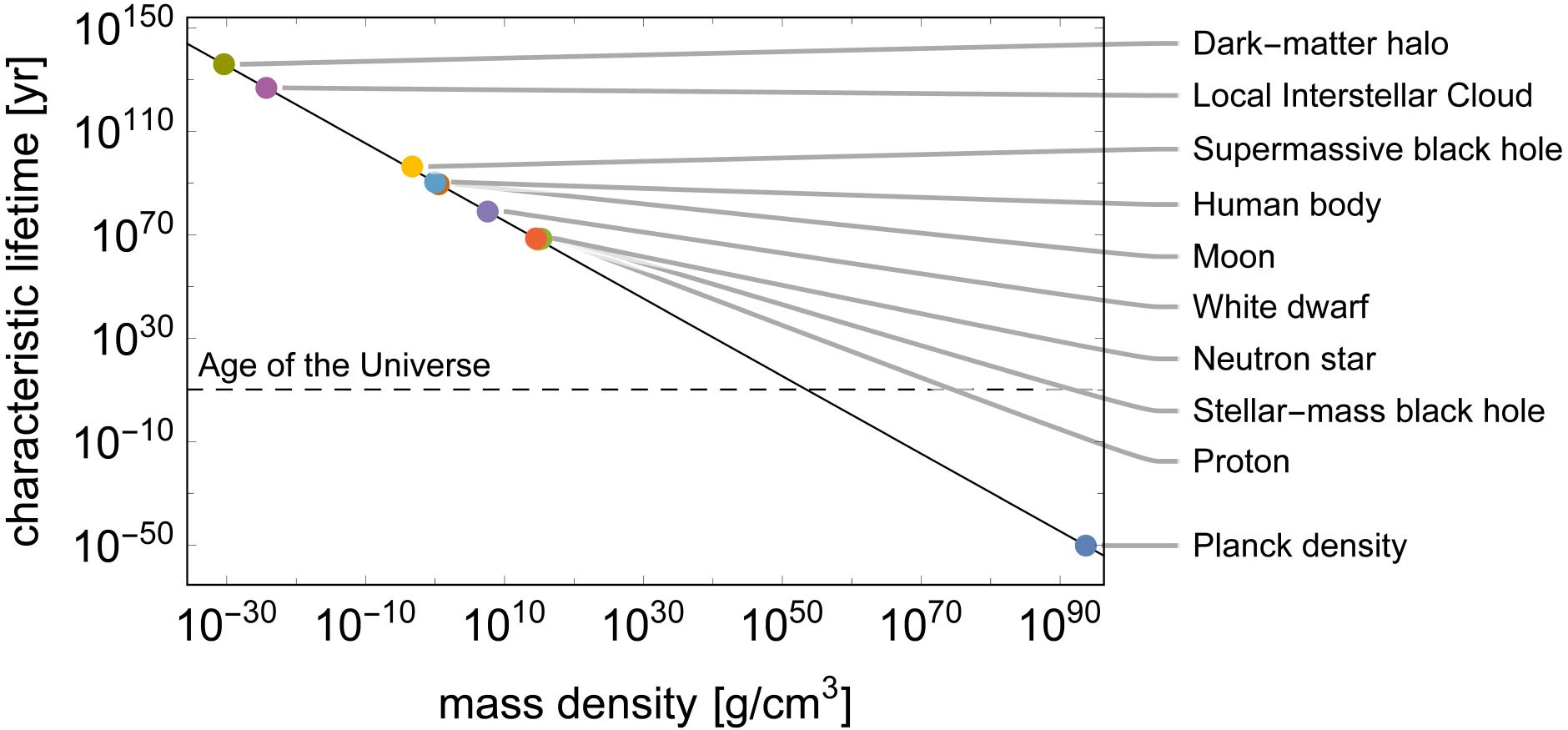
The researchers calculated that the end of the universe, if only Hawking-like radiation is taken into account, will take about 10^78 years (a 1 with 78 zeros). That is the time that white dwarf stars, the most persistent celestial objects, need to perish via Hawking-like radiation. Previous studies, which did not take Hawking radiation into account, arrived at 10^1100 years for white dwarfs (a 1 with 1100 zeros). Lead author Heino Falcke: “The ultimate end of the universe will therefore come a lot faster than expected, but fortunately it will still take a very long time.”
The researchers did the calculations deadly serious and with a wink. The basis is the reinterpretation of Hawking radiation. In 1975, physicist Stephan Hawking came up with the idea that, contrary to what the theory of relativity prescribes, particles and radiation can escape from a black hole.
Two temporary particles could be formed on the edge of a black hole, whereby, before the particles merge again, one particle is sucked into the black hole and the other particle escapes. The consequence of this Hawking radiation is, among other things, that a black hole dissolves very slowly into radiation and particles. This clashes with Albert Einstein’s theory of relativity, which states that black holes can only grow.
Neutron star is as slow as a black hole
The researchers calculated that the process of Hawking radiation also works in principle for other objects with a gravitational field. Furthermore, the calculations showed that the ‘evaporation time’ of an object in principle only depends on its density.
To the surprise of the researchers, neutron stars and stellar black holes take the same amount of time to decay: 10^67 years. This was unexpected because black holes have a stronger gravitational field and that should ensure a faster ‘evaporation.’ “But black holes have no surface,” says co-author and postdoc researcher Michael Wondrak, “They reabsorb some of their own radiation. That slows down the process.”
Man and Moon: 10^90 years
Because the researchers were at it anyway, they also calculated how long it takes for the Moon and a human to evaporate via Hawking-like radiation. That’s 10^90 years (a 1 with 90 zeros). Of course, the researchers subtly note, there are other processes that may cause humans and the moon to disappear faster than calculated.
Co-author Walter van Suijlekom, professor of mathematics at Radboud University, adds that the research is an exciting collaboration of different disciplines and that combining astrophysics, quantum physics and mathematics leads to new insights. “By asking these kinds of questions and looking at extreme cases, we want to better understand the theory, and perhaps one day, we will unravel the mystery of Hawking radiation.”
Reference: “An upper limit to the lifetime of stellar remnants from gravitational pair production” by Heino Falcke, Michael F. Wondrak and Walter D. van Suijlekom, 12 May 2025, Journal of Cosmology and Astroparticle Physics.
DOI: 10.1088/1475-7516/2025/05/023
Leave a Reply