
By Emily Winget, U.S. Naval Research Laboratory June 13, 2025
Collected at: https://scitechdaily.com/massive-solar-storm-sparks-rare-g4-alert-what-it-means-for-earth/
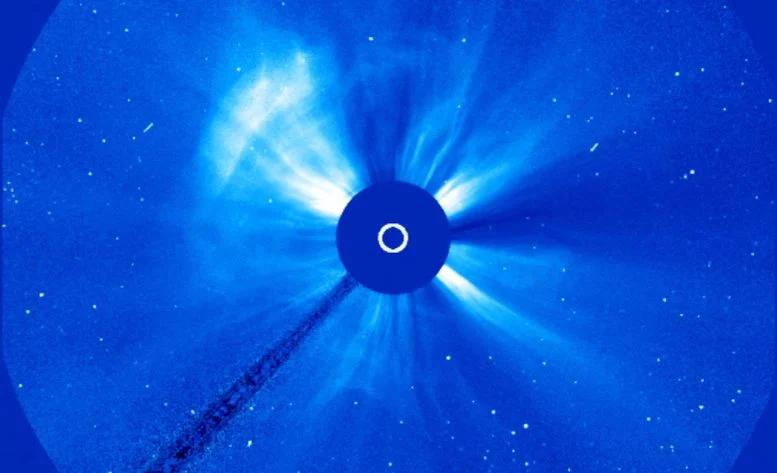
An intense solar eruption recently triggered a rare “severe geomagnetic storm” alert for Earth, with the U.S. Naval Research Laboratory capturing the CME racing toward us at 1,700 km/s.
These Earth-directed blasts from the Sun can wreak havoc on satellites, GPS systems, and even electrical grids. As auroras dazzled unexpectedly far south, scientists highlighted the crucial role of real-time data in defending infrastructure and military readiness. Decades of space weather research by NRL, including instruments like LASCO and CCOR-1, are proving essential in forecasting and mitigating the dangers of space weather.
Global Solar Alert: A Rare Earth-Wide Warning
We’re all used to local weather warnings, but it’s not every day that an alert covers the entire planet. That’s exactly what happened on May 31, when scientists detected a major eruption from the Sun that triggered a rare “severe geomagnetic storm” warning for Earth.
Using cutting-edge space-based instruments, the U.S. Naval Research Laboratory (NRL) captured the dramatic event in real time. What they saw was a powerful Coronal Mass Ejection, or CME—a giant burst of solar plasma and magnetic energy—blasting straight toward us.
“Our observations demonstrated that the eruption was a so-called ‘halo CME,’ meaning it was Earth-directed, with our preliminary analysis of the data showing an apparent velocity of over 1,700 kilometers per second for the event,” stated Karl Battams, Ph.D., computational scientist for NRL’s Heliospheric Science Division.
Understanding Geomagnetic Storms and Their Triggers
These types of solar storms disturb Earth’s magnetic field by channeling immense energy from the solar wind into the space around our planet. When the Sun’s magnetic field points southward, it can peel back Earth’s protective magnetic layer, allowing charged particles to pour in and fuel intense geomagnetic activity.
The National Oceanic and Atmospheric Administration (NOAA) classified this solar storm as G4 on a five-level scale, placing it in the “severe” category.
CMEs like this can disrupt technology in a big way. They may temporarily knock out satellites, scramble GPS signals, and interfere with radio communications. In extreme cases, they can even damage spacecraft and increase atmospheric drag on satellites, forcing them off course.
“Such disturbances can compromise situational awareness, hinder command and control, affect precision-guided systems, and even impact the electrical power grid, directly affecting military readiness and operational effectiveness,” Battams said.

What Are CMEs and Why They Matter
CMEs are colossal expulsions of plasma and magnetic field from the Sun’s corona, often carrying billions of tons of material. While CMEs generally take several days to reach Earth, the most intense events have been observed to arrive in as little as 18 hours.
“CMEs are the explosive release of mass from the Sun’s low corona and are a primary driver of space weather, playing a central role in understanding the conditions of the Earth’s magnetosphere, ionosphere, and thermosphere,” explained Arnaud Thernisien, Ph.D., a research physicist from the Advanced Sensor Technology Section within NRL’s Space Science Division.
A Direct Hit From the Sun
The May 30 event saw a relatively slow but powerful solar flare erupt from the Earth-facing side of the Sun. The energy released blasted a CME directly toward Earth, leading to the geomagnetic storm that has produced auroras as far south as New Mexico.
NRL’s space-based instrumentation, operating on NASA and NOAA spacecraft, provided vital real-time observations of this event. Notably, NRL’s venerable Large Angle Spectrometric Coronagraph (LASCO), which has been in operation since 1996, and the Compact Coronagraph 1 (CCOR-1), launched in 2024, both relayed critical data.
Early Warnings Are Crucial for Preparedness
Such observations are paramount for operational space weather monitoring, allowing forecasters to predict the timing of the event’s arrival at Earth and the potential geomagnetic storm it could induce. While precisely predicting the severity, exact timing, or duration of a geomagnetic storm remains challenging, these advance warnings are vital for enabling the Department of Defense (DoD) and other agencies to prepare.
The potential impacts of severe geomagnetic storms on DoD and Department of the Navy missions are significant and far-reaching. These events can disrupt or degrade critical systems and capabilities, including satellite communications, Global Positioning System (GPS) navigation and timing, and various remote sensing systems.
A Legacy of Space Weather Research
“NRL has been a pioneer in heliophysics and space weather research since the very inception of the field, dating back to the first discovery of CMEs through NRL space-based observations in 1971,” Battams said. “Since then, NRL has consistently maintained its position at the forefront of coronal imaging with a portfolio of groundbreaking instrumentation that has driven heliospheric and space weather studies.”
This includes:
- LASCO coronagraphs operating on the joint ESA-NASA Solar and Heliospheric Observatory (SOHO) mission since 1996
- Sun-Earth Connection Coronal and Heliospheric Investigation (SECCHI) instrument packages on the twin NASA Solar Terrestrial Relations Observatory (STEREO) spacecraft since 2006
- Wide-Field Imager for Parker Solar Probe (WISPR) instrument on NASA Parker Solar Probe (PSP) since 2018
- Solar Orbiter Heliospheric Imager (SoloHI) on ESA’s Solar Orbiter mission since 2019
- NOAA’s CCOR-1, designed and built by NRL, operating on NOAA’s GOES-19 since 2024
Real-Time Data Keeps Us Ahead
These assets, particularly instruments like LASCO and CCOR-1, are indispensable for providing the crucial real-time imagery necessary for forecasters to analyze and assess CMEs, determine Earth-impact likelihood, and issue timely warnings.
“They form the backbone of our ability to anticipate and mitigate the effects of space weather. As the G4 severe geomagnetic storm watch continues, the public and critical infrastructure operators are encouraged to visit NOAA’s Space Weather Prediction Center for the latest information and updates,” Thernisien said.
The journey of the CME, from its fierce eruption on the Sun to its arrival at Earth, approximately 93 million miles away, highlights the dynamic nature of our solar system and the ongoing importance of NRL’s vital contributions to heliophysics research and space weather preparedness. The data collected from events such as this will be instrumental in future research, further enhancing our understanding and predictive capabilities and ultimately bolstering the resilience of national security and critical infrastructure.
Leave a Reply