
By Emily Conover June 11, 2025
Collected at: https://www.sciencenews.org/article/sound-rainbow-device-acoustics
No rainstorm is needed for this rainbow — it’s made out of sound.
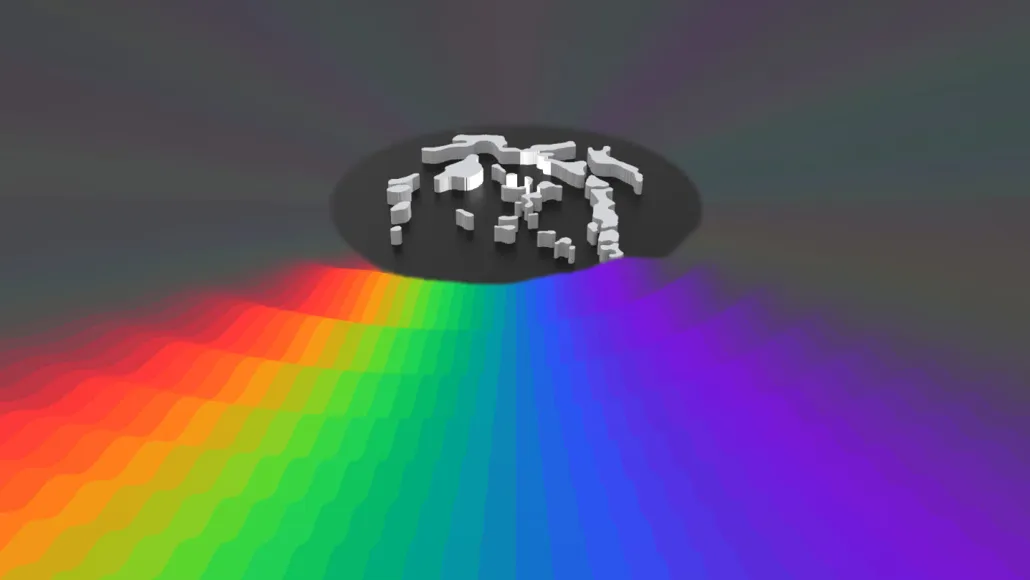
Using an oddly shaped plastic device, scientists have created an acoustic rainbow, separating white noise according to its various frequencies, or pitches. Just as a typical rainbow separates colors into different spatial locations, different pitches are directed to distinct positions around the device, the researchers report June 11 in Science Advances.
A source at the center of the device produces sound toward the higher end of the human hearing range, at frequencies from about 8 to 13 kilohertz. (For comparison, the highest note on a piano is around 4 kHz.) Zeroing in on those frequencies allowed researchers to keep the device small, about the size of a human ear, which served as inspiration for the researchers. The outer ear naturally possesses a structure that, rather than splitting noise up into pitches, allows people to determine the directionality of various pitches. Scaling up the device would permit it to act on a lower range of frequencies.
The structure’s smattering of misshapen pillars reflect the sound waves in such a way that they interfere with one another, amplifying different frequencies based on location to produce an acoustic variegation. Devices of this type could be useful for a variety of practical applications, such as manipulating the acoustics of a room by directing lower pitches into a sound absorber.
Designing a structure that can create an acoustic rainbow is complicated, thanks to the intricacies of manipulating sound waves of varying wavelengths. So the researchers used a computational process called inverse design. They used a computer model to determine what sound field a device with a given design would emit and compared it with the acoustic rainbow they were going for. Then they repeatedly tweaked the device’s geometry to minimize the difference between the two. Once the design was fine-tuned, the researchers 3-D printed the device and showed that it worked as intended.
The inverse design process results in “to the human eye, very random looking or weird looking structures,” says physicist Rasmus Christiansen of the Technical University of Denmark in Kongens Lyngby. “But they really serve their purpose well, because they’ve been tailored for providing exactly what we asked for.”
Leave a Reply