

By Rice University June 3, 2025
Collected at: https://scitechdaily.com/physicists-unveil-new-quantum-super-material-that-could-revolutionize-electronics/
A new quantum material developed at Rice University combines unique symmetry-driven properties with superconductivity.
A team of physicists from Rice University, led by Ming Yi and Emilia Morosan, has created a groundbreaking new material that could power the next generation of electronics. This material offers a rare combination of unique electronic properties that may lead to devices that are both more powerful and much more energy-efficient.
Called a Kramers nodal line metal, the material was crafted by adding a small amount of indium to a layered structure made of tantalum and sulfur. This slight adjustment shifts the crystal’s internal symmetry and unlocks remarkable new behaviors in the way electrons move.
Published on May 29 in Nature Communications, the research marks a major step toward electronics that lose far less energy during operation and sustainable technologies.
“Our work provides a clear path for discovering and designing new quantum materials with desirable properties for future electronics,” said Yi, associate professor of physics and astronomy.
Creating a new material
The researchers discovered that when they added tiny amounts of indium to tantalum disulfide (TaS₂), the material’s underlying crystalline symmetry changed, leading to a uniquely protected pattern where electrons with spin up and spin down follow different pathways in momentum space, much like cars going in opposite directions on a highway. This happens until the two paths merge at the Kramers nodal line.
This new material also demonstrated the ability to carry electricity without energy loss, displaying superconducting properties. This dual characteristic could enable the development of topological superconductors, which may enhance power systems and computing technologies.
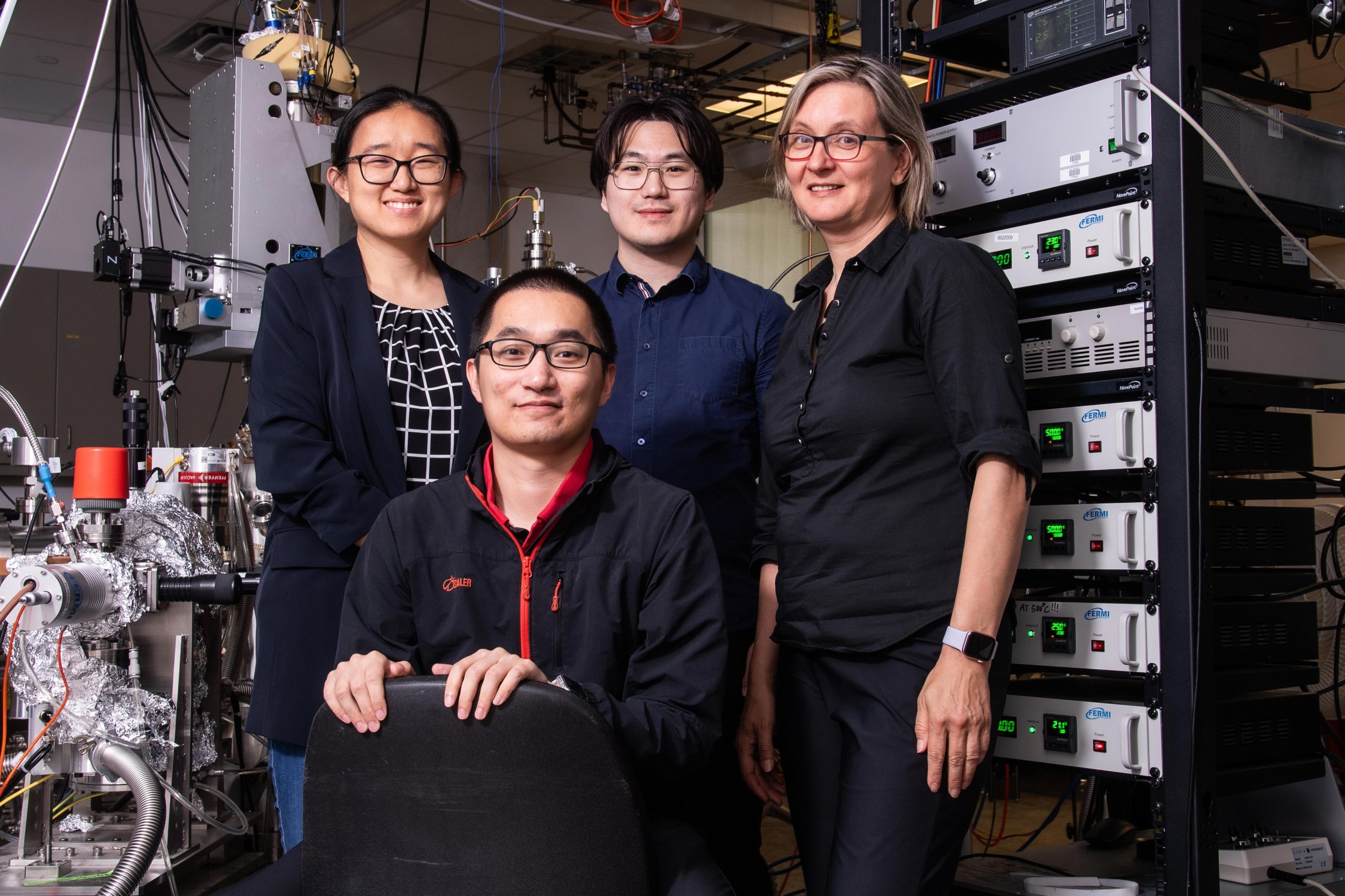
“Designing a material to meet the stringent symmetry conditions necessary for these special properties was challenging, but the outcomes have been rewarding,” said Morosan, professor of physics and astronomy, electrical and computer engineering and chemistry and director of the Rice Center for Quantum Materials.
The team experimented with various compositions to observe the optimal properties. Using advanced tools such as spin-resolved angle-resolved photoemission spectroscopy and electrical transport in applied magnetic fields, they examined the tiny particles within the material. This technique allowed them to measure the energy, movement, and spin of the electrons, the particles responsible for carrying electricity.
“Our experiments indicate that we can precisely adjust the material’s properties to accentuate its topological traits, which is vital for future applications,” said Yichen Zhang, a doctoral student at Rice and co-first author of the study.
The findings
To ensure the reliability of their findings, they combined the experimental observations with sophisticated first-principles theoretical calculations. The theoretical predictions aligned with the experimental data, providing deeper insights into the material’s electronic topology.
By uncovering and tuning the properties of a Kramers nodal line metal, Yi and Morosan’s team is not only expanding the understanding of quantum materials but also paving the way for transformative low-energy electronic technologies, said Junichiro Kono, director of the Smalley-Curl Institute and a co-author of the study.
“This groundbreaking work exemplifies the spirit of innovation that defines the Smalley-Curl Institute,” Kono said. “It advances our mission to foster cross-disciplinary collaboration across many fields, bringing together physics, materials science, and engineering to explore new quantum behaviors in matter.”
The researchers say this discovery is just the beginning, and they are eager to continue exploring these new materials to uncover even more remarkable properties that could lead to breakthroughs in technology and science.
“There is still much to explore, and we are excited about the future possibilities that this new material presents,” said Yuxiang Gao, a doctoral student at Rice and co-first author of the study.
Reference: “Kramers nodal lines in intercalated TaS2 superconductors” by Yichen Zhang, Yuxiang Gao, Aki Pulkkinen, Xingyao Guo, Jianwei Huang, Yucheng Guo, Ziqin Yue, Ji Seop Oh, Alex Moon, Mohamed Oudah, Xue-Jian Gao, Alberto Marmodoro, Alexei Fedorov, Sung-Kwan Mo, Makoto Hashimoto, Donghui Lu, Anil Rajapitamahuni, Elio Vescovo, Junichiro Kono, Alannah M. Hallas, Robert J. Birgeneau, Luis Balicas, Ján Minár, Pavan Hosur, Kam Tuen Law, Emilia Morosan and Ming Yi, 29 May 2025, Nature Communications.
DOI: 10.1038/s41467-025-60020-z
Other co-authors include Rice’s Jianwei Huang, Yucheng Guo, Ziqin Yue, and Ji Seop Oh; Aki Pulkkinen, Alberto Marmodoro and Jan Minar of the University of West Bohemia; Xingyao Guo, Xue-Jian Gao and Kam Tuen Law of Hong Kong University of Science and Technology; and Robert J. Birgeneau of the University of California, Berkeley.
Other contributors include Alex Moon and Luis Balicas of the National High Magnetic Field Laboratory; Mohamed Oudah and Alannah M. Hallas of the University of British Columbia; Alexei Fedorov and Sung-Kwan Mo of the Lawrence Berkeley National Laboratory; Makoto Hashimoto and Donghui Lu of the SLAC National Accelerator Laboratory; Anil Rajapitamahuni and Elio Vescovo of Brookhaven National Lab; and Pavan Hosur of the University of Houston.
The Department of Defense and Air Force Office of Scientific Research helped support this study.
Leave a Reply