
By Pranjal Malewar 7 Jun, 2025
Collected at: https://www.techexplorist.com/black-holes-used-particle-supercolliders/99730/
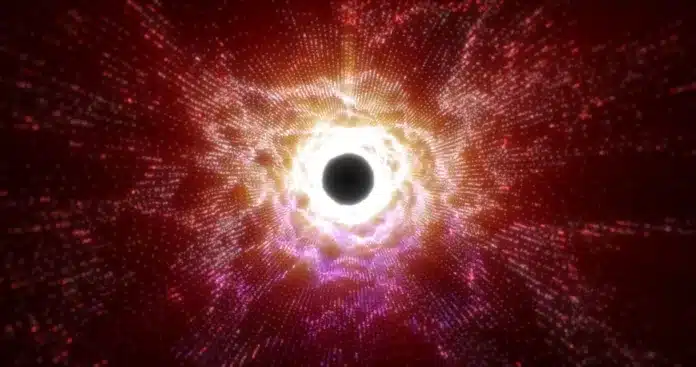
Black holes don’t just sit quietly in the depths of space—they spin with immense energy, warping spacetime itself. But here’s where it gets even wilder: Some supermassive black holes at galaxy centers are unleashing colossal bursts of energetic particles, rivaling the power of human-made supercolliders like the Large Hadron Collider.
A new Oxford study suggests that these cosmic events might mimic the conditions of Earth’s particle accelerators—but on an unimaginably vast scale.
Could black holes be the key to unlocking new physics? Are they natural laboratories for extreme energy interactions?
Particle colliders are used to smash protons at near-light speeds in the hope of uncovering the deepest secrets of matter. When particles collide, they create bursts of energy and debris, potentially revealing new, undiscovered particles—including elusive candidates for dark matter, the mysterious substance shaping the cosmos.
But what if black holes could do the same thing, naturally?
Particles falling toward black holes can reach speeds comparable to those in human-made particle colliders. If they collide near the event horizon, they can achieve tremendous energy levels.
Recently, astronomers detected X-ray photons from these plunging flows, confirming that these energetic interactions occur in nature.
“We hope particle colliders like the Large Hadron Collider will create dark matter particles, but we haven’t seen proof yet,” explains Professor Joseph Silk. “That’s why discussions are happening about building a much more powerful supercollider—but supermassive black holes might already be showing us the future.”
New simulations reveal that gas plunging toward a black hole can experience collisions at extreme energy levels, far more intense than previously believed.
Although not identical to human-made particle colliders, these natural events mirror the violent interactions created by magnetic fields accelerating particles in circular tunnels, such as the Large Hadron Collider.
Silk said, “If supermassive black holes can generate these new particles by high-energy proton collisions, then we might get a signal on Earth, some high-energy particle passing rapidly through our detectors. That would be the evidence for a novel particle collider within the most mysterious objects in the universe, attaining energies that would be unattainable in any terrestrial accelerator. Something with a strange signature could even conceivably provide evidence for dark matter.”
Some particles from these collisions fall into the black hole and vanish forever. But others, with enough energy and momentum, escape—and these escaping particles are supercharged to extreme energy levels.
Scientists found that these particle beams could be as powerful as a supercollider—or even more.
While the exact limit is unclear, they match the energy of the next-generation supercollider being planned, meaning black holes could provide valuable complementary insights into high-energy physics.
Journal Reference:
- Andrew Mummery, and Joseph Silk. Black Hole Supercolliders. Physical Review Letters. DOI: 10.1103/PhysRevLett.134.221401
Leave a Reply