
Ashley Morgan Published on June 5, 2025
Collected at: https://dailygalaxy.com/2025/06/black-hole-eats-a-neutron-star/
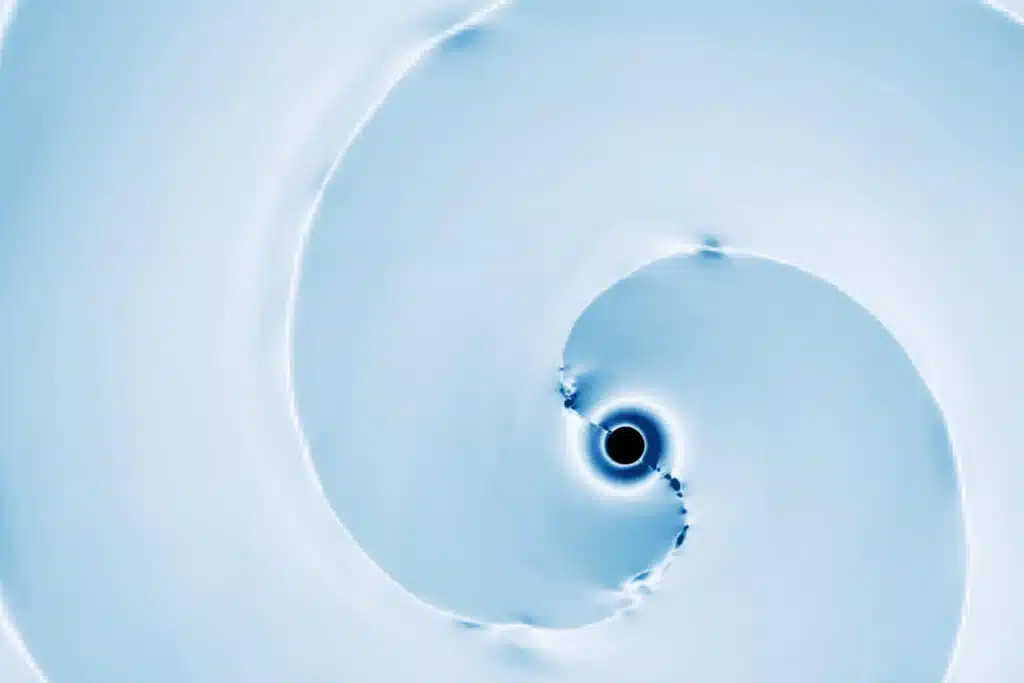
A new set of simulations offers an unparalleled look at the dramatic collision between a black hole and a neutron star, revealing the violent forces that take place just before the star is consumed. Researchers from Caltech have used advanced supercomputing power to simulate the extreme phenomena of these mergers. The two studies, recently published in The Astrophysical Journal Letters, delve into the intricate details of how the black hole’s intense gravity tears apart the neutron star, producing shockwaves, magnetic pulses, and even new types of cosmic objects.
Unleashing Cosmic Chaos: Cracks, Quakes, and Plasma Ripples
When a black hole encounters a neutron star, the gravitational force is so immense that it triggers the destruction of the neutron star’s incredibly dense crust. The team led by Caltech astrophysicist Elias Most ran simulations to explore this destructive process, revealing that as the black hole’s gravity takes hold, it “shears the surface” of the star, causing catastrophic quakes in the star’s crust. These quakes are similar to earthquakes on Earth, but on a cosmic scale. As these rifts form, they generate Alfvén waves, magnetic ripples that travel across the star like a snapping rope.
The most striking aspect of these simulations is the creation of powerful shockwaves. The team suggests these waves could produce the fast radio bursts that we occasionally detect from deep space. These bursts, which last only a fraction of a second, are one of the most mysterious phenomena in astrophysics. For the first time, researchers have simulated how such intense quakes might lead to these bursts, offering new insights into their origin.

Black Hole Pulsars: A New, Exotic Cosmic Phenomenon
One of the most exciting findings from the simulations is the creation of a black hole pulsar. A pulsar is typically a rapidly rotating neutron star that emits beams of radiation, visible across vast distances. In a black hole pulsar, however, the black hole itself replaces the neutron star. After the black hole devours its neutron star counterpart, the result is a brief moment where the black hole is surrounded by intense magnetic winds, which mimic the pulsar’s lighthouse-like beams of radiation.
This previously theorized object had never been observed until these simulations brought it to life in detail. The researchers believe this phenomenon may give scientists a new cosmic object to search for, expanding our understanding of black holes and their interactions with neutron stars.

Advancing Our Understanding with Cutting-Edge Simulations
The researchers behind these simulations used the Perlmutter supercomputer at Lawrence Berkeley National Laboratory to model the complex physics involved in such cosmic collisions. The process is far from simple; it combines the equations of general relativity to describe gravitational waves with the intricate nuclear physics of the neutron star and the plasma dynamics surrounding it.
“When you simulate two black holes merging. You need the equations of general relativity to describe the gravitational waves. But when you have a neutron star, there’s a lot more physics taking place, including the complex nuclear physics of the star and plasma dynamics around it,” Most explained.
These simulations are not only groundbreaking in their own right but also serve as an invaluable tool for interpreting real-world data from major scientific collaborations such as LIGO-Virgo-KAGRA, which studies gravitational waves. Scientists can deepen their understanding of the extreme conditions present during neutron star–black hole mergers.
Leave a Reply