
Melissa Ait Lounis Published on June 3, 2025
Collected at: https://dailygalaxy.com/2025/06/scientists-spot-water-around-young-star/
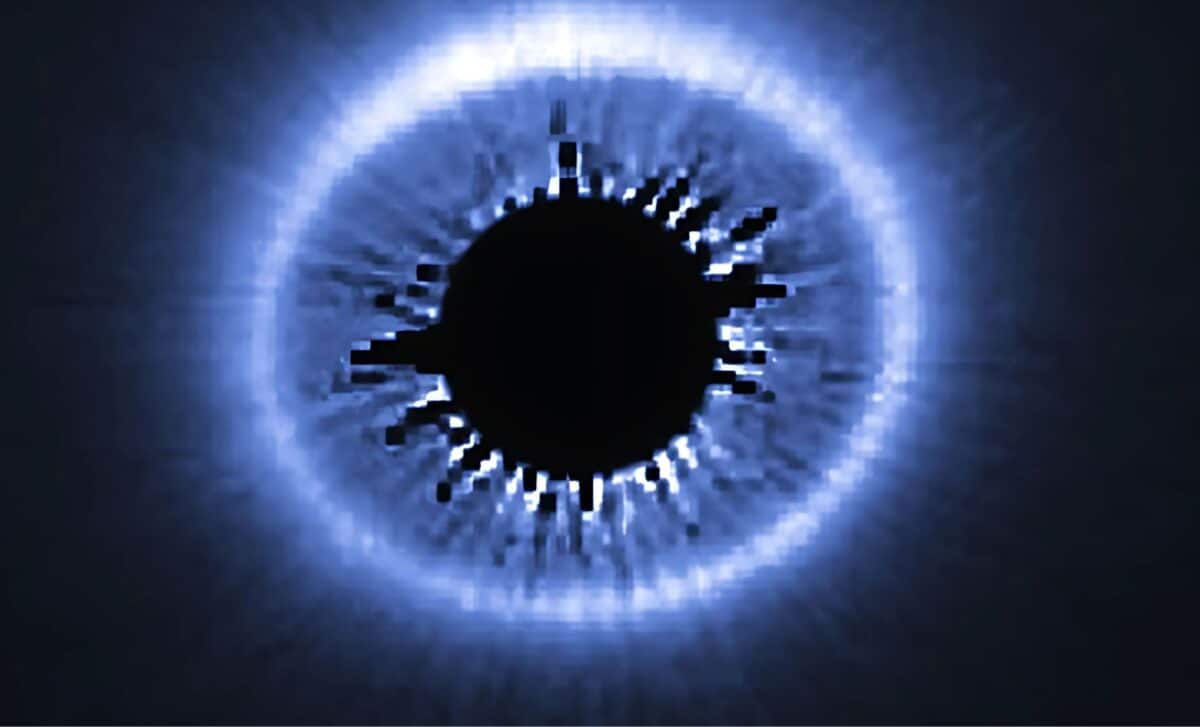
In a first-ever discovery, scientists have detected water ice surrounding a young star that closely resembles our Sun. This finding provides direct evidence supporting long-held theories about the presence of water in the early stages of solar system formation. The discovery was made possible by the James Webb Space Telescope (JWST), which observed the star HD 181327, located about 155 light-years away.
A Glimpse Into Early Planetary Formation
HD 181327 is a relatively young star, just 23 million years old, compared to our Sun’s 4.6 billion years. Unlike our mature Solar System, this star is still enveloped by a protoplanetary debris disk—a ring of dust and ice that has yet to coalesce into planets.
Using JWST’s near-infrared spectrograph (NIRSpec), researchers from Johns Hopkins University identified crystalline water ice in the debris disk. This form of water ice is similar to what is found in the rings of Saturn and icy bodies within the Kuiper Belt of our own Solar System.
Chen Xie, the study’s lead author, explained that “Webb unambiguously detected not just water ice, but crystalline water ice,” emphasizing that this water ice plays a vital role in helping planets form. She also pointed out that these “Icy materials may also ultimately be ‘delivered’ to terrestrial planets that may form over a couple hundred million years in systems like this.”
Water Ice Concentrated In The Outer Debris Ring
The JWST data revealed that over 20 percent of the debris ring’s mass consists of water ice mixed with dust particles, forming what astronomers call “dirty snowballs.” This is strikingly similar to the Kuiper Belt, a region in our own Solar System that is rich in icy bodies and minor planets. Closer to the star, the proportion of water ice drops sharply. At the disk’s halfway point, ice constitutes only about 8 percent of the material, and toward the center, virtually no water ice was detected.
This pattern is likely due to ultraviolet radiation from the star, which vaporizes ice in the inner regions of the disk. Another possibility is that water in these areas might be trapped inside rocks or planetesimals.
A Dynamic And Active Debris Disk
HD 181327’s debris disk is highly active, with ongoing collisions between icy bodies. These collisions release tiny particles of dusty water ice, which JWST is particularly well-equipped to detect. Co-author Christine Chen from the Space Telescope Science Institute noted, “HD 181327 is a very active system,” and described how the data resembles observations of Kuiper Belt objects within our own Solar System.
Another intriguing aspect revealed by JWST is a broad, dust-free gap between the star and the debris disk. This feature adds to the similarities between HD 181327’s system and the architecture of our Solar System, further supporting the idea that studying such young stars can illuminate the processes that shaped our own planetary neighborhood.
Looking ahead: the future of planetary system studies
This discovery confirms hints first observed by NASA’s Spitzer Space Telescope in 2008 and opens new paths for researchers to study water in planetary formation. With JWST and upcoming next-generation telescopes, astronomers plan to continue exploring debris disks and young systems to deepen understanding of how planets—and the water vital to life—come to be.
These observations not only refine planetary formation models but also shed light on the origins of water delivery to planets, including Earth, providing a window into our cosmic past.
Leave a Reply