
By Amit Malewar 4 Jun, 2025
Collected at: https://www.techexplorist.com/most-precise-measurement-magnetic-anomaly-muon/99665/
Imagine a tiny cosmic dancer—the muon—twirling through the quantum stage like its well-known sibling, the electron. But there’s a twist! This subatomic performer carries an invisible magnet, and the strength of its spin is measured by a special number called “g.” Ideally, g would be 2, but nature has a sneaky habit of bending the rules.
Why? Because the muon doesn’t exist in isolation. It’s surrounded by a restless sea of virtual particles—ghostly visitors from the quantum vacuum—that flicker in and out of existence faster than the blink of an eye. These fleeting interactions nudge the muon’s magnetism ever so slightly, making it a bit more than 2.
Scientists have found that the muon’s “g” value isn’t exactly 2—it’s slightly different due to a factor called the magnetic anomaly (aμ), which is calculated using (g-2)/2. This is where the Muon g-2 experiment gets its name!
The muon’s magnetic anomaly reflects the influence of all known particles in the Standard Model, and physicists can calculate these effects with extreme accuracy. However, when experiments at Brookhaven National Laboratory in the late 1990s and early 2000s measured this anomaly, they found a possible mismatch with the theoretical predictions at the time.
Now, physicists are on a quest to measure this tiny discrepancy with ultra-high precision. If the experimental value of g-2 deviates from theoretical predictions, it may signal the presence of unknown subatomic particles lurking in the depths of nature.
The anomalous magnetic moment, or g–2, of the muon is essential because it provides a sensitive test of the Standard Model of particle physics.
At Fermilab, over 200 brilliant minds from across the globe are joining forces to explore one of physics’s most tantalizing mysteries—the Muon g-2 experiment. By studying how muons behave in a magnetic field, scientists hope to uncover hidden particles that may be present in the quantum vacuum, influencing the universe in ways that are yet to be understood.
Now, scientists have unveiled their third and final measurement of the mysterious muon magnetic anomaly, bringing astonishing precision to the forefront. This value, tied to the famous g-2 measurement, remains consistent with results from 2021 and 2023, but with a remarkable improvement: 127 parts per billion, beating the original goal of 140 parts per billion!
Peter Winter, a physicist at Argonne National Laboratory and co-spokesperson for the Muon g-2 collaboration, said, “This is an inspiring moment because we not only achieved our goals but exceeded them, which is not very easy for these precision measurements. With the support of the funding agencies and the host lab, Fermilab, it has been very successful overall, as we reached or surpassed pretty much all the items that we were aiming for.”
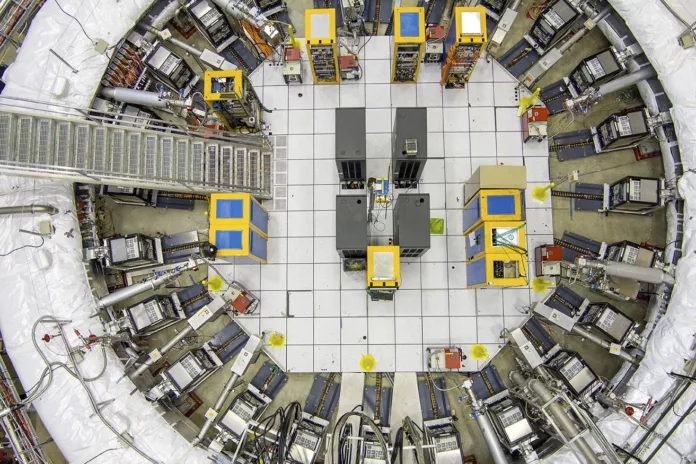
In 2013, a massive magnetic storage ring—originally from Brookhaven—was carefully transported over 3,000 kilometers from Long Island, New York, to Fermilab in Batavia, Illinois. After years of upgrades, the Fermilab Muon g-2 experiment finally sprang to life on May 31, 2017, ready to push the boundaries of knowledge.
Meanwhile, a global team of theorists formed the Muon g-2 Theory Initiative, determined to refine the theoretical predictions. By 2020, their work produced an updated Standard Model value using data from multiple experiments, sharpening the precision like never before.
Then came the twist: In 2021, Fermilab announced its first results, confirming Brookhaven’s earlier findings but with improved accuracy; just as the excitement built, a new theoretical approach emerged—one powered by computational might. This fresh prediction came much closer to the experimental result, narrowing the mysterious gap.
Scientists recently combined findings from multiple research groups using a new computational method to refine their prediction. This updated value is closer to the experimental measurement, reducing the chances of discovering new physics. However, researchers will continue investigating the differences between data-driven and computational approaches to understand any remaining discrepancies.
The most precise experimental measurement of the muon’s magnetic moment from the Fermilab Muon g-2 experiment is:
aμ = (g-2)/2 (muon, experiment) = 0.001 165 920 705 +- 0.000 000 000 114(stat.) +- 0.000 000 000 091(syst.)
This final measurement is based on three years of data (2021–2023), combined with earlier results, creating a dataset that is more than three times larger than the one used in 2023. Thanks to this expanded data, researchers finally achieved the precision goal they set back in 2012.
The analysis also focuses on the experiment’s highest-quality data.
Simon Corrodi, assistant physicist at Argonne National Laboratory and analysis co-coordinator, said, “As it has been for decades, the magnetic moment of the muon continues to be a stringent benchmark of the Standard Model. The new experimental result sheds new light on this fundamental theory and will set the benchmark for any new theoretical calculation to come.”
The Muon g-2 collaboration has described the result in a paper submitted today to Physical Review Letters.
Leave a Reply