
By Amit Malewar 28 Apr, 2025
Collected at: https://www.techexplorist.com/eos-vast-cloud-hydrogen-solar-system/99175/
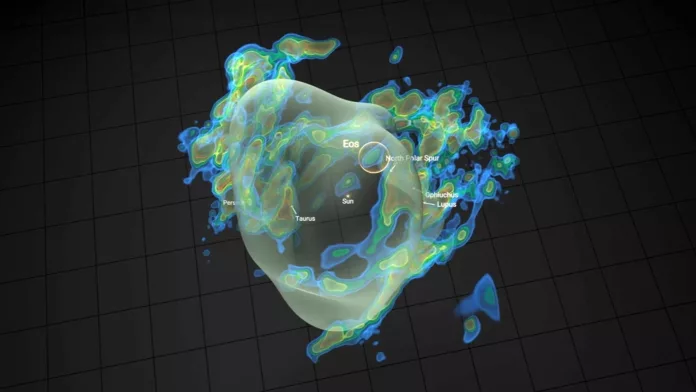
In a groundbreaking discovery, astronomers at Rutgers University have unveiled Eos – a local diffuse molecular cloud within the Local Bubble – a colossal, previously undetected hydrogen cloud near the solar system. Named after the Greek goddess of dawn, this newly identified structure is one of the largest molecular clouds ever observed, offering fresh insights into the interstellar medium.
Eos remained hidden from astronomers for years, evading detection due to its low carbon monoxide content—a key marker typically used to identify molecular clouds. Instead of relying on conventional methods, researchers employed a novel ultraviolet detection technique, tracing far-ultraviolet fluorescence from hydrogen molecules to make the cloud visible for the first time.
Eos is approximately 300 light-years from Earth, situated at the boundary of the Local Bubble, a vast, gas-filled region that surrounds the solar system. The cloud stretches across an area 40 times the full moon’s width and possesses an estimated mass of 3,400 times that of the Sun.
Researchers predict that Eos will slowly dissipate over the next six million years, providing a rare window into the lifecycle of molecular clouds.
Molecular clouds like Eos are crucial for star formation, serving as raw material for the birth of new celestial bodies. By analyzing Eos’ structure and behavior, scientists aim to understand how galaxies convert interstellar gas into stars and planets. Additionally, this discovery paves the way for new observational techniques that could uncover other previously hidden cosmic structures.
“This discovery is exciting because we can now directly measure how molecular clouds form and evolve,” said Dr. Blakesley Burkhart, the Rutgers astrophysicist leading the study. The findings could reshape our understanding of the interstellar medium, offering a deeper look at the mechanisms driving cosmic evolution.
With Eos now detected, astronomers anticipate using this ultraviolet detection method to search for other undiscovered hydrogen-rich clouds, potentially leading to new revelations about the vast and dynamic nature of the universe.
Journal Reference:
- Burkhart, B., Dharmawardena, T.E., Bialy, S. et al. A nearby dark molecular cloud in the Local Bubble revealed via H2 fluorescence. Nat Astron (2025). DOI: 10.1038/s41550-025-02541-7

Leave a Reply