

By Ellen Neff, Columbia University April 22, 2025
Collected at: https://scitechdaily.com/the-quantum-zoo-just-got-wilder-magnet-free-states-discovered-in-twisted-crystals/
A mysterious menagerie of quantum states — once purely theoretical — has been brought to life by researchers at Columbia using twisted molybdenum ditelluride.
These newly observed states, some never seen before, hint at the possibility of topological quantum computers that don’t require magnetic fields, overcoming a major obstacle in the field. By employing a highly sensitive optical technique, scientists have not only identified a range of exotic quantum states but also demonstrated a new experimental approach that may transform the way we study quantum matter.
Quantum States: A Growing “Zoo”
Quantum matter can exist in an astonishing variety of states, each reflecting the unusual behaviors that emerge when large numbers of electrons interact. For decades, many of these quantum states were purely theoretical, predicted through math and simulations, but not yet observed in real materials. Scientists often refer to this vast landscape as a “quantum zoo,” filled with exotic and undiscovered “species” of matter.
In a study published April 3 in Nature, researchers expanded this zoo by identifying more than a dozen previously unobserved quantum states.
“Some of these states have never been seen before,” said lead author Xiaoyang Zhu, Howard Family Professor of Nanoscience at Columbia. “And we didn’t expect to see so many either.”
Topological Quantum Computing Without Magnets
Notably, some of these new states could be key to developing topological quantum computers — an advanced concept in quantum computing that remains theoretical. Unlike current quantum computers, which rely on superconducting materials prone to magnetic interference and operational errors, topological quantum computers promise more stability and fault tolerance. The challenge has been that most efforts to produce topological states have required external magnets.
Zhu’s team may have overcome that hurdle. Using a highly sensitive optical technique, they discovered states that don’t require any external magnetic field. Instead, these states emerge naturally in a material known as twisted molybdenum ditelluride, which has unique internal properties that support topological behavior.
From Hall Effect to Quantum Breakthroughs
The phenomenon underlying some of the new states that Zhu and his team uncovered could be related to the Hall effect. The classical Hall effect, which was discovered in 1879, describes how electrons flowing through a strip of metal bunch up along its edge when exposed to a magnetic field; the stronger the magnet, the stronger the difference in voltage across the metal. When electrons are exposed to a magnetic field at ultracold temperatures and in just two dimensions, where the effects of quantum mechanics are most readily observed, the change in voltage is no longer proportional to the magnetic field; instead of a linear increase, it becomes “quantized” and jumps in steps that are related to the charge of an electron—a particle with the smallest known charge.
Those quantum steps can be broken down into even smaller ones, forming states with charges that are fractions of that of an electron: -½, -⅔, -⅓, and so on; for this observation, Columbia Professor Emeritus Horst Stormer shared the Nobel Prize in Physics in 1998. This “fractional quantum Hall effect” is a counterintuitive quirk of quantum mechanics, Stormer explained in his Nobel Lecture: “It implies that many electrons, acting in concert, can create new particles having a charge smaller than the charge of any individual electron. This is not the way things are supposed to be…. And yet we know with certainty that none of these electrons has split up into pieces.”
Moiré Materials Unlock Hidden Quantum States
Researchers have been hunting for the fractional quantum Hall effect for decades, and it has shown up in a number of different materials. A major step forward occurred in 2023 when Xiaodong Xu, a physicist at the University of Washington and member of Columbia’s Department of Energy-funded Energy Frontier Research Center on Programmable Quantum Materials (ProQM), discovered an anomalous—aka, magnet-free—fractional quantum Hall effect in layers of molybdenum ditelluride that had been twisted to form what’s known as a moiré pattern. Xu’s discovery was supported by experiments at Cornell and by results from Shanghai Jiao Tong University.
Xu’s work, led by his PhD students Jiaqi Cai and Heonjeoon Park and published in two papers also in Nature, revealed two coveted fractional quantum anomalous Hall (FQAH) states, explained Zhu. There were more to come.
The Moiré Secret to Topological States
The materials the ProQM team has been working with, and that they often research with, are Moiré materials, atom-thin layers made up of various elements that are twisted, ever so slightly, relative to each other. The result is a honeycomb pattern with properties not found in single layers or the bulk crystals from which the layers are peeled.
When layers of molybdenum ditelluride are twisted, they become topological. That means their electrons are held in particular arrangements that encourage them to join up into the larger whole that can, in turn and counterintuitively, break down into fractional quantum Hall charges. The twisting also yields an internal magnetic field—eliminating the need for an external magnet.
A Fortuitous Experiment Sparks Discovery
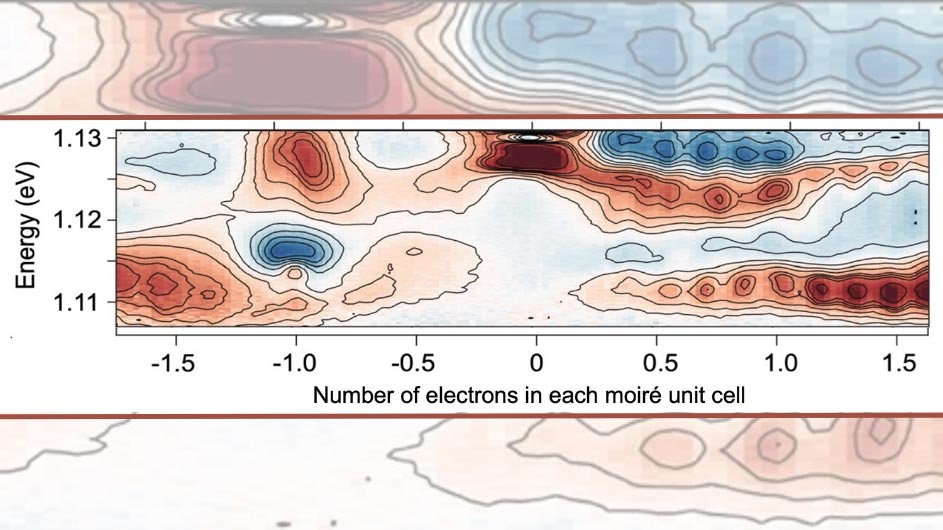
Just last summer, Yiping Wang, Max-Planck NYC Center Postdoctoral Fellow at Columbia and lead author on the current Nature paper, obtained a sample from Xu’s lab. Zhu was traveling when she decided to run some experiments on it with a pump-probe spectroscopy technique developed by co-author and Simons Fellow Eric Arsenault. Her screen lit up with peaks, corresponding to dozens of fractional charges—including at fractions that have been theoretically predicted to be the components needed to build a topological quantum computer: so-called non-Abelian anyons.
In their pump-probe approach, one laser pulse “melts” the quantum states in the material and then a second detects the change in dielectric constant, a measure of the strength of electrical interactions, as the states re-emerge. Arsenault’s method uses an extremely fast laser capable of teasing apart the subtle differences in so many fractional energy levels. “This discovery also establishes pump-probe spectroscopy as hitherto the most sensitive technique in detecting quantum states of matter,” said Zhu.
A New Quantum Playground
In addition to discovering the states in their lowest, or ground, energy, it also captures details as they change. “It feels like we’ve entered new dimension, time, to explore correlation and topology in the ground state,” said Wang. “They just keep surprising us, especially when we push them out of equilibrium.”
Now, it’s time to figure out precisely what all these new states are and what they could be most useful for. “There are just so many. We hope these results and our technique inspire others to explore,” said Zhu.
It is indeed a zoo out there.
Reference: “Hidden states and dynamics of fractional fillings in twisted MoTe2 bilayers” by Yiping Wang, Jeongheon Choe, Eric Anderson, Weijie Li, Julian Ingham, Eric A. Arsenault, Yiliu Li, Xiaodong Hu, Takashi Taniguchi, Kenji Watanabe, Xavier Roy, Dmitri Basov, Di Xiao, Raquel Queiroz, James C. Hone, Xiaodong Xu and X.-Y. Zhu, 3 April 2025, Nature.
DOI: 10.1038/s41586-025-08954-8
Leave a Reply