
By Arizona State University April 26, 2025
Collected at: https://scitechdaily.com/how-planet-smashing-collisions-stole-earths-life-essential-elements/
Earth and Mars are mysteriously low in elements like copper and zinc, which are crucial for planetary chemistry and potentially life.
A new study overturns old theories by showing that these elements were once abundant in the early building blocks of planets. The real loss likely occurred later through epic space collisions, not during early formation as once thought. This discovery radically shifts our understanding of how habitable planets like Earth came to be.
Mystery of Missing Elements on Earth and Mars
For decades, scientists have tried to solve a fundamental mystery: where did Earth’s key elements come from—and why are some of them missing? A new study offers an unexpected answer that reshapes our understanding of how Earth formed.
Led by Assistant Professor Damanveer Grewal of Arizona State University, in collaboration with researchers from Caltech, Rice University, and MIT, the study challenges long-held beliefs about why Earth and Mars are deficient in moderately volatile elements (MVEs). These elements, such as copper and zinc, are crucial for planetary chemistry and often occur alongside life-supporting ingredients like water, carbon, and nitrogen. Tracing their origin is essential to understanding how Earth became habitable.

Meteorites Reveal Hidden Clues
Published in Science Advances, the research takes a novel approach by studying iron meteorites. These are the metal-rich remnants of ancient planetary building blocks, or planetesimals, that formed in the early inner solar system.
“We found conclusive evidence that first-generation planetesimals in the inner solar system were unexpectedly rich in these elements,” said Grewal. “This discovery reshapes our understanding of how planets acquired their ingredients.”
Cosmic Collisions as the Culprit
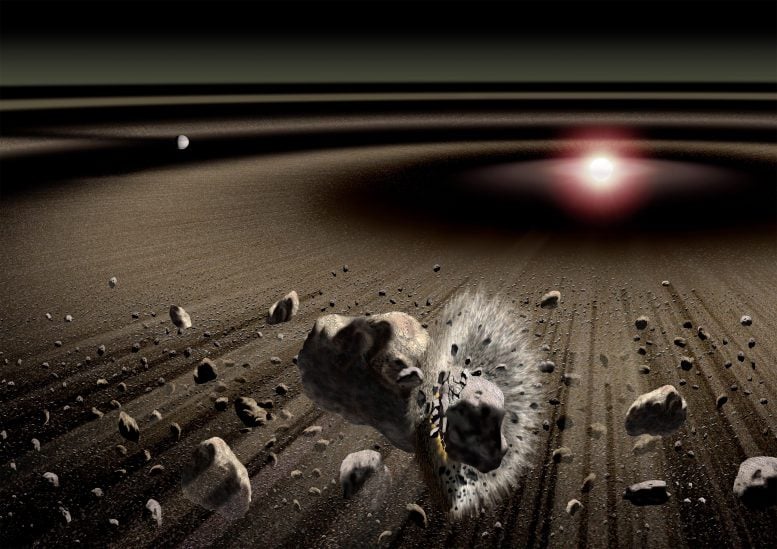
Until now, scientists believed that MVEs were lost either because they never fully condensed in the early solar system or escaped during planetesimal differentiation. However, this study reveals a different story: many of the first planetesimals held onto their MVEs, suggesting that the building blocks of Earth and Mars lost theirs later, during a period of violent cosmic collisions that shaped their formation.

Redefining Planetary Chemistry
Surprisingly, the team found that many inner solar system planetesimals retained chondrite-like MVE abundances, showing that they accreted and preserved MVEs despite undergoing differentiation. This suggests that the progenitors of Earth and Mars did not start out depleted in these elements, but instead, their loss occurred over a prolonged history of collisional growth rather than incomplete condensation in the solar nebula or planetesimal differentiation.
Rewriting Earth and Mars’ Origins
“Our work redefines how we understand the chemical evolution of planets,” Grewal explained. “It shows that the building blocks of Earth and Mars were originally rich in these life-essential elements, but intense collisions during planetary growth caused their depletion.”
Reference: “Enrichment of moderately volatile elements in first-generation planetesimals of the inner Solar System” by Damanveer S. Grewal, Surjyendu Bhattacharjee, Bidong Zhang, Nicole X. Nie and Yoshinori Miyazaki, 5 February 2025, Science Advances.
DOI: 10.1126/sciadv.adq7848
Leave a Reply