
By Tania Ewing and Associates April 26, 2025
Collected at: https://scitechdaily.com/ghostly-plasma-storms-found-in-supposedly-empty-space-around-earth/
Scientists using South Africa’s MeerKAT telescope have peered into the interstellar medium like never before, uncovering unexpected turbulence and plasma structures around the nearest millisecond pulsar to Earth.
The twinkling of this pulsar revealed solar-system-sized plasma blobs within our so-called “empty” Local Bubble and offered the first detailed 3D view inside a pulsar’s bow shock — where supersonic stellar winds smash into surrounding space. These findings challenge long-held assumptions about the local cosmos and open a new window into the invisible drama between stars.
Challenging Old Models of Space Turbulence
One of the first things many people learn in astronomy is that stars twinkle, while planets do not. But twinkling isn’t limited to visible light—some objects in the radio sky also appear to flicker, or “scintillate.” Among these are pulsars, rapidly spinning neutron stars that emit beams of radio waves.
Now, a team of Australian scientists has used the twinkling signal from a nearby pulsar to probe the structure of the interstellar medium—the space between stars—within our galaxy. By analyzing how the pulsar’s radio waves flickered, they were able to map previously hidden layers of plasma, including features inside a rare and turbulent structure known as a bow shock, where fast-moving stellar winds collide with surrounding space.
New research published on April 21 in Nature Astronomy challenges long-held ideas about the structure of the local interstellar medium, the space just beyond our solar system, and offers fresh insight that could reshape models of pulsar bow shocks.
High-Precision Observations with MeerKAT
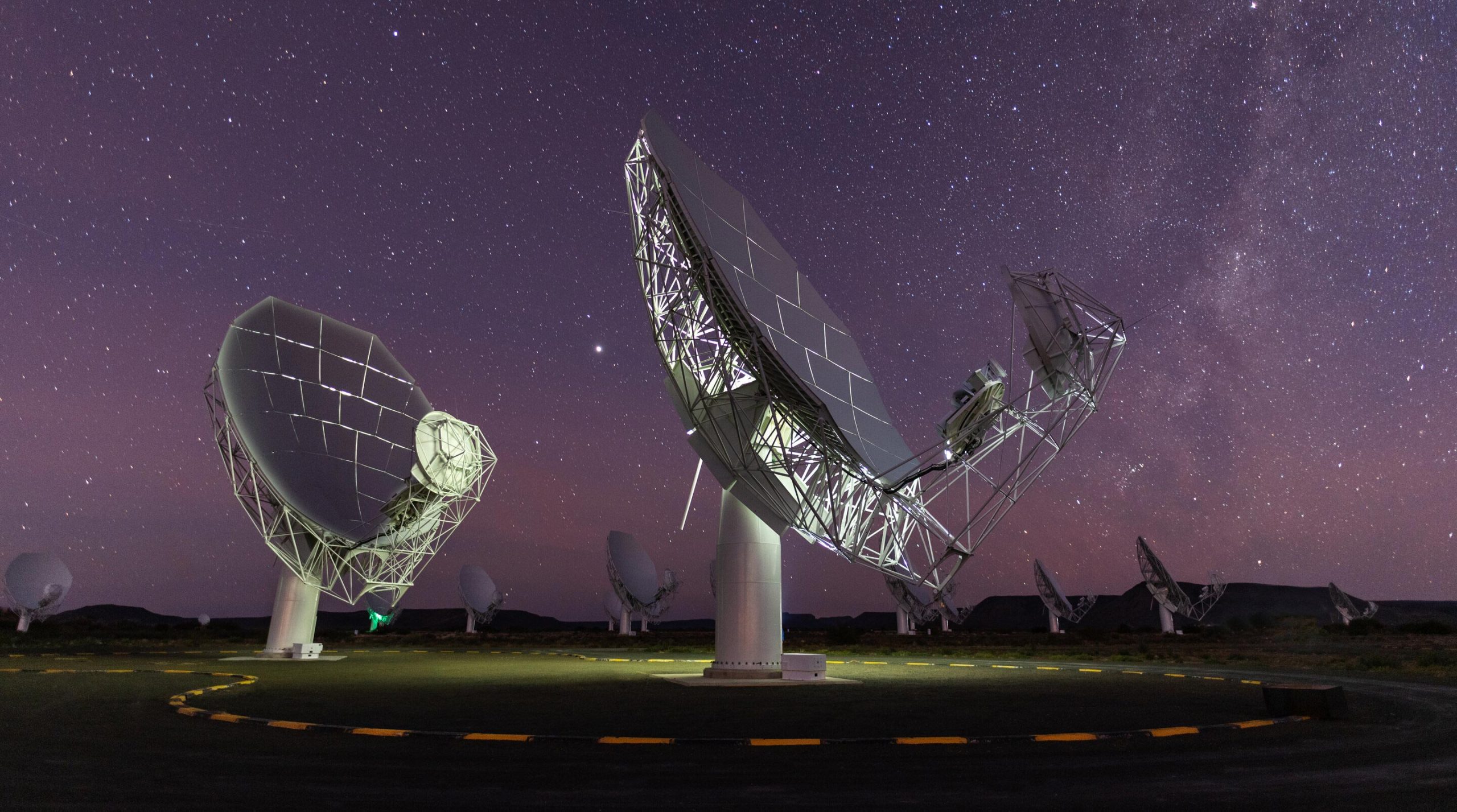
The findings come from a study led by Dr. Daniel Reardon of the ARC Centre of Excellence for Gravitational Wave Discovery and Swinburne University of Technology. Over six days, the team observed the closest and brightest known millisecond pulsar to Earth using South Africa’s MeerKAT radio telescope, the most sensitive of its kind in the Southern Hemisphere.
Although pulsars don’t shine in visible light like ordinary stars, they emit radio waves that appear to “twinkle” as they pass through the turbulent plasma that fills space between stars. “This plasma is created from gas that is heated and stirred up by energetic events in our galaxy, like exploding stars,” explained Dr. Reardon.
Scintillation as a Window into Interstellar Weather
“When a pulsar scintillates, it reveals valuable information about the location, structure, and motion of the plasma, as well as about the dynamics of the pulsar—we use scintillation to get unique insights about these interstellar storms.”
The pulsar in question, unimaginatively named J0437-4715, is located relatively close to our solar system, in an area of our galaxy called the Local Bubble—a region almost devoid of gas and dust, created by the explosions of 15 stars about 14 million years ago.
Surprising Plasma Structures Discovered
Using the data gleaned from MeerKAT, the scientists studied patterns called “scintillation arcs,” which provide a three-dimensional map, of plasma structures in the galaxy that are impossible to study using other methods. “These scintillation arcs revealed an unexpected abundance of compact solar-system-sized blobs of plasma within our Local Bubble, which was thought to be more smooth,” Dr. Reardon said.
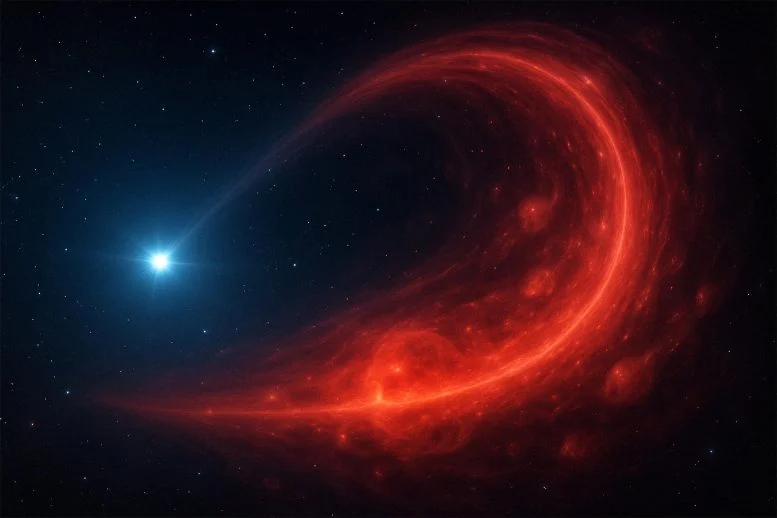
For the first time, the team also used scintillation to study the bow shock created by the pulsar as it ploughs supersonically through the interstellar medium. “Travelling at Mach 10, the pulsar and its energetic wind of fast-moving particles create a shock wave of heated gas.” The shock is akin to the bow wave at the front of a ship.
A New Frontier in Measuring Plasma
While most pulsars should create bow shocks, only about a dozen have ever been observed as a faint red glow of energised Hydrogen atoms. This study marks the first time scientists have been able to peer inside a pulsar bow shock to measure plasma speeds. “To our surprise, the scintillation arcs revealed multiple sheets of plasma inside the shock, including one unexpectedly moving towards the front of the shock,” Dr. Reardon said.
This groundbreaking study, made possible by the pulsar’s closeness to Earth and the power of the MeerKAT telescope, achieved several significant firsts including a measurement of the three-dimensional shape of a bow shock, measurement of plasma speeds inside the shock, and the most detailed view of plasma structures within our Local Bubble. “We can learn a lot from a twinkling pulsar!”
Reference: “Bow shock and Local Bubble plasma unveiled by the scintillating millisecond pulsar J0437−4715” by Daniel J. Reardon, Robert Main, Stella Koch Ocker, Ryan M. Shannon, Matthew Bailes, Fernando Camilo, Marisa Geyer, Andrew Jameson, Michael Kramer, Aditya Parthasarathy, Renée Spiewak, Willem van Straten and Vivek Venkatraman Krishnan, 21 April 2025, Nature Astronomy.
DOI: 10.1038/s41550-025-02534-6
Leave a Reply