

By Light Publishing Center, Changchun Institute of Optics, Fine Mechanics And Physics, CAS April 19, 2025
Collected at: https://scitechdaily.com/meet-the-quadruplon-scientists-discover-a-new-four-body-quantum-particle/
Scientists have discovered a new four-body quasi-particle, the quadruplon, in a 2D semiconductor. Using laser experiments and advanced theory, they identified unique spectral features unexplained by existing models, confirming the quadruplon’s existence.
A central goal of physics is to understand why different materials exhibit specific properties, such as electrical, optical, thermal, or magnetic behavior. These properties are fundamental to nearly all technological applications. Modern quantum theory explains them through various types of “elementary excitations,” commonly referred to as quasi-particles.
Well-known quasi-particles include phonons (quantized lattice vibrations in a crystal), electrons and holes influenced by the crystal lattice in semiconductors, and polarons, electrons or holes further modified by their interaction with phonons. More complex examples include excitons, which are bound electron-hole pairs resembling hydrogen atoms. Two excitons can bind together to form a molecular-like structure known as a biexciton, analogous to a hydrogen molecule.
Although a biexciton consists of four particles (two electrons and two holes), it is typically treated as a system composed of two interacting excitons, effectively a reducible, two-body system. In contrast, physicists have proposed the existence of genuine four-body quasi-particles that cannot be reduced to combinations of two-body entities. However, experimental evidence for such irreducible four-body states is extremely limited, and none has been confirmed in semiconductors to date.
First Evidence of a Genuine Four-Body Quasi-Particle
In a new paper published in eLight, a team of scientist led by Professor Cun-Zheng Ning from College of Integrated Circuits and Optoelectronic Chips, Shenzhen Technology University and Electronic Engineering Department, Tsinghua University, China, reported experimental results and supporting theory that show first evidence of the existence of a genuine four-body quasi-particle called quadruplon in a semiconductor of a mono-molecular thickness, the so-called two-dimensional material, Molybdenum Ditelluride.
The team used a monolayer of Molybdenum Ditelluride sandwiched by thin layers of boron nitride from the top and bottom after the top is contacted by a metal electrode. The bottom boron nitride layer serves as a dielectric layer under which “gate” electrode is used. The device structure allows the team to tune the charges inside the monolayer semiconductor to study how the spectral responses will change with gate voltage.
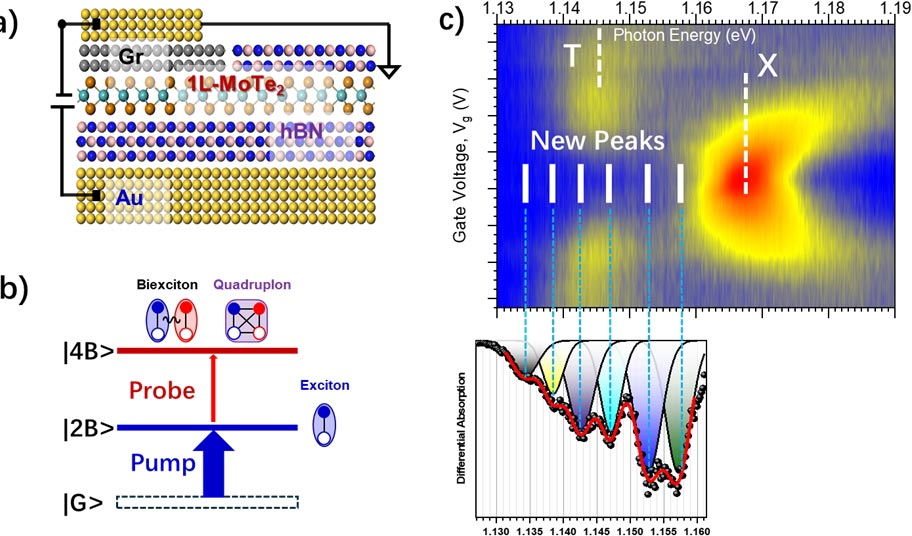
To study the spectral properties, the team then used an optical pump-probe technique: a strong short pulse of hundreds of femtosecond in length is sent to pump the electrons in the monolayer, and a weak probe pulse is then used to see how the pump-excited monolayer absorbs photons of probe laser after a short delay.
The rationale of such experiments is as follows: the strong pump excites electrons from the crystals to form various quasi-particles or multi-body entities such as excitons, or trions involving one electron and two holes (or two electrons and one hole), or bi-excitons mentioned above. The photons of the probe pulse are then absorbed by these newly created quasi-particles to jump to various higher new states, called final states, which typically involve now four-particles. By measuring the reflected or transmitted light of the probe pulse, one can gain important information about the final states, or the four-body states.
Since these quasi-particles often have a very short lifetime on the order of picoseconds, a probe pulse must come soon enough before they die out. To get more systematic information from this pump-probe technique, the team varied gate voltage, strength of pump pulse, delay time between the pump and probe, the energy and polarization of the probe pulses, and the temperature of the samples etc. In a typical such experiment, various quasi-particles appear in terms of characteristic spectral peaks.
Surprising Results: Beyond Known Quasi-Particles
Scientists so far have only observed quasi-particles such as excitons, trions, bi-excitons, or entities that involve weakly couplings of these known entities. They often appear as a spectral peak or two below the exciton peak in an absorption spectrum.
“To our surprise, our measured absorption spectrum showed at least 6 peaks below that of exciton,” said Cun-Zheng Ning, the leader of the team. “The first thing one has to rule out in this situation is effects of defects. Our group has prepared and tested many hundreds of samples of this type over the last ten years. We knew how to tell the difference between a good sample with almost no defect peaks and a bad one with. We repeated experiments on five of our best samples with little defects and these peaks are repeatable and robust,” continued Ning.
“To further establish the intrinsic nature of these peaks, we performed systematic temperature and pump-power dependence of these new spectral peaks. We tried every experiment we could think of and were able to do. All experimental evidence showed intrinsic nature and robustness of the new spectral features,” said Dr. Jiacheng Tang, who was a PhD student in Ning’s group and the first author of the paper.
Once the new spectral features were established, the team tried to explain them in terms of existing theories that include excitons, trions, and bi-excitons. It turned out that these known quasi-particles could not explain all these new features. The team had to go beyond traditional approximations by including all the possible terms of Coulomb interaction between two electrons and two holes. To their pleasant amazement, the new theory could now produce all the key features of the experiment.
“Normally, one might consider the problem solved, since we got very good agreement between experiment and theory,” said Ning. “But since the four-body interaction involves so many different terms, it is curious to ask which of these terms caused the new spectral peaks. Furthermore, we lacked an intuitive picture of understanding. So I challenged my student if we could work out an alternative theory that is more intuitive,” continued Ning.
The Role of Cluster Expansion and the Discovery of the Quadruplon
The alternative theory Ning had in mind is so-called cluster expansion. It is a technique to make successive approximation to the full Coulomb interaction, which is not exactly solvable. The advantage of the cluster expansion is its intuitive nature.
“To our pleasant surprise and satisfaction, we were able to successfully establish the correspondence between the two theoretical approaches. We were able to show that the experimental results could be explained by both approaches,” Ning further explained and he continued “Now the additional advantage of the cluster expansion approach is that one can artificially turn on and off a particular cluster to see which of these clusters is responsible for the new spectral features.”
Eventually, the authors were able to show that there was a crucial cluster, the so-called fourth order cluster that involved two electrons and two holes which cannot be reduced to combinations of lower orders. Once this cluster is included, all the experimental features were reproduced. Thus, they were able to finally pinpoint the unique role of this fourth order cluster, which corresponds to a new composite entity, or quasi-particle, involving two electrons and two holes. The authors call this new particle quadruplon, in accordance with some theoretical literature.
As for the future, the authors believe that there are a lot to be explored. They plant to measure similar spectral features in other material systems. In addition, the authors believe that the light emission properties of the newly discovered quadruplon are highly interesting, as they might reveal the new quantum nature of the new highly correlated many-body complex.
Reference: “The quadruplon in a monolayer semiconductor” by Jiacheng Tang, Cun-Zheng Ning, Hao Sun, Qiyao Zhang, Xingcan Dai and Zhen Wang, 26 March 2025, eLight.
DOI: 10.1186/s43593-025-00081-1
Funding: National Natural Science Foundation of China, Pingshan Innovation Platform Project of Shenzhen Hi-tech Zone Development Special Plan in 2022, Universities Engineering Technology Center of Guangdong, Key Programs Development Project of Guangdong, Natural Science Foundation of Top Talent at SZTU, Tsinghua University Initiative Scientific Research Program
Leave a Reply