
By University of New South Wales April 12, 2025
Collected at: https://scitechdaily.com/stars-that-sing-how-hidden-frequencies-unravel-the-milky-ways-mysteries/
A team of UNSW Sydney researchers has unlocked the “sounds” of stars to better understand their age, mass, and evolutionary stage.
By listening to stellar oscillations in a cluster called M67, home to 27 stars born together 4 billion years ago, they’ve traced how stars evolve and what lies ahead for our Sun. Using data from NASA’s Kepler K2 mission, they detected frequency patterns that act like stellar fingerprints, revealing the secrets of their interiors. This discovery doesn’t just shed light on stars—it helps decode the history of the Milky Way and even the potential for life-supporting planets.
Listening to the Stars: A Galactic Time Machine
A new study led by researchers at UNSW Sydney has uncovered how a group of stars 2,700 light-years away reveals their life stages through the “sounds” they emit. These stellar vibrations, subtle oscillations detectable by telescopes, offer insights into how stars change over time. The discovery could help astronomers better map the history of the Milky Way and other galaxies, deepening our understanding of stellar evolution.
The study, published on April 2 in Nature, was led by Dr. Claudia Reyes during her PhD at the UNSW School of Physics. She examined 27 stars within a cluster known as M67, a group of stars that all formed from the same cloud of gas around four billion years ago.
Clues Hidden in Stellar Mass
Because the stars in M67 have nearly identical chemical compositions but differ in mass, they provide a rare opportunity to study how stars evolve under similar conditions.
“When we study stars in a cluster, we can see their whole sequence of individual evolution,” Dr. Reyes says.
Although these stars are the same age, their different masses mean they age at different rates. M67 is especially valuable because it includes a range of giant stars: from smaller, less evolved subgiants to large red giants nearing the final stages of their life cycles.
The study also opens ways to learn more about what our own star – the Sun – will do as it becomes bigger and older. This is because, “the Sun was born in a cluster similar to the one we studied,” says Dr. Reyes.
What’s the Deal with Clusters?
Observing such a broad evolutionary range of stars within a single cluster has never been achieved before at such detail.
“This is the first time we have really studied such a long range of evolutionary sequences, like we have in this cluster,” says coauthor Professor Dennis Stello, also from the UNSW School of Physics.
“Verifying the age of a star is one of the most difficult things to do in astronomy, because the age of a star isn’t revealed by its surface,” Prof. Stello says.
“It is what happens inside that shows how old it is.”
Because the stars in the M67 cluster are of a similar age and composition to our Sun, they can offer insights into our solar system’s past and formation, as well as its future as the Sun evolves.
“Almost all stars are initially formed in clusters,” Prof. Stello says. “They are basically big families of hundreds to thousands of stars born from one big cloud of gas.
“Usually, they would slowly disperse into a diffuse random selection of stars.
“But some of them are still within groups – clusters. You can see them when you look to the sky as areas with lots of stars close together, where they are still closely bound, like the cluster we studied here.”
A Symphony in the Sky
The study allows for the precise determination of a star’s age and mass based on its oscillation frequencies. The frequencies by which any star ‘rings’ depends on the physical properties of the matter inside of it, giving clues about its density, temperature and age.
This was the first time researchers could interrogate the ‘ringing’ across a cluster of stars to learn more about their interiors. They used the Kepler K2 mission as the primary way to observe, or ‘listen’.
Stars That Sing in Frequencies
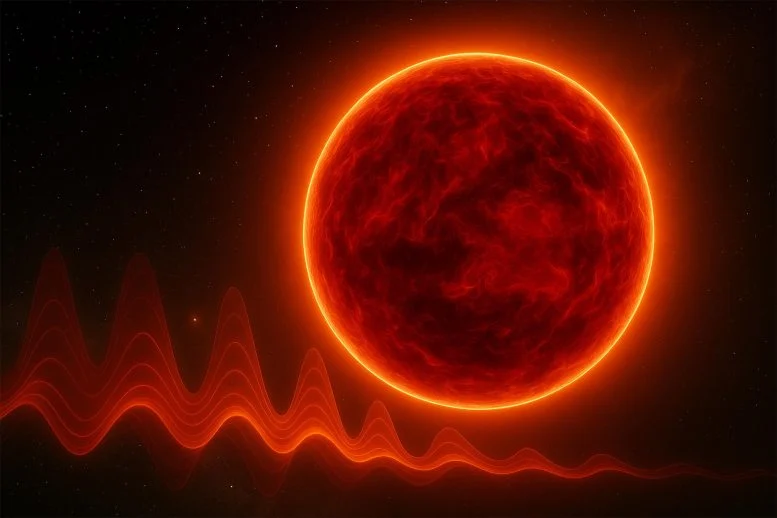
Prof. Stello says the process is like listening to an orchestra, and identifying instruments based on their sound.
“The frequency by which an instrument is vibrating – or ringing – depends on the physical properties of the matter that the sound travels through,” he says.
“Stars are the same. You can ‘hear’ a star based on how it rings.
“We can see the vibration – or the effect of the vibration – of the sound just like you can see the vibration of a violin string.”
The biggest stars have the deepest sounds. Small stars have high-pitched sounds. And no one star plays just the one note at once – each star covers a symphony of sound coming from its interior.
In Space, No One Can Hear You Scream (or Sing)
Sound exists as a wave of energy, a vibration, moving through particles – solid, liquid or gas. But in space, there are no particles, which means there’s no sound.
Prof. Stello says each star is like a breathing ball of gas – cooling down and heating up – with slight changes in brightness.
“It’s these fluctuations in brightness that we watched and measured, to gauge the sound frequencies,” he says.
As stars mature towards red giants, their frequencies change and behave differently. These changes can track their evolution.
The frequency differences between the many nodes ‘played’ by a star can give clues about a star’s interior properties.
By studying the 27 stars in the M67 open cluster, the researchers could, for the first time, observe the relationship between small and large frequency differences in giant stars, which can now be applied to individual stars.
Mapping the Milky Way’s History
To better understand the formation and evolution of galaxies, scientists need to know the age of all its components, including the stars.
Dr. Reyes says this study will lead to the accurate identification of the mass and age of stars in the Milky Way – something yet to be achieved.
This is also important for understanding stars that host planets, as a star’s properties are critical for supporting life on those worlds.
Prof. Stello says frequency signatures will also be important when modeling the future evolution of our own Sun.
“This study has enabled us to probe the fundamental physics that happens inside stars, deep into their interiors, and the fundamental physics under these extreme conditions,” he says.
“This is something we still grapple with. It’s important for us to build evolution models that we can trust, so that we can predict what happens not only to the Sun, but also to other stars as they grow older.
“Seeing the evolutionary phase of stars directly through the fingerprint of frequencies is what enables us to be much more certain about the ‘ingredients’ we put into our models,” he says.
What’s in the Future?
Dr. Reyes says their findings were unexpected.
“We discovered something new with this signature in the frequencies,” she says.
Dr. Reyes says we already have data from many years of studying the Milky Way and its stars.
“The next step is to go back and look at that data,” she says. “To look for these particular frequencies that nobody thought to look for before.
“And we can do this by listening to the stars.”
Explore Further: How Starquakes Reveal a Hidden Stage in Galactic Evolution

You actually make it appear so easy with your presentation however I find this matter to be really one thing that I think I might by no means understand. It kind of feels too complicated and very broad for me. I’m having a look forward on your subsequent post, I’ll attempt to get the hang of it!
Leave a Reply