
By Emily Conover April 10, 2025 at 2:00 pm
Collected at: https://www.sciencenews.org/article/neutrino-mass-shrinks-katrin-electron
Neutrinos are known to have tiny masses. A new result proclaims the subatomic particles to be even tinier still.
The electrically neutral particles, produced in radioactive decays and in reactions in the sun and elsewhere in the cosmos, have a mass of less than 0.45 electron volts, physicists report in the April 11 Science. The result, from the Karlsruhe Tritium Neutrino, or KATRIN, experiment slashes the experiment’s previous upper limit for neutrino mass by nearly half.
Neutrinos are the only class of fundamental particle for which the mass, one of the most basic attributes of any particle, is unknown. The particles are so much lighter than others that they were long thought to have no mass at all. Now, one of the major puzzles in particle physics is understanding why neutrinos are so lightweight — less than a millionth the mass of an electron. Measuring their masses would be a step toward understanding.
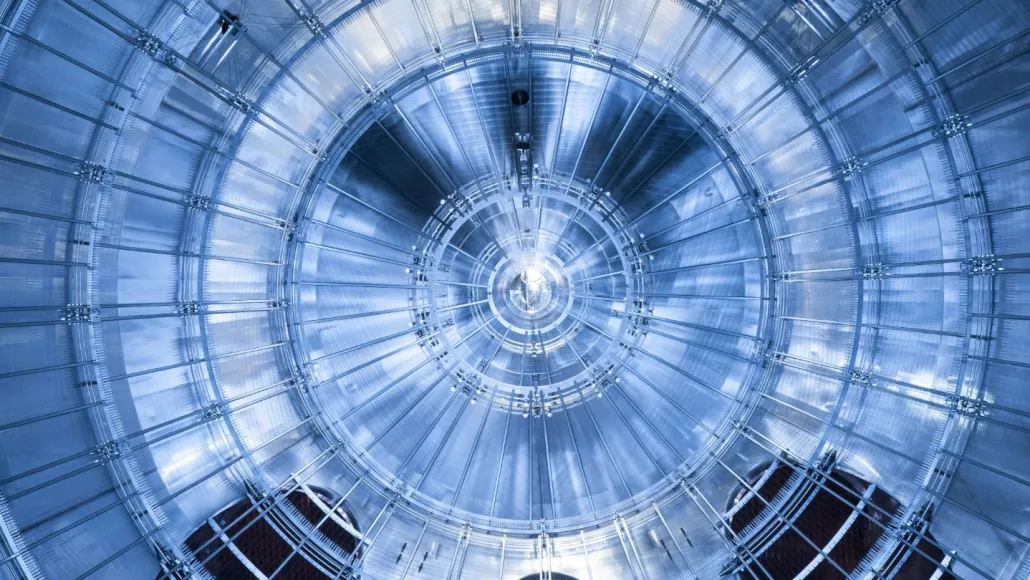
Based in Karlsruhe, Germany, KATRIN studies an antimatter version of neutrino known as an electron antineutrino. The researchers observed radioactive decays of tritium, a heavy variety of hydrogen. Each decay spits out an electron antineutrino and an electron of varying energies. The neutrino’s mass limits the maximum energy the electron can have. Using measurements of a whopping 36 million electrons, the researchers looked for that subtle effect of the antineutrino’s mass.
KATRIN will keep taking data until about the end of 2025, says physicist Diana Parno of Carnegie Mellon University in Pittsburgh. With those data, plus additional data that have been collected and not yet analyzed, the researchers aim to further constrain the possible masses of neutrinos.
Other scientists have put a ceiling on neutrino mass using observations of the cosmos. That’s possible because the particles and their mass shaped the early universe, with impacts that scientists can observe today. But that estimate could be wrong if scientists don’t understand the universe as well as they think. KATRIN’s findings are independent of such assumptions.
Leave a Reply