
By Mark Thompson March 28, 2025
Collected at: https://www.universetoday.com/articles/detecting-exoplanets-by-their-magnetospheres
Exoplanets, or planets beyond our Solar System, are discovered using a variety of techniques. The transit method detects periodic dimming of a star’s light when a planet passes in front of it. The radial velocity method measures tiny shifts in a star’s spectrum caused by the gravitational tug of an orbiting planet. The gravitational microlensing method relies on the bending of light from a background star due to a planet’s gravitational field. Numerous other techniques also exist, ensuring we have multiple ways to find these alien worlds. A team of astronomers, eager for new methods, has uncovered a rather unusual but successful approach.
 Artist impression of an exoplanet around a dim Sun-like star.
This new method, published in the journal Astronomy and Astrophysics, was led by C. K. Louis from the University of Paris. Their idea revolves around detecting planetary magnetospheres. The magnetic fields of stars can be detected using Zeeman Doppler Imaging (ZDI), a technique that analyses the polarisation of emitted light or its absorption in spectral lines. However, the extremely weak magnetic signals of exoplanets are not easily detectable using this method. The overlapping spectral information from both the star and the exoplanet makes this technique largely ineffective for planet hunting.
The team has therefore explored and developed several indirect methods for detecting exoplanetary magnetic fields when direct measurement is challenging. These techniques include analyzing planet-modulated chromospheric emission (variations in the emission from a star’s chromosphere influenced by an orbiting planet), observing neutral atomic hydrogen absorption during planetary transits, and examining planetary auroral radio emissions.
 Aurora borealis captured over the UK (Credit : Mark Thompson)
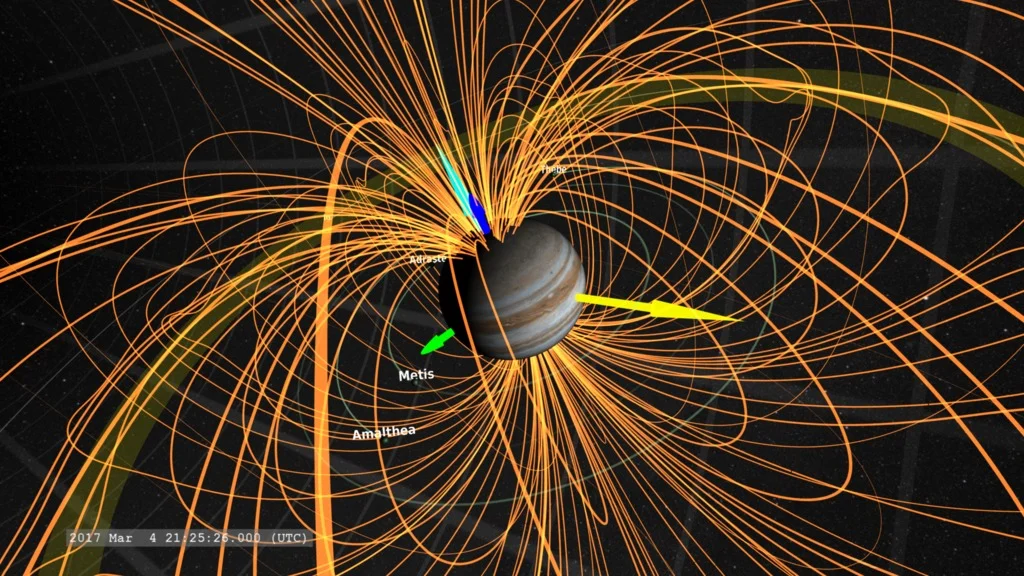
The latter study, focusing on auroral radio emissions, is particularly exciting. These emissions are produced by the Cyclotron Maser Instability—a term that sounds like science fiction and frankly gives me goosebumps, but refers to a plasma instability occurring when energetic electrons spiral around a magnetic field, emitting radiation. Such emissions have been studied in our own Solar System, including Earth, and occur along magnetic field lines, especially during auroral events.
Radio emissions from planetary aurorae provide key insights into local magnetic fields, with their detection and characteristics varying significantly across different planets. They were first discovered around Jupiter in 1955, with emissions ranging from a few kilohertz to 40 megahertz. However, their visibility depends on the observer’s position relative to the emitting body, posing challenges for long-distance detection.
To explore this concept, the team ran several simulations based on Jupiter and the Galilean satellites. Their results were promising. They found that successfully detecting exoplanets through radio emissions requires sufficient observational data over an extended timeframe. However, they also discovered that targeted observations, rather than undermining research, can actually enhance the potential for identifying subtle astronomical signals. With upcoming instruments like SKA-low, the future looks bright for radiation-based studies of exoplanet magnetospheres, offering more refined detection capabilities.


Leave a Reply