

By Sissa Medialab March 23, 2025
Collected at: https://scitechdaily.com/ghost-particles-in-the-deep-are-unlocking-secrets-of-quantum-gravity/
Scientists are diving into the deep sea to study one of the universe’s biggest mysteries—quantum gravity.
Using KM3NeT, a vast underwater neutrino telescope, researchers are watching ghost-like particles that may hold the key to uniting the physics of the very large and the very small. By analyzing how neutrinos oscillate—or don’t—during their journey through space, they’re searching for subtle signs of decoherence, a possible effect of quantum gravity.
A Tiny Particle and a Big Physics Puzzle
Quantum gravity is the missing piece in physics: a theory that could unite general relativity, which describes the universe on large scales, with quantum mechanics, which governs the behavior of the tiniest particles. One possible key to this long-standing puzzle may be the neutrino, a tiny, electrically neutral particle that’s nearly invisible because it almost never interacts with matter. Trillions pass through your body every second without leaving a trace.
Because neutrinos interact so rarely, they’re notoriously difficult to detect. But once in a while, a neutrino will collide with something, like a water molecule deep beneath the sea. When that happens, it can create a faint blue light known as Čerenkov radiation, which can be picked up by sensitive detectors like KM3NeT.
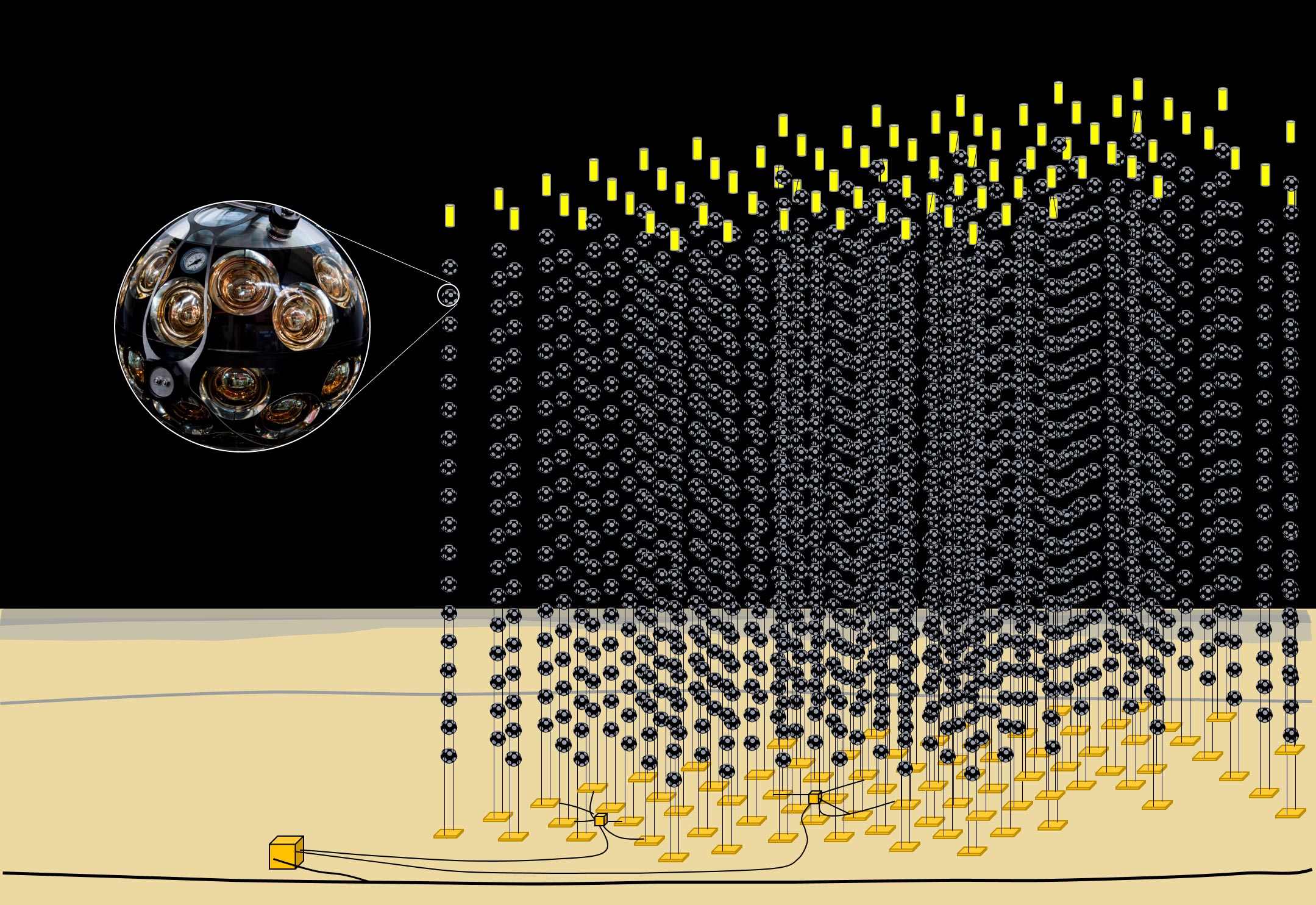
KM3NeT: A Deep-Sea Telescope for Ghost Particles
KM3NeT (the Kilometer Cube Neutrino Telescope) is a vast underwater observatory designed to capture these rare neutrino interactions in the deep ocean. It includes two main detectors, one of which, ORCA (Oscillation Research with Cosmics in the Abyss), was used in this study. ORCA sits about 2,450 meters below the surface, just off the coast of Toulon, France.
But detecting neutrinos is just the first step. To probe quantum gravity, researchers also look for subtle signs that these particles are affected by a phenomenon called “decoherence,” a possible clue to physics beyond our current understanding.
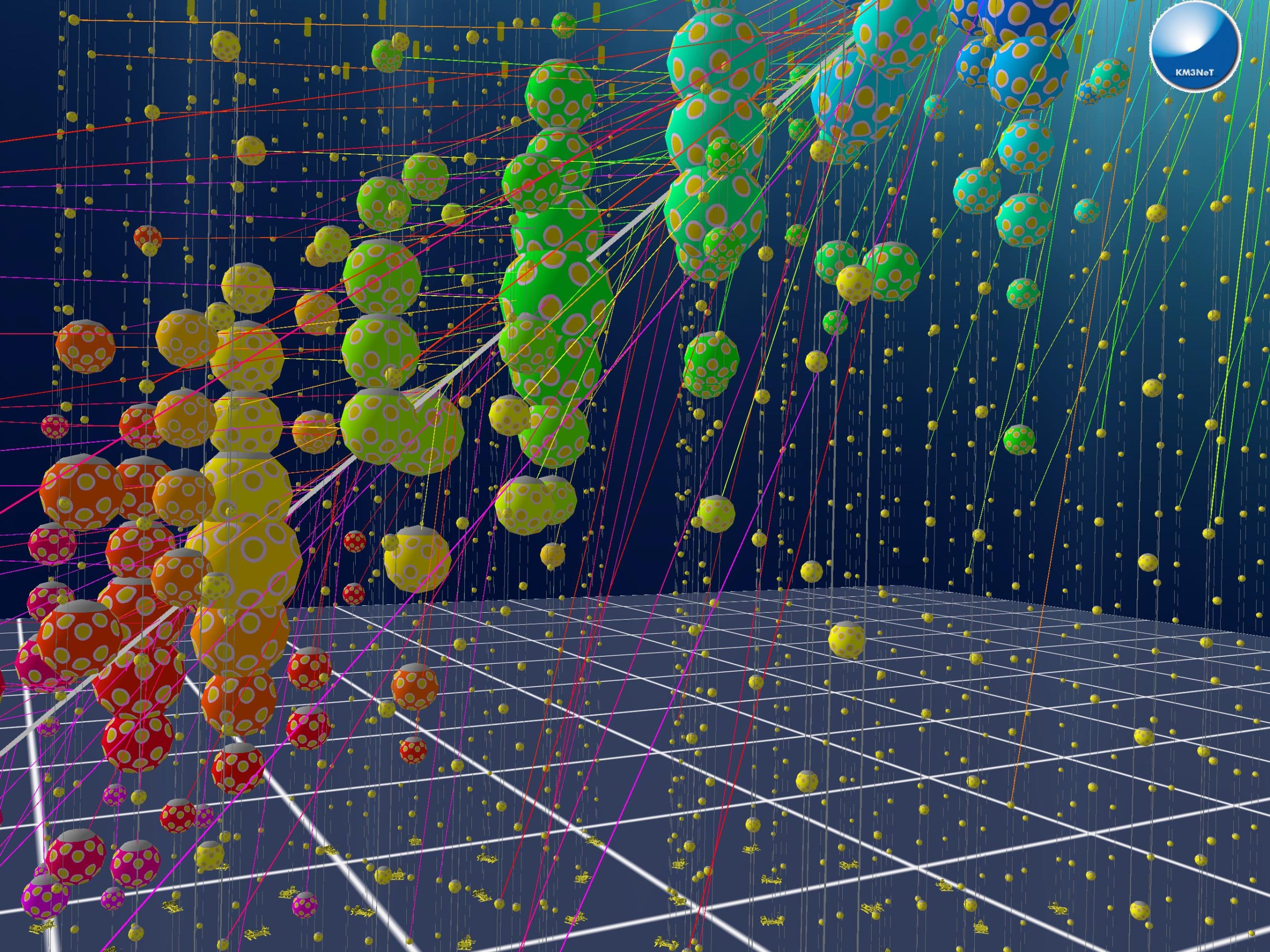
How Neutrinos Change and What That Tells Us
As they travel through space, neutrinos can “oscillate,” meaning they change identity—a phenomenon scientists refer to as flavor oscillations. Coherence is a fundamental property of these oscillations: a neutrino does not have a definite mass but exists as a quantum superposition of three different mass states. Coherence keeps this superposition well-defined, allowing the oscillations to occur regularly and predictably. However, quantum gravity effects could attenuate or even suppress these oscillations, a phenomenon known as “decoherence.”
“There are several theories of quantum gravity which somehow predict this effect because they say that the neutrino is not an isolated system. It can interact with the environment,” explains Nadja Lessing, a physicist at the Instituto de Física Corpuscular of the University of Valencia and corresponding author of this study, which includes contributions from hundreds of researchers worldwide.
“From the experimental point of view, we know the signal of this would be seeing neutrino oscillations suppressed.” This would happen because, during its journey to us—or more precisely, to the KM3NeT sensors at the bottom of the Mediterranean—the neutrino could interact with the environment in a way that alters or suppresses its oscillations.
However, in Lessing and colleagues’ study, the neutrinos analyzed by the KM3NeT/ORCA underwater detector showed no signs of decoherence, a result that provides valuable insights.
Pushing Boundaries and Looking Ahead
“This,” explains Nadja Lessing, “means that if quantum gravity alters neutrino oscillations, it does so with an intensity below the current sensitivity limits.” The study has established upper limits on the strength of this effect, which are now more stringent than those set by previous atmospheric neutrino experiments. It also provides indications for future research directions.
“Finding neutrino decoherence would be a big thing,” says Lessing. So far, no direct evidence of quantum gravity has ever been observed, which is why neutrino experiments are attracting increasing attention. “There has been a growing interest in this topic. People researching quantum gravity are just very interested in this because you probably couldn’t explain decoherence with something else.”
Reference: “Search for quantum decoherence in neutrino oscillations with six detection units of KM3NeT/ORCA” by S. Aiello, A. Albert, A.R. Alhebsi, M. Alshamsi, S. Alves Garre, A. Ambrosone, F. Ameli, M. Andre, L. Aphecetche, M. Ardid, S. Ardid, H. Atmani, J. Aublin, F. Badaracco, L. Bailly-Salins, Z. Bardačová, B. Baret, A. Bariego-Quintana, Y. Becherini, M. Bendahman, F. Benfenati, M. Benhassi, M. Bennani, D.M. Benoit, E. Berbee, V. Bertin, S. Biagi, M. Boettcher, D. Bonanno, A.B. Bouasla, J. Boumaaza, M. Bouta, M. Bouwhuis, C. Bozza, R.M. Bozza, H. Brânzaş, F. Bretaudeau, M. Breuhaus, R. Bruijn, J. Brunner, R. Bruno, E. Buis, R. Buompane, J. Busto, B. Caiffi, D. Calvo, A. Capone, F. Carenini, V. Carretero, T. Cartraud, P. Castaldi, V. Cecchini, S. Celli, L. Cerisy, M. Chabab, A. Chen, S. Cherubini, T. Chiarusi, M. Circella, R. Cocimano, J.A.B. Coelho, A. Coleiro, A. Condorelli, R. Coniglione, P. Coyle, A. Creusot, G. Cuttone, R. Dallier, A. De Benedittis, B. De Martino, G. De Wasseige, V. Decoene, I. Del Rosso, L.S. Di Mauro, I. Di Palma, A.F. Díaz, D. Diego-Tortosa, C. Distefano, A. Domi, C. Donzaud, D. Dornic, E. Drakopoulou, D. Drouhin, J.-G. Ducoin, R. Dvornický, T. Eberl, E. Eckerová, A. Eddymaoui, T. van Eeden, M. Eff, D. van Eijk, I. El Bojaddaini, S. El Hedri, V. Ellajosyula, A. Enzenhöfer, G. Ferrara, M.D. Filipović, F. Filippini, D. Franciotti, L.A. Fusco, S. Gagliardini, T. Gal, J. García Méndez, A. Garcia Soto, C. Gatius Oliver, N. Geißelbrecht, E. Genton, H. Ghaddari, L. Gialanella, B.K. Gibson, E. Giorgio, I. Goos, P. Goswami, S.R. Gozzini, R. Gracia, C. Guidi, B. Guillon, M. Gutiérrez, C. Haack, H. van Haren, A. Heijboer, L. Hennig, J.J. Hernández-Rey, W. Idrissi Ibnsalih, G. Illuminati, D. Joly, M. de Jong, P. de Jong, B.J. Jung, G. Kistauri, C. Kopper, A. Kouchner, Y.Y. Kovalev, V. Kueviakoe, V. Kulikovskiy, R. Kvatadze, M. Labalme, R. Lahmann, M. Lamoureux, G. Larosa, C. Lastoria, A. Lazo, S. Le Stum, G. Lehaut, V. Lemaître, E. Leonora, N. Lessing, G. Levi, M. Lindsey Clark, F. Longhitano, F. Magnani, J. Majumdar, L. Malerba, F. Mamedov, J. Mańczak, A. Manfreda, M. Marconi, A. Margiotta, A. Marinelli, C. Markou, L. Martin, M. Mastrodicasa, S. Mastroianni, J. Mauro, G. Miele, P. Migliozzi, E. Migneco, M.L. Mitsou, C.M. Mollo, L. Morales-Gallegos, A. Moussa, I. Mozun Mateo, R. Muller, M.R. Musone, M. Musumeci, S. Navas, A. Nayerhoda, C.A. Nicolau, B. Nkosi, B. Ó Fearraigh, V. Oliviero, A. Orlando, E. Oukacha, D. Paesani, J. Palacios González, G. Papalashvili, V. Parisi, E.J. Pastor Gomez, C. Pastore, A.M. Păun, G.E. Păvălaş, S. Peña Martínez, M. Perrin-Terrin, V. Pestel, R. Pestes, P. Piattelli, A. Plavin, C. Poirè, V. Popa, T. Pradier, J. Prado, S. Pulvirenti, C.A. Quiroz-Rangel, N. Randazzo, S. Razzaque, I.C. Rea, D. Real, G. Riccobene, J. Robinson, A. Romanov, E. Ros, A. Šaina, F. Salesa Greus, D.F.E. Samtleben, A. Sánchez Losa, S. Sanfilippo, M. Sanguineti, D. Santonocito, P. Sapienza, J. Schnabel, J. Schumann, H.M. Schutte, J. Seneca, I. Sgura, R. Shanidze, A. Sharma, Y. Shitov, F. Šimkovic, A. Simonelli, A. Sinopoulou, B. Spisso, M. Spurio, D. Stavropoulos, I. Štekl, S.M. Stellacci, M. Taiuti, Y. Tayalati, H. Thiersen, S. Thoudam, I. Tosta e Melo, B. Trocmé, V. Tsourapis, A. Tudorache, E. Tzamariudaki, A. Ukleja, A. Vacheret, V. Valsecchi, V. Van Elewyck, G. Vannoye, G. Vasileiadis, F. Vazquez de Sola, A. Veutro, S. Viola, D. Vivolo, A. van Vliet, E. de Wolf, I. Lhenry-Yvon, S. Zavatarelli, A. Zegarelli, D. Zito, J.D. Zornoza, J. Zúñiga and N. Zywucka, 20 March 2025, Journal of Cosmology and Astroparticle Physics.
DOI: 10.1088/1475-7516/2025/03/039
Leave a Reply