
March 14, 2025 by Bernard Rizk, University of Ottawa
Collected at: https://phys.org/news/2025-03-physicists-optical-vortex-atom-ionization.html
A team of researchers from the University of Ottawa has made significant strides in understanding the ionization of atoms and molecules, a fundamental process in physics that has implications for various fields including X-ray generation and plasma physics.
The research, titled “Orbital angular momentum control of strong-field ionization in atoms and molecules,” is published in Nature Communications.
Think about atoms—the building blocks of everything around us. Sometimes, they lose their electrons and become charged particles (that’s ionization). It happens in lightning, in plasma TVs, and even in the northern lights. Until now, scientists thought they could only control this process in limited ways.
Led by Ravi Bhardwaj, Full Professor at uOttawa’s Department of Physics, and Ph.D. student Jean-Luc Begin, in collaboration with Professors Ebrahim Karimi, Paul Corkum and Thomas Brabec, the research introduces innovative methods to control ionization using specially structured light beams.
Ionization is crucial in strong field physics and attosecond science, where it describes how electrons escape from their atomic bonds. Traditionally, it was understood that this process could not be manipulated beyond certain limits. However, this new study challenges that notion.
“We have demonstrated that by using optical vortex beams—light beams that carry angular momentum—we can precisely control how an electron is ejected from an atom,” explains Professor Bhardwaj. “This discovery opens up new possibilities for enhancing technology in areas such as imaging and particle acceleration.”
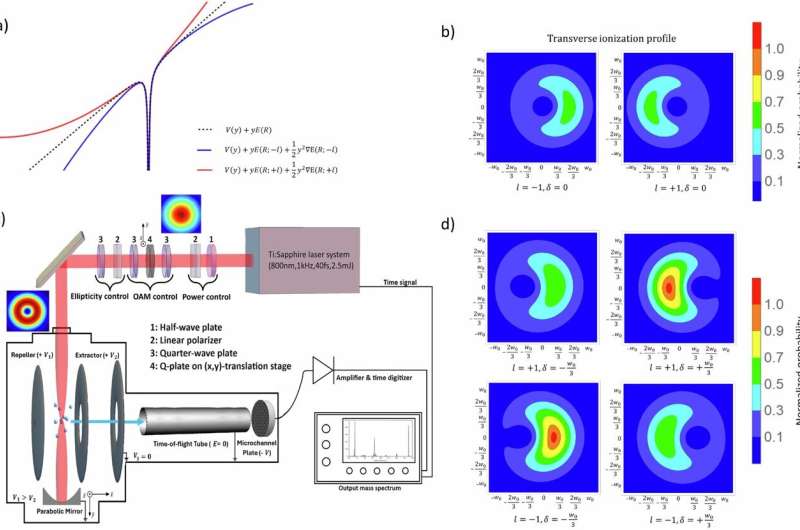
The research took place over two years at uOttawa’s Advanced Research Complex. The team found that the handedness and properties of the optical vortex beams significantly affect ionization rates. By adjusting the position of a “null intensity region” within the beam, they achieved selective ionization, introducing a novel concept called optical dichroism.
This work builds upon foundational theories in the field and has the potential to revolutionize how scientists approach ionization. This isn’t just for physics textbooks—it could lead to better medical imaging, faster computers, and more efficient ways to study materials. It’s especially promising for quantum computing, where controlling individual particles is crucial.
Professor Bhardwaj says, “Changing the way we think about how electrons are ejected has been challenging, but our research proves that using advanced laser technologies can lead to new discoveries that impact both science and technology.”
More information: Jean-Luc Bégin et al, Orbital angular momentum control of strong-field ionization in atoms and molecules, Nature Communications (2025). DOI: 10.1038/s41467-025-57618-8
Journal information: Nature Communications

I know this if off topic but I’m looking into starting my own weblog and was curious what all is required to get setup? I’m assuming having a blog like yours would cost a pretty penny? I’m not very internet smart so I’m not 100 certain. Any suggestions or advice would be greatly appreciated. Many thanks
Leave a Reply