
March 5, 2025 by Lauren Biron, Lawrence Berkeley National Laboratory
Collected at: https://phys.org/news/2025-03-nanodiamonds-droplets-boost-quantum-precision.html
Combine a garden-variety green laser, microwaves with roughly the energy of your wi-fi, and some diamond dust in drops of water, and what do you get? A precise chemical detection tool.
For the first time, researchers have combined nanodiamonds in microdroplets of liquid for quantum sensing. The new technique is precise, fast, sensitive, and requires only small amounts of the material to be studied—helpful when studying trace chemicals or individual cells. The results were published in the journal Science Advances in December.
“We weren’t even sure whether our technique would work, but it turned out to be surprisingly easy and effective,” said Ashok Ajoy, a faculty scientist in the Chemical Sciences Division at the Department of Energy’s Lawrence Berkeley National Laboratory (Berkeley Lab) and assistant professor at UC Berkeley who led the project. “There are broad applications where these sensors could be deployed into interesting environments and help you find something that would usually be hard to detect.”
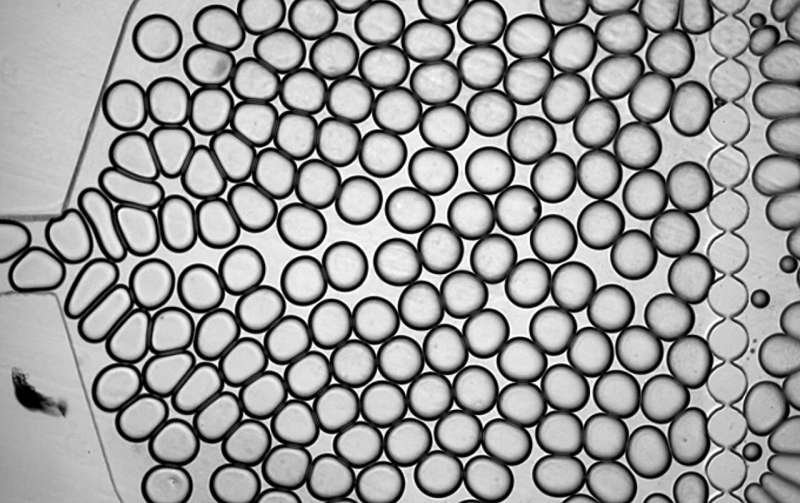
Quantum sensing takes advantage of unique properties that emerge at the smallest scales. In their new method, researchers make a series of microdroplets that are millions of times smaller than a raindrop. These are filled with a special kind of diamond where some of the carbon atoms are removed and nitrogen atoms are added.
These “nitrogen vacancies” act as quantum sensors and give the nanodiamonds a special property: as the droplets flow past a laser and are hit by microwaves, the nanodiamonds give off light. The amount of light in the presence of a microwave field is related to the materials around the nanodiamond, letting the researchers determine whether a chemical of interest is nearby.
The combination of flowing droplets and carefully modulated microwaves lets researchers ignore unwanted background noise and adds to their precision. When it comes to detecting trace amounts of slightly magnetic (or “paramagnetic”) chemicals in small sample volumes, the new flowing nanodiamond approach is already outperforming leading techniques.
(If you’re thinking that science has spared no expense, don’t fear—researchers can analyze hundreds of thousands of droplets for about 63 cents of diamond dust, making it both a relatively inexpensive and effective option.)
Small sensors, big applications
With further development, there are many potential ways to use the nanodiamonds in droplets.
In the new study, a team of researchers headed by UC Berkeley and Berkeley Lab graduate student Adrisha Sarkar and Berkeley Lab postdoc Zack Jones successfully showed they could pick up trace amounts of two paramagnetic species: gadolinium ions and TEMPOL, a stable radical molecule that is sensitive to oxygen.
Several other kinds of paramagnetic ions are of interest, but difficult to study using traditional techniques. Such is the case for reactive oxygen species (ROS), short-lived molecules of oxygen that have been linked to cell metabolism, aging, and stress. The new technique could prove a better way to detect reactive oxygen within single cells, giving experts a way to track cell health, with implications for studying diseases such as cancer. The team is already preparing for such a study.
They’re also looking at how to attach additional components that aid in identification (such as antibodies) to the nanodiamonds, expanding the tool for biological research. One can imagine using the technique to build better diagnostic tests to identify viruses when only trace amounts of the virus are present.
Or, because the method is relatively low-tech, Ajoy foresees a portable system that could be used to monitor the air or water for harmful trace contaminants and chemicals, either in the field or in industrial settings. Because the nanodiamond microdroplets are cheap and plentiful, the technique could be scaled up to measure hundreds of different samples with great sensitivity and address complex, real-world problems.
The new approach could also be useful for creating self-driving bioreactors of the future. Bioreactors create controlled environments for growing microorganisms that can make medicines, biofuels, or food ingredients. Because each droplet of nanodiamonds can act as a microscopic “beaker” and can hold a single cell, researchers could potentially use the technique to tune bioreactors.
“You can envision setting up bioreactors in austere environments around the world or in space, to make things like food that you couldn’t deliver on a daily basis,” said Deepti Tanjore, director of the Advanced Biofuels and Bioproducts Process Development Unit at Berkeley Lab. “Having precise quantum sensors that tell you how the microorganism culture is behaving is an important step toward that dream. To build a self-regulating bioreactor, we need that real-time intracellular data.”
The work brought together experts in chemistry, microfluidics, biosciences, and Earth sciences.
More information: Adrisha Sarkar et al, High-precision chemical quantum sensing in flowing monodisperse microdroplets, Science Advances (2024). DOI: 10.1126/sciadv.adp4033
Journal information: Science Advances

In this great pattern of things you receive a B+ just for effort. Where exactly you actually lost us ended up being on your facts. As they say, the devil is in the details… And it couldn’t be more correct in this article. Having said that, permit me say to you what did work. Your authoring is certainly really engaging which is probably why I am making the effort in order to comment. I do not really make it a regular habit of doing that. Next, although I can easily notice a leaps in reason you come up with, I am definitely not sure of exactly how you appear to unite your details which in turn make your final result. For now I will, no doubt yield to your issue however wish in the future you actually link your facts much better.
Leave a Reply