
By Amit Malewar 4 Mar, 2025
Collected at: https://www.techexplorist.com/researchers-cool-objects-detecting-absence-of-light/97401/
In a groundbreaking experiment, researchers at Imperial College London’s Department of Physics have uncovered a surprising method to cool objects by measuring the absence of photons. This discovery could open new avenues in quantum science and technology.
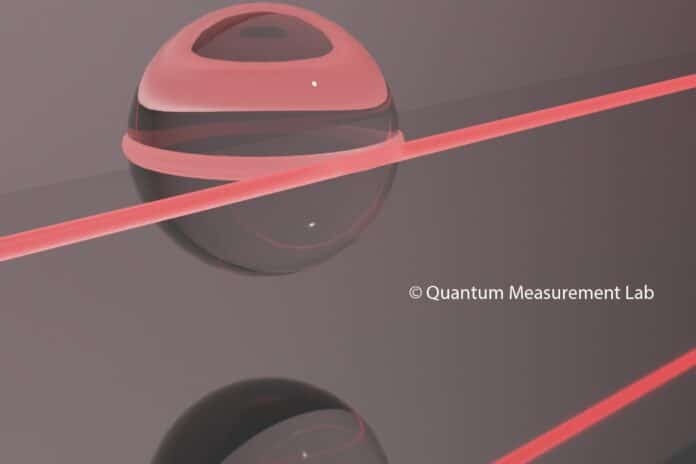
The team conducted experiments that coupled light and sound within a tiny glass bead, which is only four times wider than a human hair. By injecting light into the bead and measuring the absence of scattered light, they found that the object’s vibrations (or sound waves) were cooled more effectively than traditional laser cooling.
Named after the Whispering Gallery in St Paul’s Cathedral, the “whispering-gallery-mode resonators” trap light and sound long enough for them to interact. This interaction allows scientists to gather information about the sound waves by measuring the light leaving the glass sphere.
The researchers used single-photon detectors to determine whether the sound waves had scattered light particles (photons). Interestingly, when no photons were detected, the sound waves were quieter than usual, and when a single photon was detected, the sound waves were louder.
Evan Cryer-Jenkins, a co-first author from the Quantum Measurement Lab, explained that the result makes sense because light and sound correlate in their experiment. The information gained from measuring the light helps to cool the sound waves further.
In another twist, when light is not measured (represented by the closed eye symbol), the sound wave undergoes laser cooling. Surprisingly, detecting a single photon causes the sound wave to heat up, while detecting no photons makes the sound wave even colder than laser cooling alone.
Jack Clarke, another co-first author, noted that noticing the absence of something can be as informative as noticing its presence, similar to realizing it’s not raining or you’ve lost your keys.
This powerful laser light method for cooling objects can be applied to many systems, such as trapped atoms and ions. The team demonstrated that, using measurements, they could go beyond the usual limits of laser cooling.
Arjun Gupta, a co-first author from the lab, mentioned that quantum measurement is a fascinating field with many more discoveries.
Journal References
- Evan A. Cryer-Jenkins, Kyle Major, Jack Claerke et al. Enhanced Laser Cooling of a Mechanical Resonator via Zero-Photon Detection. Physical Review Letters DOI: 10.1103/PhysRevLett.134.073601
- Jack Clarke, Evan Cryer-Jenkins, Arjun Gupta et al. Theoretical framework for enhancing or enabling cooling of a mechanical resonator via the anti-Stokes or Stokes interaction and zero-photon detection. Physical Review A DOI: 10.1103/PhysRevA.111.023516


My partner and I absolutely love your blog and find the majority of your post’s to be just what I’m looking for. Does one offer guest writers to write content for you? I wouldn’t mind composing a post or elaborating on a lot of the subjects you write with regards to here. Again, awesome web site!


Leave a Reply