
Melissa Ait Lounis Published on February 21, 2025
Collected at: https://dailygalaxy.com/2025/02/misinterpreting-newton-first-law-300-years/
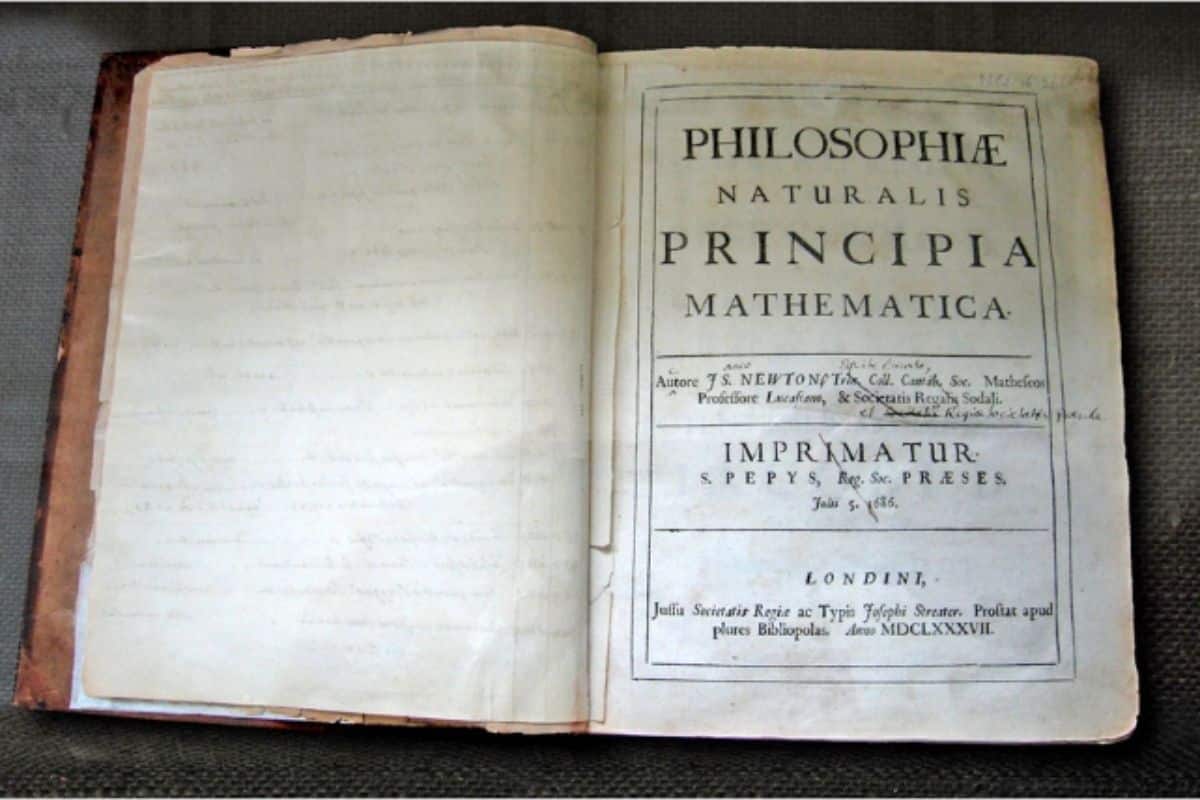
For nearly 300 years, Isaac Newton’s first law of motion has been one of the most fundamental principles in physics. But a new study suggests that a small mistranslation in its original English version may have led generations of scientists and educators to misunderstand its true meaning.
A Critical Mistranslation In Newton’s Work
Newton’s first law, often called the law of inertia, states that an object in motion will continue moving in a straight line—or remain at rest—unless acted upon by an external force. This widely accepted version comes from an early English translation of Newton’s Latin text, which has been cited in physics textbooks for generations.
However, Hoek discovered a key issue with this translation. The problem lies in the Latin word “quatenus,” which means “insofar as” but was incorrectly translated as “unless.” This seemingly minor mistake changes the entire way we interpret Newton’s statement.
Why It Changes Everything?
At first glance, this correction may seem insignificant. After all, Newton’s mathematical principles and laws of motion still work as intended. Also, the way we interpret and teach these concepts could be affected.
The widely accepted version of Newton’s first law implies that objects move freely unless something disturbs them. But Hoek’s revised interpretation suggests that Newton was not describing a hypothetical, force-free scenario. Instead, he was stating that all motion in the real world is constantly influenced by forces.
Why The Error Remained Unnoticed For Centuries?
The mistranslation of Newton’s work was actually discovered in 1999 by two scholars, but it never gained widespread recognition. Now, Hoek hopes to bring more attention to this overlooked detail.
Many physicists and scholars remain skeptical. Hoek says responses to his findings generally fall into two categories. “Some find my reading too wild and unconventional to take seriously. Others think that it is so obviously correct that it is barely worth arguing for,” said Hoek.
Newton’s Real Message?
Newton’s work was groundbreaking because it linked the motion of objects on Earth with the movement of celestial bodies. His laws demonstrated that the same forces govern everything from falling apples to orbiting planets.
One of the examples Newton used to illustrate his first law was a spinning top, which slows down over time due to air resistance. “Newton explicitly shows us how the First Law, as he understands it, applies to accelerating bodies which are subject to forces – that is, it applies to bodies in the real world,” noted the Virginia Tech philosopher.
If he truly meant that objects remain in uniform motion only insofar as no forces act upon them, it suggests that he fully recognized that all real-world motion is subject to constant external influences.
Hoek’s reinterpretation actually strengthens Newton’s ideas, reinforcing the fact that motion is never free from external forces—whether it’s a car coming to a stop due to friction, or a planet orbiting a star due to gravity.
Leave a Reply