
By Aalto University February 18, 2025
Collected at: https://scitechdaily.com/45x-faster-scientists-just-shattered-wave-speed-records/
Researchers have discovered ultra-fast “plastronic waves” on a water-repellent surface, traveling at unprecedented speeds.
This breakthrough opens the door to monitoring delicate gas layers that could transform biotechnology, materials science, and industrial efficiency.
A Breakthrough in Wave Speed
Ripples, like those formed by raindrops hitting a puddle, are known as capillary waves. These waves have been studied for centuries and continue to fascinate scientists today because they provide valuable insights into the surfaces they travel across. This makes them particularly useful in studying soft materials and biological systems, especially in microfluidic applications that examine fluid behavior on a microscopic scale.
Now, a team of physicists and biomedical researchers from Aalto University’s Department of Neuroscience and Biomedical Engineering and Department of Applied Physics has discovered new properties of capillary waves—setting a record for their speed in the process.
Their findings were published on February 12 in Nature Communications.
Superhydrophobic Surfaces and Their Secret Gas Layer
To make this discovery, the interdisciplinary team, led by Assistant Professor Heikki Nieminen and Professor Robin Ras, designed a synthetic surface inspired by lotus leaves. This surface, made from an extremely water-repellent material known as a superhydrophobic surface, traps a thin layer of gas—called a plastron—underwater. This microscopic gas layer not only helps protect the surface from corrosion and contamination but also enhances its hydrodynamic properties.
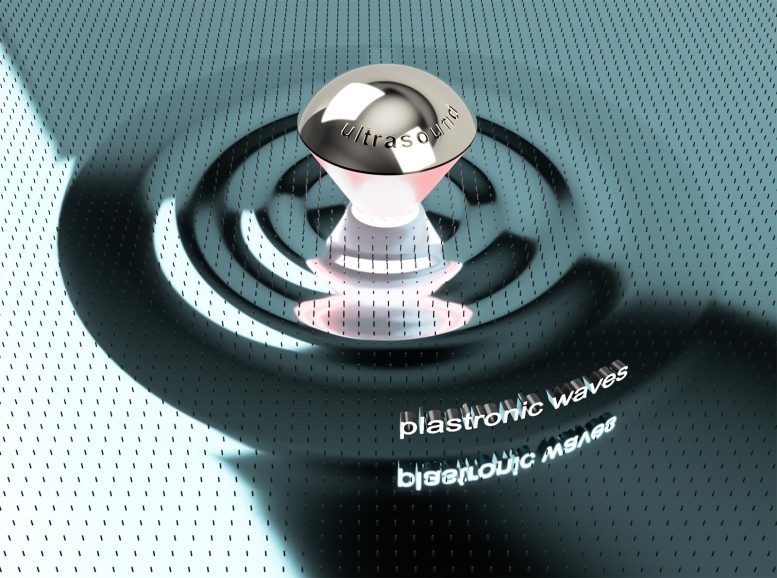
With the objective of deepening the understanding of superhydrophobicity, the team investigated the mechanical response of the plastron to highly focused ultrasound. In doing so, they generated ripples, which they dubbed “plastronic waves.”
Speeding Past the Limits of Capillary Waves
“Plastronic waves traveled along the water, the superhydrophobic surface, and the gas layer 45 times faster than capillary waves normally do,” Nieminen says.
Setting a wave speed record is only part of the result; using the same waves to monitor the plastron’s stability is another. Maintaining the delicate gas layer on top of the superhydrophobic surface is both highly important and very challenging.
“Superhydrophobicity relies on the plastron’s stability to open new possibilities in submerged applications, for example, in improving equipment lifespan and operational efficiency in both industrial and biomedical environments. Our new technique is a tool for monitoring the gas layer’s stability better than previously,” says the first author of the study, Postdoctoral Researcher Maxime Fauconnier, who also carried out the experiment.
Potential Applications in Biotechnology
In addition to furthering fundamental science, the discovery represents possible early stages for use in fields like biotechnology and materials science.
“We showed that we could measure how the plastron changes and gradually dissolves into the water, by monitoring the variation of wave speed over time. This system could be used as a sensor in other applications. It could be useful in pharmacology and cell technology, for example,” Fauconnier says.
Reference: “Fast capillary waves on an underwater superhydrophobic surface” by Maxime Fauconnier, Bhuvaneshwari Karunakaran, Alex Drago-González, William S. Y. Wong, Robin H. A. Ras and Heikki J. Nieminen, 12 February 2025, Nature Communications.
DOI: 10.1038/s41467-025-55907-w
The work was funded by the Research Council of Finland, the Finnish Cultural Foundation, and the European Union’s HORIZON research and innovation program.
Leave a Reply