
By Kenna Hughes-Castleberry, JILA February 23, 2025
Collected at: https://scitechdaily.com/the-secret-energy-inside-every-black-hole-is-more-powerful-than-we-thought/
Black holes are more than just cosmic vacuum cleaners — they are powerful energy engines capable of redistributing vast amounts of power.
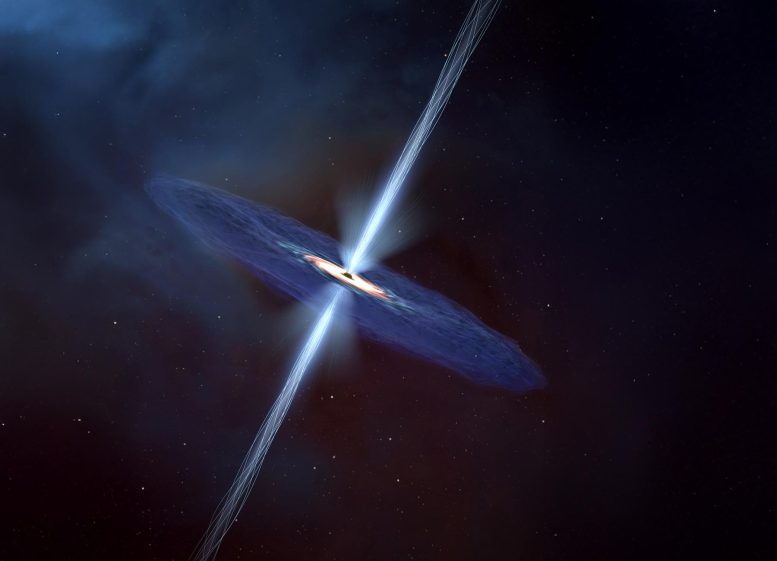
Black holes spin and extract energy through powerful magnetic fields, fueling the formation of energetic jets. Advanced simulations show that up to 70% of this energy can be redirected into space, influencing black hole brightness and galactic dynamics.
Unraveling the Power of Black Holes
Black holes have long fascinated scientists — not just as cosmic vacuum cleaners but as powerful energy engines capable of extracting and redistributing immense amounts of energy. These mysterious giants are often surrounded by swirling disks of gas and dust, known as accretion disks. When these disks become strongly magnetized, they can function like galactic power plants, drawing energy from the black hole’s spin through a process called the Blandford-Znajek (BZ) effect.
While researchers believe the BZ effect is the primary mechanism behind this energy extraction, many questions remain. It’s still unclear what determines how much energy is directed into powerful jets — streams of particles and radiation shooting out from the black hole’s poles — or instead lost as heat.
Advanced Simulations to Decode Black Hole Physics
To explore these mysteries, JILA postdoctoral researcher Prasun Dhang, along with JILA Fellows and University of Colorado Boulder astrophysics professors Mitch Begelman and Jason Dexter, turned to advanced computer simulations. By modeling black holes with thin, highly magnetized accretion disks, they aimed to uncover the underlying physics governing these extreme systems.
Their findings, published on February 14 in The Astrophysical Journal, provide key insights into black hole dynamics and could reshape our understanding of their influence on galaxy formation.
“It’s long been known that infalling gas can extract spin energy from a black hole,” elaborates Dexter. “Usually, we assume this is important for powering jets. By making more precise measurements, Prasun has shown there’s a lot more energy extracted than previously known. This energy could be radiated away as light, or it could cause gas to flow outwards. Either way, extracted spin energy could be an important energy source for lighting up the regions near the black hole event horizon.”
Comparing Black Hole to Black Hole
For decades, scientists have studied black holes and their interactions with surrounding gas and magnetic fields to understand how they power some of the universe’s most energetic phenomena. Early research focused primarily on low-luminosity black hole sources with quasi-spherical accretion flow as these systems are comparatively easier to simulate and align with many observed jets.
However, high-luminosity black holes with geometrically thinner, denser magnetized disks present a unique challenge. These systems are theoretically unstable due to imbalances in heating and cooling.
However, previous studies, including those by Mitch Begelman, suggested that strong magnetic fields might stabilize these thin disks, but the details of their role in energy extraction and jet formation remained unclear in such conditions.
“We wanted to understand how energy extraction works in these highly magnetized environments,” Dhang explains.
Simulating Magnetized Flows Around Black Holes
The team used advanced computer simulations to explore this phenomenon, specifically, a special type of model called the 3D general relativistic magnetohydrodynamic (GRMHD) model. The GRMHD model works as a computational framework that simulates the behavior of magnetized plasma in the curved spacetime around black holes, combining the physics of magnetic fields, fluid dynamics, and Einstein’s theory of general relativity to capture the complex interactions in these extreme environments. Using the framework, the researchers observed how magnetic fields interacted with black holes spinning at different speeds.
“The goal was to see how magnetic flux threading [permeating] the black hole impacts energy extraction and whether it leads to the formation of jets,” Dhang says.
The simulations modeled thin, magnetized accretion disks and examined how much energy the black hole transferred to its surroundings. By studying the efficiency of this energy extraction, the team identified various black hole spins and magnetic configurations with jets.
Manifestation of BZ power
From their simulations, the team found that depending on the black hole’s spin, between 10% and 70% of the energy extracted through the BZ process was channeled into jets.
“The higher the spin, the more energy the black hole can release,” Dhang notes.
However, not all energy went into jets; some was absorbed back into the disk or dissipated as heat.
While the simulations couldn’t determine where the excess energy went, Dhang plans to study this further to better understand how jets form, as jets are often found in active galactic nuclei systems such as quasars.
Mysteries Continue
From their models, the researchers found that the strong magnetic fields increased the disk’s radiative efficiency, making it brighter. This extra luminosity may explain why some black holes appear far more luminous than theoretical models predict.
“The unused energy close to the black hole could heat the disk and contribute to a corona,” Dhang notes.
The corona, a region of hot gas surrounding the black hole that emits intense X-rays, is crucial for shaping the light we observe from these systems, but its exact formation process remains unclear.
The researchers hope to use further simulations to understand the dynamics of making a black hole corona.
Reference: “Energy Extraction from a Black Hole by a Strongly Magnetized Thin Accretion Disk” by Prasun Dhang, Jason Dexter and Mitchell C. Begelman, 14 February 2025, The Astrophysical Journal.
DOI: 10.3847/1538-4357/ada76e
This work was supported by the National Science Foundation, the NASA Astrophysics Theory Program, and the Alfred P. Sloan Fellowship.
Leave a Reply