
By Mark Thompson, Universe Today February 22, 2025
Collected at: https://scitechdaily.com/astronomers-just-found-a-3-million-light-year-connection-between-galaxies/
A new breakthrough in cosmic mapping has unveiled the structure of a colossal filament, part of the vast cosmic web that connects galaxies.
Dark matter and gas shape these filaments, but their faint glow makes them hard to detect. By using advanced telescope technology and hundreds of hours of observation, astronomers have captured the most detailed image yet, bringing us closer to decoding the evolution of galaxies and the hidden forces shaping the universe.
The Hidden Order of the Universe
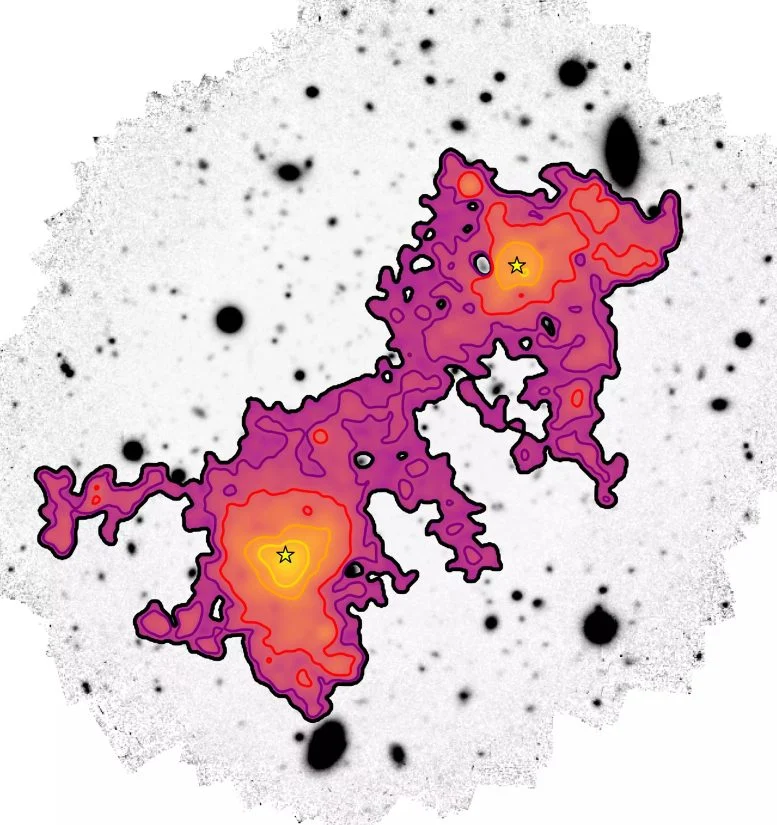
At first glance, the universe may appear to be a chaotic swarm of scattered galaxies. But in reality, they are part of a vast, interconnected structure known as the cosmic web — the largest framework in the cosmos. This web is made up of enormous filaments of dark matter and gas, stretching between galaxies and surrounding vast empty voids. Now, after hundreds of hours of telescope observations, astronomers have captured the highest-resolution image ever taken of a single cosmic filament linking forming galaxies. This filament is so distant that we see it as it was when the universe was just 2 billion years old.
Dark Matter: The Invisible Architect
Dark matter, which makes up about 85% of the universe’s total matter, is largely invisible — it doesn’t emit, absorb, or reflect light. Instead, its presence is only detectable through its gravitational influence on galaxies and other cosmic structures. Dark matter plays a key role in shaping the large-scale structure of the universe, forming the backbone of the cosmic web. Scientists have been studying this web using simulations and gravitational lensing techniques to better understand dark matter and its crucial role in the evolution of the universe.

The Challenge of Mapping the Cosmic Web
One of the biggest challenges that astronomers face studying the cosmic web is that the gas has mainly been detected through its absorption of light from a more distant object. The results of such studies however do not help us to understand the distribution of gas in the web. Studies that focus on hydrogen which is the most common element in the universe, can only be detected from a very faint glow so that previous attempts to map its distribution have failed.
Revealing the Web: Advanced Telescope Technology
This new paper was published by a team of researchers led by scientists from the University of Milano-Bicocca and included members from the Max Planck Institute for Astrophysics. The team employed the use of the Multi-Unit Spectroscopic Explorer (MUSE) on the Very Large Telescope at the European Southern Observatory in Chile. The instrument was designed to capture 3D data of astronomical objects by combining images and spectroscopic observations across thousands of wavelengths simultaneously. Even with the capabilities of MUSE, the team had to capture data over hundreds of hours to reveal sufficient detail in the filaments of the cosmic web.

A Cosmic Filament Spanning 3 Million Light-Years
The team was led by PhD student at the University of Milano-Bicocca Davide Tornotti and they used MUSE to study a filament that measures 3 million light-years in length. The filament connects two galaxies, each with a supermassive black hole deep in their core. They were able to demonstrate a new way of mapping the intergalactic filaments, helping to understand more about galactic formation and the evolution of the universe.
Simulations Confirm the Observations
Before they were able to start collecting the data, the team were able to run simulations of the emissions from filaments based upon the current model of the universe. They were then able to compare the results and both were remarkably similar. The discovery can help us to learn how galaxies in the cosmic web are fuelled but the team assert that they still need more data. More structures are now being uncovered as the techniques are repeated with the goal to finally reveal how gas is distributed among the cosmic web.
Adapted from an article originally published on Universe Today.
Explore Further: First Direct Image of the Cosmic Web Reveals the Universe’s Hidden Highways
Reference: “High-definition imaging of a filamentary connection between a close quasar pair at z = 3” by Davide Tornotti, Michele Fumagalli, Matteo Fossati, Alejandro Benitez-Llambay, David Izquierdo-Villalba, Andrea Travascio, Fabrizio Arrigoni Battaia, Sebastiano Cantalupo, Alexander Beckett, Silvia Bonoli, Pratika Dayal, Valentina D’Odorico, Rajeshwari Dutta, Elisabeta Lusso, Celine Peroux, Marc Rafelski, Mitchell Revalski, Daniele Spinoso and Mark Swinbank, 29 January 2025, Nature Astronomy.
DOI: 10.1038/s41550-024-02463-w
Leave a Reply