
Tanya Weaver Thu 20 Feb 2025
Collected at: https://eandt.theiet.org/2025/02/20/accelerating-development-next-gen-perovskite-solar-cells
A new manufacturing technique paves the way for low-cost and scaleable solar generation, according to new research by the University of Sheffield.
While solar power is deemed an environmentally friendly technology, the materials used to manufacture solar panels may have a significant environmental impact. Often these are scarce and expensive elements, such as copper and indium, that need to be mined and refined.
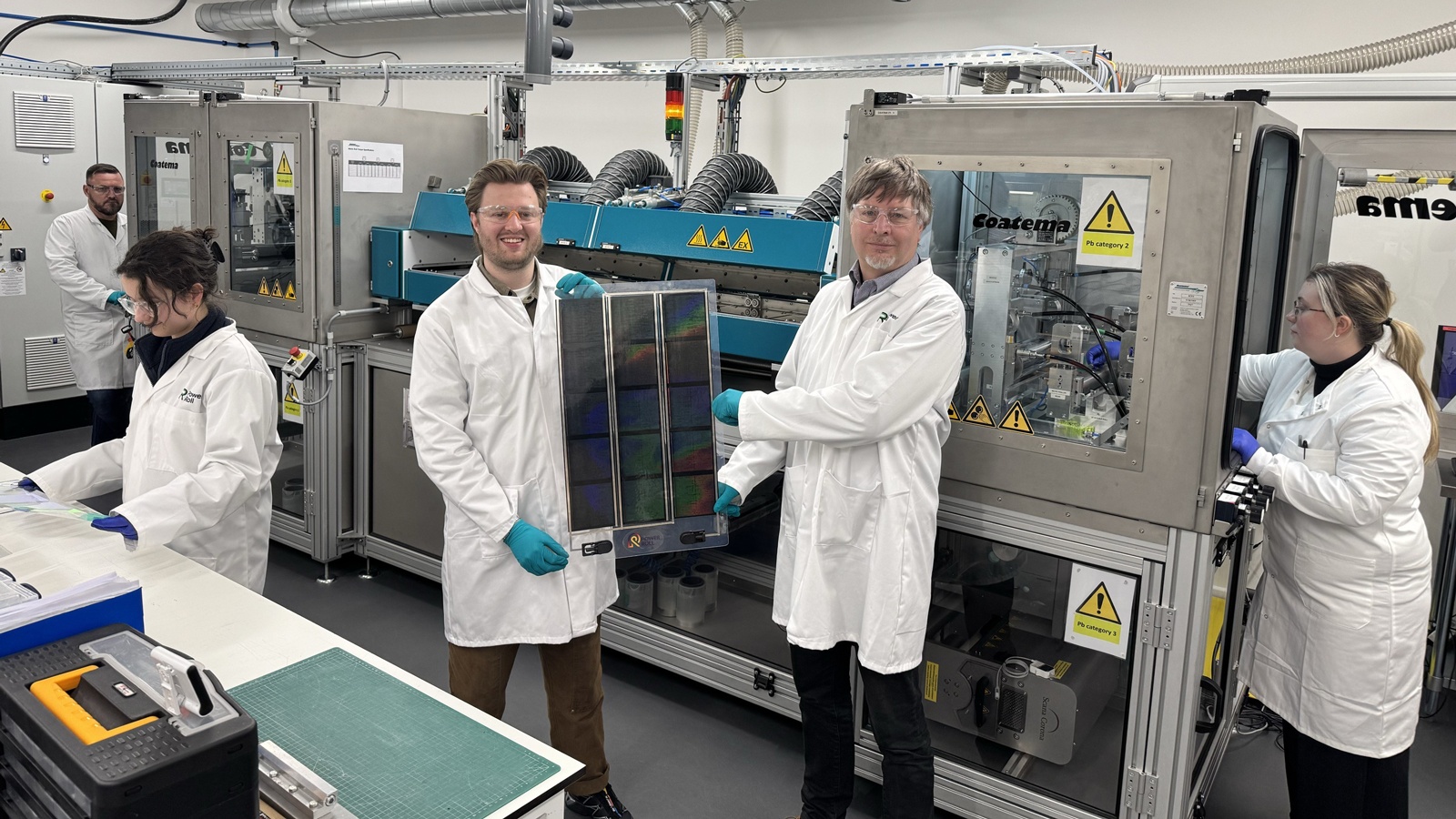
UK-based solar tech firm Power Roll is developing lightweight and flexible solar cells made from perovskite materials.
The use of perovskite materials in solar energy is the subject of increasing research and investment, as these materials are flexible, lightweight, cheap to produce, scalable and as efficient as today’s leading solar photovoltaic materials, which are mainly silicon.
Perovskite solar cells can also be easily deposited on to most surfaces, including rooftops and other unconventional surfaces unable to stand the weight of conventional solar panels.
Power Roll has been collaborating with researchers at the University of Sheffield for over 10 years to further progress the understanding of the use of perovskites in solar energy generation. The result is the development of a new solar cell.
This solar cell is made by embossing tiny grooves into a plastic film and then filling them with a perovskite material.
While regular devices use a sandwich structure composed of a number of layers deposited in a specific order, this new microgroove structure creates a solar cell that has a back-contact format.
The back-contact cells have all the electrical contacts on the back of the device, making it easier and cheaper to manufacture, with the potential for high efficiency.
To check the structure and composition of the solar cells, the research team used a Hard X-ray nanoprobe microscope from Oxfordshire-based Diamond Light Source to take very detailed images of the solar cells.
These also helped to spot hidden problems such as empty spaces, flaws and the boundaries between tiny crystals within the semiconductor material.
Professor David Lidzey, from the school of mathematical and physical sciences at the University of Sheffield, said: “A key advantage of these flexible films is that the panel can be stuck onto any surface.
“In the UK, you currently have to think twice about adding thick solar panels on to relatively fragile roofs of warehouses that are not really designed to be load-bearing. With this lightweight solar technology, you could essentially stick it anywhere. This could be a game-changer for solar energy in low and middle income countries.”
Dr Nathan Hill, research scientist at Power Roll, said: “We are advancing technology that could play a significant role in achieving global net zero targets, and by combining our collective research and academic capabilities we are able to further prove out the science sitting behind Power Roll’s technology.”
The next phase of the work on this project will be to further develop the use of X-ray microscopy in characterising these materials. New experiments are scheduled this summer, at Diamond Light Source, to help understand key aspects of device operation, particularly stability.
Leave a Reply