
February 13, 2025 by Journal of Remote Sensing
Collected at: https://phys.org/news/2025-02-explores-future-large-scale-high.html
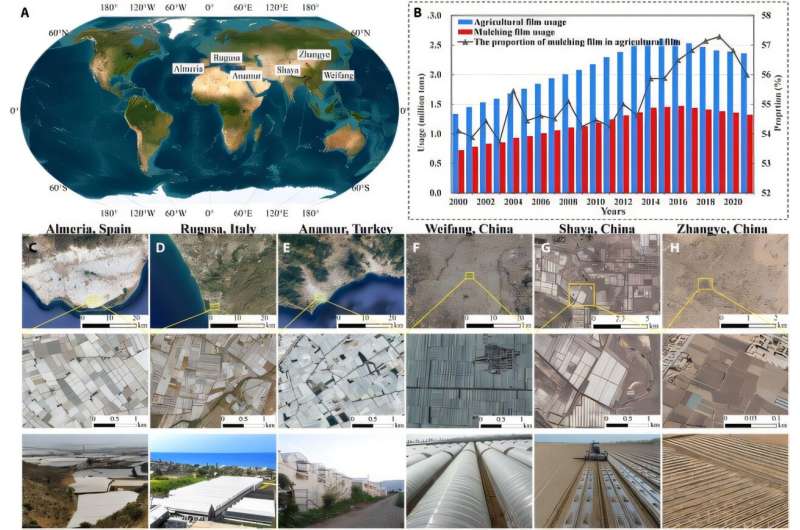
Agricultural films are essential for boosting land productivity, yet their widespread use has raised significant ecological concerns. To address these challenges, accurate mapping of agricultural films is crucial for both strategic agricultural planning and environmental impact assessment.
A recent study has sorted out the research dynamics of agricultural film mapping and emphasized the future direction of large-scale, long-term, and high-precision agricultural film mapping by visualizing the evolution of remote sensing data, analyzing the spectral-temporal-spatial characteristics of plastic greenhouses (PGs) and plastic-mulched farmland (PMF), and comparing the advantages and disadvantages of existing mapping methods.
Agricultural films, essential for enhancing crop productivity, have raised significant ecological concerns due to their environmental impact. There are some problems, i.e., the diversity of film types, the difference of coverage time, and the variation of spectral properties, which lead to the scarcity of large-scale PGs and PMF maps despite numerous efforts in agricultural film mapping.
As the demand for sustainable agricultural practices grows, accurate and scalable mapping solutions have become a critical need. Based on these challenges, there is a pressing need for in-depth research into new methodologies that can address these issues and improve the precision and applicability of agricultural film mapping.
On January 30, 2025, a research team from the Institute of Geographic Sciences and Natural Resources Research at the Chinese Academy of Sciences published a new paper in the Journal of Remote Sensing. Their study not only used bibliometric methods to sort out the research dynamics of agricultural film mapping since 2000, visualized the evolution of remote sensing data, but also analyzed the spectral-temporal-spatial characteristics of PGs and PMF, compared the advantages and disadvantages of existing mapping methods, and further emphasized the future directions of large-scale, long-time series, high-precision agricultural film mapping.
The team conducted a bibliometric analysis on the research dynamics of agricultural film mapping. The number of publications on agricultural film mapping has grown exponentially from 2000 to 2023, which indicates that the topic has received significant attention and research interest in recent years.
The study systematically organized and visualized the evolution of remote sensing data sources for agricultural film mapping since 2000, including high-resolution optical images (such as QuickBird and WorldView), medium-resolution satellite data (like Landsat and Sentinel-2), and radar data (e.g., Radarsat-2). Their findings revealed that medium- and low-resolution images were used for large-scale and long-term PGs and PMF mapping, while high-resolution images were combined with deep learning to extract local deep information.
This study conducted an in-depth analysis of the spectral-temporal-spatial characteristics of PGs and PMF. The reflectance of PGs is between that of impervious surfaces and vegetation. PMF are usually the mixture of mulching films and soil, and their spectra are often the combinations of the two. Spectral features are considered crucial variables in agricultural film mapping, with spectral indices offering stable performance over time. Spectral features alone are insufficient to accurately identify agricultural film.
Both PGs and PMF exhibit significant variation in spatial and optical characteristics across different regions. The incorporation of temporal and spatial features is helpful to improve classification accuracy, especially through object-based classification methods.
This study also compared the advantages and disadvantages of existing mapping methods. Supervised classifiers provided higher accuracy than unsupervised classifiers. Deep learning based on high-resolution images has greatly improved the accuracy of agricultural film mapping, but it is mostly used for PGs extraction in typical regions.
The study further emphasized the future direction of large-scale, long-time series, high-precision agricultural film mapping. Future research should focus on integrating multi-source data, expanding sample datasets, constructing robust algorithms, separating types, and extracting coverage time of agricultural film. A long-time series dataset with high accuracy will provide valuable information and scientific guidance for effective land management and eco-environmental protection.
“This review synthesizes critical advancements in agricultural film mapping, identifies existing research gaps, and provides fresh perspectives for producing national or global agricultural film maps,” said the lead researcher.
“These insights provide a scientific foundation for monitoring agricultural film, optimizing land management, and mitigating environmental risks. Looking ahead, prioritizing global collaborations to harmonize multi-source datasets and adaptive algorithms will be essential to advance sustainable agriculture and evidence-based policymaking.”
The accurate and timely agricultural film maps are expected to support effective land management, rationalize human land use behavior, and inform policy formulation for environmental sustainability. This study can provide a comprehensive understanding of the current state of agricultural film mapping and future directions of large-scale, long-term, and high-precision agricultural film mapping.
More information: Mengmeng Zhang et al, A Review of Agricultural Film Mapping: Current Status, Challenges, and Future Directions, Journal of Remote Sensing (2024). DOI: 10.34133/remotesensing.0395


I’ve been exploring for a little bit for any high-quality articles or blog posts in this sort of house . Exploring in Yahoo I at last stumbled upon this site. Studying this information So i’m satisfied to convey that I have a very good uncanny feeling I discovered exactly what I needed. I so much for sure will make sure to don’t put out of your mind this website and provides it a look regularly.


Leave a Reply