
By The City College of New York January 26, 2025
Collected at: https://scitechdaily.com/hydrogen-ions-are-revolutionizing-quantum-tech-heres-how/
Researchers have discovered an innovative way to manipulate electronic properties in a magnetic Weyl semimetal using hydrogen ions.
By adjusting the material’s electronic bandstructures, they can control the chirality of electron transport, opening possibilities for groundbreaking applications in quantum computing and nano-spintronics.
A New Way to Manipulate Topological Materials
A team of physicists at The City College of New York, led by Lia Krusin-Elbaum, has developed an innovative technique using hydrogen cations (H⁺) to control the electronic properties of a magnetic Weyl semimetal. This type of material, known as a topological material, allows electrons to behave like massless particles called Weyl fermions. These unique particles exhibit a property known as chirality, or “handedness,” which links their spin and momentum.
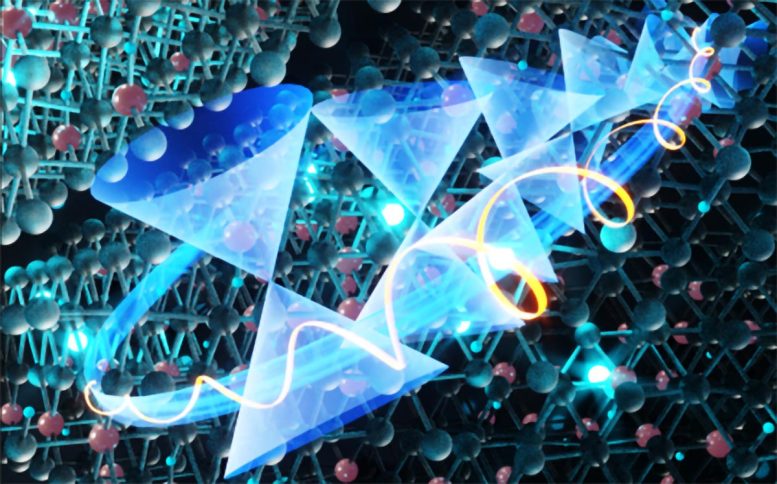
The researchers focused on the magnetic material MnSb2Te4, where they discovered that introducing hydrogen ions can effectively “tune” and enhance the chirality of electron transport. This process reshapes the material’s energy features, known as Weyl nodes, in a controllable way. Their discovery could pave the way for new quantum devices that leverage topological states, with potential applications in advanced chiral nano-spintronics and fault-tolerant quantum computing.
Their findings, published in Nature Communications under the title “Transport chirality generated by a tunable tilt of Weyl nodes in a van der Waals topological magnet,” demonstrate the potential of this technique to expand the possibilities of quantum technology.
Tuning Weyl Nodes for Enhanced Performance
The tuning of Weyl nodes with H+ heals the system’s (Mn-Te) bond disorder and lowers the internode scattering. In this process — which The City College team tests in the Krusin Lab using angularly-resolved electrical transport — electrical charges move differently when the in-plane magnetic field is rotated clockwise or counterclockwise, generating desirable low-dissipation currents. The reshaped Weyl states feature a doubled Curie temperature and a strong angular transport chirality synchronous with a rare field-antisymmetric longitudinal resistance — a low-field tunable ‘chiral switch’ that is rooted in the interplay of topological Berry curvature, chiral anomaly, and a hydrogen-mediated form of Weyl nodes.
“The major advance of this work is enlarging the breadth of designer topological quantum materials beyond nature’s blueprint. Tunable topological bandstructures facilitated by hydrogen or other light elements through defect-related pathways expand the availability of accessible platforms for exploring and harnessing topological phases with stunning macroscopic behaviors, opening a path to a potentially disruptive chirality-based implementations in future quantum devices,” said Krusin-Elbaum, professor in CCNY’s Division of Science.
Toward the Future of Quantum Devices
The research in the Krusin Lab centers on exploring novel quantum phenomena such as Quantum Anomalous Hall (QAH) effect, which describes an insulator that conducts dissipationless current in discrete channels on its surfaces, 2D superconductivity, and axion state phenomena featuring a quantized thermal transport, all with the potential if industrialized to advance energy-efficient technologies. Krusin-Elbaum and her team said that the technique they have demonstrated is very general and ultimately may advance the potential of intrinsic topological magnets to transform future quantum electronics.
Reference: “Transport chirality generated by a tunable tilt of Weyl nodes in a van der Waals topological magnet” by Afrin N. Tamanna, Ayesha Lakra, Xiaxin Ding, Entela Buzi, Kyungwha Park, Kamil Sobczak, Haiming Deng, Gargee Sharma, Sumanta Tewari and Lia Krusin-Elbaum, 13 November 2024, Nature Communications.
DOI: 10.1038/s41467-024-53319-w
The CCNY-based Harlem Center for Quantum Materials is a partner in the research. It strives to solve fundamental problems in novel functional materials systems that have vital scientific and technological importance. The research is supported in part by the National Science Foundation.
Leave a Reply