
By University of Geneva January 25, 2025
Collected at: https://scitechdaily.com/secrets-of-hot-jupiters-revealed-wasp-132-breaks-the-rules-of-planetary-systems/
New research has revealed that Hot Jupiters do not always push away or destroy nearby planets during their migration. This surprising finding changes our understanding of how planetary systems form and evolve, offering a fresh perspective on their complex structures.
Hot Jupiters, once thought to orbit their stars alone, were believed to either consume or eject any nearby planets during their inward migration. However, recent discoveries have upended this idea, and a new study from the University of Geneva (UNIGE) delivers compelling evidence for a more complex reality.
Collaborating with the National Centre of Competence in Research (NCCR) PlanetS, the Universities of Bern (UNIBE) and Zurich (UZH), and several international institutions, researchers have uncovered a surprising planetary system, WASP-132. This system features not just a Hot Jupiter but also an inner Super-Earth and a distant icy giant.
Published in Astronomy & Astrophysics, these findings challenge existing theories about Hot Jupiter migration and highlight the diverse architectures planetary systems can achieve.

Understanding Hot Jupiters and Their Formation
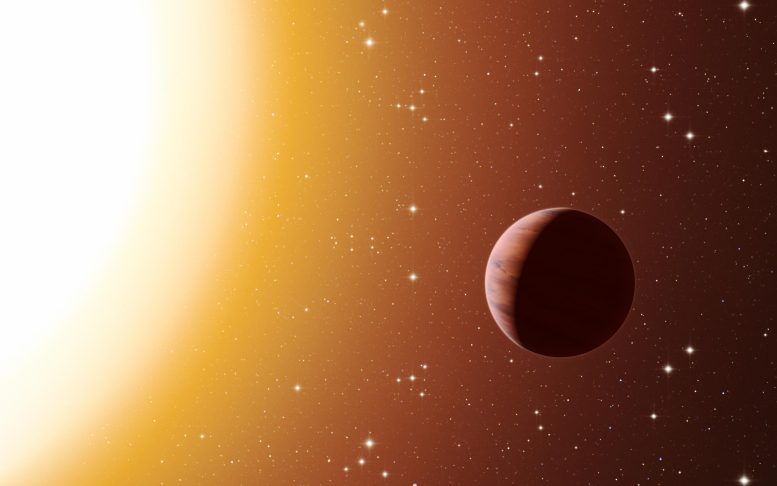
Hot Jupiters are giant planets with masses comparable to Jupiter but orbiting much closer to their star than Mercury is to the Sun. Such extreme proximity makes it unlikely for these planets to form where they are observed, as there isn’t enough gas and dust near the star to support their formation. Instead, they likely form farther out in the system and migrate inward over time as the planetary system evolves.
“These results provide important constraints on theories of planet formation.”
Until recently, astronomers observed that Hot Jupiters were isolated around their star, with no other planets in their vicinity. This observation was supported by a theory suggesting that the inward migration of giant planets either ejects or consumes any inner planets during the process. However, new observations are challenging this assumption.

A team led by the University of Geneva (UNIGE) Faculty of Science, in collaboration with the Universities of Bern (UNIBE), Zurich (UZH), and international partners including the University of Warwick, has discovered a remarkable multi-planetary system. This system includes a Hot Jupiter, an inner Super-Earth even closer to the star, and a massive outer giant planet much farther away. These findings suggest that Hot Jupiters may not always be isolated, and their migration process must allow for the preservation of such complex planetary arrangements.
Discovery of a Multi-Planetary System
The WASP-132 system is a unique multi-planetary system. It contains a Hot Jupiter that orbits its star in 7 days and 3 hours; a Super-Earth (a rocky planet 6 times the mass of the Earth) that orbits the star in just 24 hours and 17 minutes; and a giant planet (5 times the mass of Jupiter) that orbits the host star in 5 years. In addition, a much more massive companion, probably a brown dwarf (a celestial body whose mass is between that of a planet and that of a star), orbits at a very long distance.
“The WASP-132 system is a remarkable laboratory for studying the formation and evolution of multi-planetary systems. The discovery of a Hot Jupiter alongside an inner Super-Earth and a distant giant planet calls into question our understanding of the formation and evolution of these systems,” says François Bouchy, associate professor in the Department of Astronomy at the UNIGE Faculty of Science and co-author of the study. “This is the first time we have observed such a configuration!,” adds Solène Ulmer-Moll, a postdoctoral researcher at UNIGE and UNIBE at the time of the study and co-author of the paper.

Long-Term Observations Reveal Complex Systems
For exoplanetologists, the story of the star WASP-132 began in 2006, as part of the Wide-Angle Search for Planets (WASP) program. In 2012, the accumulation of more than 23,000 photometric measurements made it possible to identify a planetary candidate, WASP-132b, with a radius of 0.87 times Jupiter’s and an orbital period of 7.1 days. In 2014, the CORALIE spectrograph, installed on the Swiss Euler telescope and led by the UNIGE, began a campaign to monitor this candidate. In 2016, WASP-132b was confirmed and its mass was measured to be equal to 0.41 Jupiter masses. Furthermore, the CORALIE measurements indicate the presence of another giant planet with a very long period.
Around the same star, at the end of 2021, the TESS space telescope revealed the signal from a transiting Super-Earth with a diameter of 1.8 Earth radii and a period of only 1.01 days. In the first half of 2022, the HARPS spectrograph at the La Silla observatory measured the mass of this Super-Earth, which is six times the mass of Earth, as part of a program led by David Armstrong from the University of Warwick.

“The detection of the inner Super-Earth was particularly exciting,” explains Nolan Grieves, a postdoctoral researcher in the Department of Astronomy at the UNIGE Faculty of Science at the time of the study, and first author of the paper. “We had to carry out an intensive campaign using HARPS and optimized signal processing to characterize its mass, density, and composition, revealing a planet with a density similar to that of the Earth.”
Observations of WASP-132 are not over yet, however, as ESA’s Gaia satellite has been measuring the minute variations in the positions of stars since 2014, with an aim to reveal their planetary companions and outer brown dwarfs.
Revising Theories with New Findings
The discovery of an outer cold giant planet and an inner Super-Earth adds another layer of complexity to the WASP-132 system. The standard hypothesis of migration by dynamical perturbation of the Hot Jupiter towards the interior does not hold, as this would have destabilized the orbits of the other two planets. Instead, their presence suggests a more stable and dynamically “cool” migration path in a proto-planetary disc for the hot Jupiter, preserving its neighbors.
The combination of precise radius and mass measurements has also made it possible to determine the density and internal composition of the planets. The Hot Jupiter WASP-132b reveals a heavy element enrichment of around 17 Earth masses, in agreement with models of gas giant formation. The Super-Earth has a composition dominated by metals and silicates that is fairly similar to that of the Earth.

“The combination of a Hot Jupiter, an inner Super-Earth, and an outer giant planet in the same system provides important constraints on theories of planet formation and in particular their migration processes,” concludes Ravit Helled, professor at the UZH and co-author of the study. “WASP-132 demonstrates the diversity and complexity of multi-planetary systems, underlining the need for very long-term, high-precision observations.”
Reference: “Discovery of a cold giant planet and mass measurement of a hot super-Earth in the multi-planetary system WASP-132” by Nolan Grieves, François Bouchy, David J. Armstrong, Babatunde Akinsanmi, Angelica Psaridi, Solène Ulmer-Moll, Yolanda G. C. Frensch, Ravit Helled, Simon Müller, Henrik Knierim, Nuno C. Santos, Vardan Adibekyan, Léna Parc, Monika Lendl, Matthew P. Battley, Nicolas Unger, Guillaume Chaverot, Daniel Bayliss, Xavier Dumusque, Faith Hawthorn, Pedro Figueira, Marcelo Aron Fetzner Keniger, Jorge Lillo-Box, Louise Dyregaard Nielsen, Ares Osborn, Sérgio G. Sousa, Paul Strøm and Stéphane Udry, 15 January 2025, Astronomy & Astrophysics.
DOI: 10.1051/0004-6361/202348177
Leave a Reply