

By The University of Hong Kong January 24, 2025
Collected at: https://scitechdaily.com/revolutionary-microscopy-unlocks-the-secrets-of-quantum-entanglement/
Scientists have developed ‘entanglement microscopy,’ a technique that maps quantum entanglement at a microscopic level.
By studying the deep connections between particles, researchers can now visualize the hidden structures of quantum matter, offering new perspectives on particle interaction that could revolutionize technology and our understanding of the universe.
Quantum entanglement is a fascinating phenomenon where particles remain mysteriously linked, even when separated by vast distances. Understanding how this connection works, especially in complex quantum systems, has been a long-standing challenge in physics.
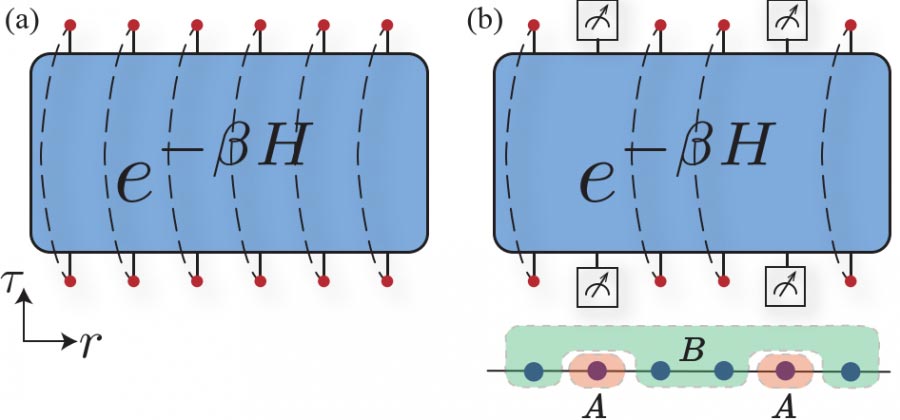
Researchers from the Department of Physics at The University of Hong Kong (HKU), along with their collaborators, have recently developed an innovative algorithm called entanglement microscopy. This breakthrough technique allows scientists to visualize and map entanglement at a microscopic level. By closely examining the intricate interactions between entangled particles, this method reveals hidden structures within quantum matter — offering new insights that could revolutionize technology and expand our understanding of the universe.

This study, led by Professor Zi Yang Meng and co-authored by his PhD students Ting-Tung Wang and Menghan Song of HKU Department of Physics, in collaboration with Professor William Witczak-Krempa and PhD student Liuke Lyu from the University of Montreal, unveils the hidden structures of quantum entanglement in many-body systems, offering a fresh perspective on the behavior of quantum matter. Their findings were recently published in the prestigious journal Nature Communications.
A Breakthrough in Mapping Quantum Entanglement
Quantum entanglement describes a deep connection between particles, where the state of one particle is instantly linked to another, even across vast distances. Imagine rolling two dice in different locations—quantum entanglement is like finding that the outcome of one die always determines the outcome of the other, no matter how far apart they are. This phenomenon, famously called ‘spooky action at a distance’ by Albert Einstein, is not just a theoretical curiosity but underpins technologies like quantum computing, cryptography, and the study of exotic materials and black holes. However, it is intrinsically difficult to obtain the entanglement information in quantum many-body systems both analytically and numerically due to the exponentially large degree of freedoms.
Researchers have addressed this challenge by developing ‘entanglement microscopy’, an innovative protocol based on large-scale quantum Monte Carlo simulation that can successfully extract the quantum entanglement information in small regions of quantum systems. By focusing on these microscopic areas, this method reveals how particles interact and organize themselves in intricate ways, especially near critical points in quantum phase transitions—special states where quantum systems undergo profound changes in behavior.

Their exploration focused on two prominent models at two-dimension: the transverse field Ising model and fermionic t-V model that realizes the Gross-Neveu-Yukawa transition of Dirac fermions, each revealing fascinating insights into the nature of quantum entanglement. They discovered that at the Ising quantum critical point, entanglement is short-range, meaning particles are connected only over small distances. This connection can abruptly vanish due to changes in distance or temperature—a phenomenon known as ‘sudden death’. In contrast, their investigation of the fermionic transition revealed a more gradual decline in entanglement even at larger separations, indicating that particles can maintain connections despite being far apart.
Intriguingly, the team discovered that in two-dimensional Ising transitions, three-party entanglement was absent, yet present in one-dimensional systems. This implies that system dimensionality significantly affects entanglement behavior. To simplify, low-dimensional systems are akin to a small group of friends where deep connections (complex multi-particle entanglement) are more probable. Conversely, high-dimensional systems, comparable to larger, more complex social networks, often suppress such connections. These findings provide important understanding of how entanglement structure alters with increasing system complexity.
Applications and Impact
This breakthrough has significant implications for advancing quantum technologies. By providing a clearer understanding of entanglement, it could help optimize quantum computing hardware and algorithms, enabling faster problem-solving in fields like cryptography and artificial intelligence. It also opens the door to designing next-generation quantum materials with applications in energy, electronics, and superconductivity. Furthermore, this tool could deepen our understanding of fundamental physics and improve quantum simulations in chemistry and biology.
The findings are detailed in the paper ‘Entanglement microscopy and tomography in many-body systems’, published in the journal Nature Communications.
Reference: “Entanglement microscopy and tomography in many-body systems” by Ting-Tung Wang, Menghan Song, Liuke Lyu, William Witczak-Krempa and Zi Yang Meng, 2 January 2025, Nature Communications.
DOI: 10.1038/s41467-024-55354-z
Leave a Reply