
By Doshisha University January 16, 2025
Collected at: https://scitechdaily.com/safer-stronger-smarter-scientists-develop-game-changing-quasi-solid-battery/
Researchers have developed a quasi-solid-state lithium-ion battery that offers enhanced stability, safety, and a longer lifespan.
Technological advancements have driven the widespread adoption of electric devices and vehicles. These innovations offer not only convenience but also environmental benefits by providing cleaner alternatives to fuel-powered machines. Lithium-ion batteries (LIBs) are the primary energy source for many electronic devices and electric vehicles. Commercial LIBs typically use an organic electrolyte solution, which is essential for achieving high energy efficiency. However, meeting safety standards becomes increasingly challenging as market demand grows.
Solid-state batteries present a safer alternative by eliminating flammable liquid electrolytes. However, the interface between solid electrodes and solid electrolytes often hinders efficient lithium-ion transfer. Additionally, the expansion and contraction of solid electrodes during charging and discharging can damage the interface, further impeding ion flow. To address these challenges, there is a critical need to develop advanced solid-state batteries with stable and efficient interfaces that improve safety, functionality, and overall performance.
Development of a Safer Quasi-Solid-State Battery
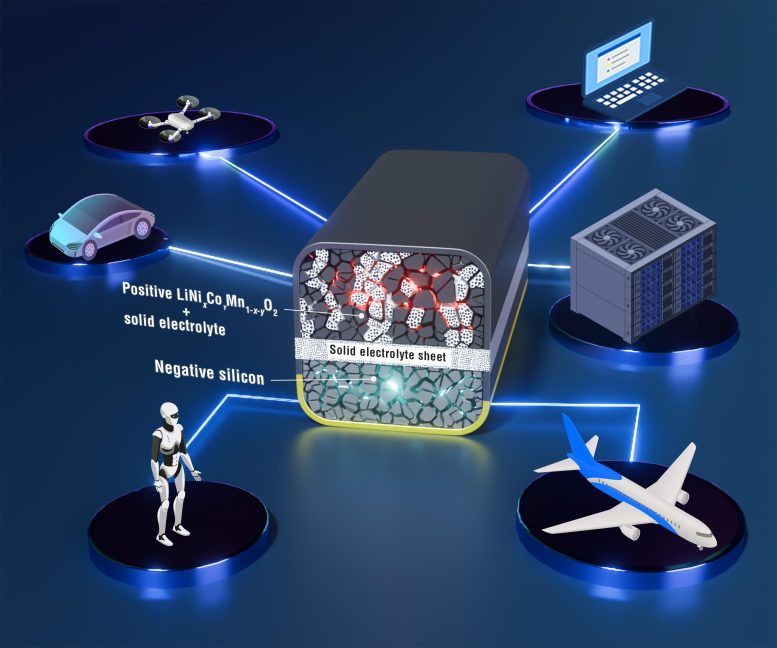
To overcome these challenges, a team of researchers from Japan has developed a non-flammable quasi-solid-state LIB that can overcome the limitations of conventional batteries. The study was led by Ryosuke Kido from Doshisha University and TDK Corporation, Japan, Professor Minoru Inaba and Professor Takayuki Doi from Doshisha University, and Atsushi Sano from TDK Corporation and their findings were published online on 11 October 2024, in the Journal of Energy Storage. It has also been published in the Volume 102 on 15 November 2024.
Giving further insight into their work, Mr. Kido the main author of the paper, says, “Increasing the capacity of positive and negative electrode active materials to achieve higher energy density reduces cycle performance and safety. The flame-retardant quasi-solid-state battery we developed, combining a liquid electrolyte and a solid electrolyte, provides a safer and more durable alternative to all-solid-state batteries with high energy density.”
The new battery design includes a silicon (Si) negative electrode and a LiNi0.8Co0.1Mn0.1O2 (NCM811) positive electrode, which is considered next-generation materials for LIBs. These electrodes are separated by a solid lithium-ion conducting glass-ceramic sheet (LICGC™) from OHARA. To enhance compatibility and performance, the researchers developed non-flammable, nearly saturated electrolyte solutions tailored to each electrode. The solutions used tris(2,2,2-trifluoroethyl) phosphate and methyl 2,2,2-trifluoroethyl carbonate, which were compatible with the electrodes and the solid electrolyte interface. The resulting 30 mAh-class quasi-solid-state pouch cells demonstrated excellent ionic conductivity, thermal stability, and electrochemical performance.
Innovative Battery Design and Materials
The researchers went on to assess the thermal stability and electrochemical performance of the quasi-solid-state LIB using electrochemical impedance spectroscopy, charge-discharge tests, and accelerating rate calorimetry (ARC). Notably, the battery demonstrated high charge/discharge capacity with good cycle performance and little change in the internal resistance. Moreover, the ARC test revealed that the Si-LICGC-NCM811 structure with the respective electrolyte solutions showed improved thermal stability and that the heat generation associated with the side reaction was very low even in the high-temperature range of around 150 °C.
Overall, the newly developed LIB has the potential to enhance the development of efficient and safer next-generation electric vehicles and cordless appliances like drones. Its widespread application can not only improve user convenience but also promote sustainable economic growth.
Mr. Kido concludes with the long-term implications of their work by saying, “As the world moves toward carbon neutrality, electric vehicles have been gaining significant attention in recent years. It is vital to develop highly safe automotive batteries with extended lifespans. The quasi-solid-state battery from our study has the potential to improve the longevity of liquid-based LIBs and enhance energy density while maintaining the safety of all-solid-state batteries.”
The study represents a step toward developing next-generation energy storage solutions that balance safety, efficiency, and environmental sustainability.
Reference: “Highly safe quasi-solid-state lithium ion batteries with two kinds of nearly saturated and non-flammable electrolyte solutions” by Ryosuke Kido, Taisuke Horikawa, Atsushi Sano, Tsuyoshi Nagashima, Ryo Okada, Minoru Inaba and Takayuki Doi, 11 October 2024, Journal of Energy Storage.
DOI: 10.1016/j.est.2024.114115
Leave a Reply