
By University of Jyväskylä January 19, 2025
Collected at: https://scitechdaily.com/the-shape-shifting-atom-that-redefines-nuclear-physics/
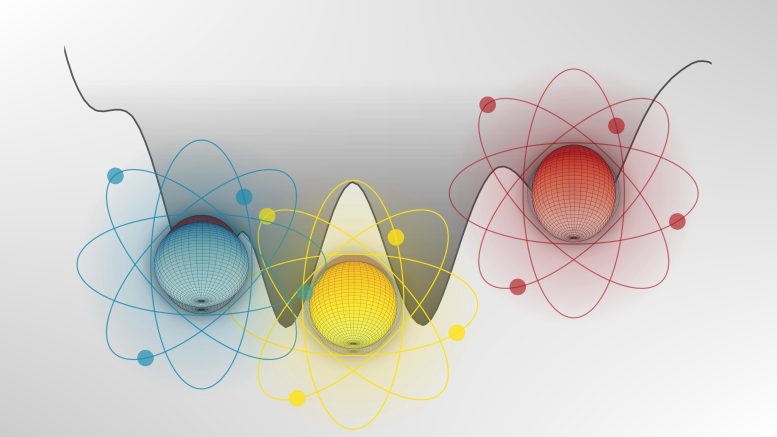
Scientists have reached a significant milestone in nuclear physics with the direct observation of three distinct deformations in the atomic nucleus of lead-190 (190Pb).
These deformations correspond to three unique shapes: spherical, oblate (resembling a flattened sphere, like a tomato), and prolate (elongated, like a watermelon), coexisting near the nucleus’s ground state. Published in Communications Physics in January 2025, this breakthrough was made possible through a combination of advanced experimental techniques and highlights the need for improved theoretical models to fully understand these phenomena.
Unveiling Shape Coexistence in Atomic Nuclei
For more than six decades, scientists have known that atomic nuclei can coexist in different shapes. However, measuring three coexisting deformations within a single nucleus has remained a challenge. A team of researchers from the University of Jyväskylä (Finland) and the University of Liverpool (UK) has now achieved this breakthrough.
Using advanced techniques, they identified γ rays emitted during the relaxation of nuclear states, directly linking these emissions to specific shape configurations. Their findings confirmed the prolate nature of one excited band, reassigned the lowest-lying band to an oblate shape (contradicting earlier studies suggesting a spherical shape), and identified a possible candidate for the first spherical excited state.
“190Pb is one of the most intriguing nuclei we have studied,” says Adrian Montes Plaza, dual-doctorate researcher at the University of Liverpool and the University of Jyväskylä, who analyzed the data. “Not only does it showcase multiple coexisting shapes, but our findings also suggest it could serve as a textbook example of nuclear states with wave functions significantly mixing contributions from each of these shapes.”
Revealing the Mysteries of 190Pb
The experiments were conducted at the Accelerator Laboratory of the University of Jyväskylä, where three advanced techniques were used to study the properties of 190Pb. The first measured γ rays and conversion electrons emitted immediately after its synthesis at the production target.
The second focused on γ rays emitted following the de-excitation of a metastable state. The third technique determined the lifetimes of excited nuclear states exploiting the Doppler effect, providing crucial insights into the collectivity of different configurations.
“Combining multiple experimental techniques is proving to be a powerful approach for exploring rare nuclear phenomena,” explains Senior Researcher Janne Pakarinen, the corresponding author. “Each method provides complementary information, allowing us to build a better picture of the configuration mixing in 190Pb.”
Advancing Nuclear Theory with Rare Phenomena
The study also highlights the importance of rare nuclei like 190Pb in advancing theoretical models. Shape coexistence presents a significant challenge for nuclear theory to accurately describe complex quantum phenomena. The results from 190Pb provide an important benchmark for state-of-the-art models, offering new constraints to refine our understanding of the nuclear interaction.
Reference: “Direct measurement of three different deformations near the ground state in an atomic nucleus” by Adrian Montes Plaza, Janne Pakarinen, Philippos Papadakis, Rolf-Dietmar Herzberg, Rauno Julin, Tomás R. Rodríguez, Andrew D. Briscoe, Andrés Illana, Joonas Ojala, Panu Ruotsalainen, Eetu Uusikylä, Betool Alayed, Ahmed Alharbi, Odette Alonso-Sañudo, Kalle Auranen, Ville Bogdanoff, Jamie Chadderton, Arwin Esmaylzadeh, Christoph Fransen, Tuomas Grahn, Paul T. Greenlees, Jan Jolie, Henna Joukainen, Henri Jutila, Casper-David Lakenbrink, Matti Leino, Jussi Louko, Minna Luoma, Adam McCarter, Bondili Sreenivasa Nara Singh, Panu Rahkila, Andrea Raggio, Jorge Romero, Jan Sarén, Maria-Magdalini Satrazani, Marek Stryjczyk, Conor M. Sullivan, Álvaro Tolosa-Delgado, Juha Uusitalo, Franziskus von Spee, Jessica Warbinek and George L. Zimba, 3 January 2025, Communications Physics.
DOI: 10.1038/s42005-024-01928-8
Leave a Reply