
By National Institutes of Natural Sciences January 18, 2025
Collected at: https://scitechdaily.com/james-webb-unveils-a-mysterious-planet-unlike-anything-in-our-solar-system/
The James Webb Space Telescope has provided groundbreaking insights into a new type of exoplanet, fundamentally different from those in our Solar System, by piercing through thick cloud layers to analyze atmospheric compositions. This discovery challenges existing classifications and expands our understanding of planetary formation and characteristics.
New data from the James Webb Space Telescope, combined with advanced simulations, have revealed a completely new type of planet unlike anything in our Solar System. This discovery offers fresh insights into how planets and planetary systems form.
Astronomers have confirmed over 5,500 exoplanets orbiting stars beyond the Sun. Many of these worlds are vastly different from the planets we know, making it challenging to determine their true nature. Among the most common are planets that fall between Earth and Neptune in size. Scientists have long debated whether these planets are rocky, Earth-like worlds with thick, hydrogen-rich atmospheres or icy, Neptune-like planets enveloped by water-rich atmospheres, often called “water worlds.” However, studying these planets has been complicated by high, thick cloud layers that frequently obscure the lower atmospheres, leaving much of their nature a mystery.
The Enigma of Exoplanets
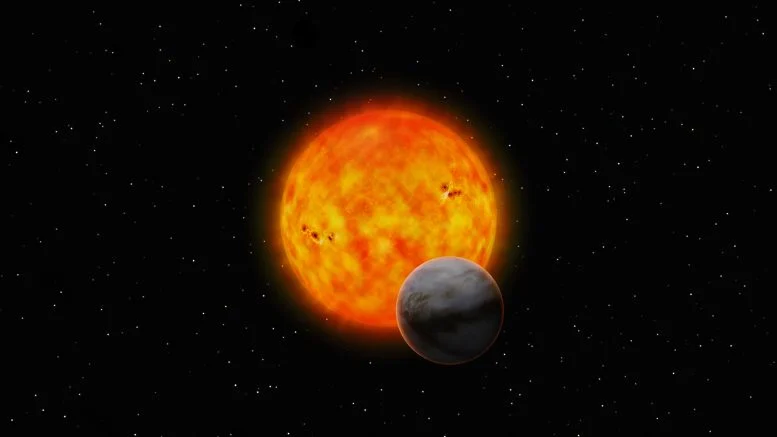
An international team of researchers led by Everett Schlawin at the University of Arizona and Steward Observatory and Kazumasa Ohno at the National Astronomical Observatory of Japan used the James Webb Space Telescope to peer through the clouds on an example of this kind of exoplanet known as GJ 1214 b. Located only 48 light years from the Solar System, in the direction of the constellation Ophiuchus, GJ 1214 b is the easiest example of this planet to study.
Instead of a hydrogen-rich super-Earth, or a water world, the new data revealed concentrations of carbon dioxide (CO2) comparable to the levels found in the dense CO2 atmosphere of Venus in the Solar System. However, there were still many uncertainties in the new data.
Analyzing GJ 1214 b
“The detected CO2 signal from the first study is tiny, and so it required careful statistical analysis to ensure that it is real,” explains Ohno. “At the same time, we needed the physical and chemical insights to extract the true nature of GJ 1214 b’s atmosphere from Schlawin’s study.” Then Ohno took the lead, using theoretical models to run a plethora of “what if” scenarios about the atmosphere of the planet. Out of all of these models, the ones that best fit the data all suggest a carbon-dominated atmosphere, like a “super-Venus.”
Although fascinating, the atmospheric signature detected in this work is very small. Schlawin compares it to reading a book, “It’s equivalent to Leo Tolstoy’s War and Peace. If I gave you two copies and changed one sentence in one of the books, could you find that sentence?” The team stresses the need for future studies to confirm and expand their findings about this common yet mysterious type of exoplanet.
References:
“Possible Carbon Dioxide above the Thick Aerosols of GJ 1214 b” by Everett Schlawin, Kazumasa Ohno, Taylor J. Bell, Matthew M. Murphy, Luis Welbanks, Thomas G. Beatty, Thomas P. Greene, Jonathan J. Fortney, Vivien Parmentier, Isaac R. Edelman, Samuel Gill, David R. Anderson, Peter J. Wheatley, Gregory W. Henry, Nishil Mehta, Laura Kreidberg and Marcia J. Rieke, 16 October 2024, The Astrophysical Journal Letters.
DOI: 10.3847/2041-8213/ad7fef
“A Possible Metal-dominated Atmosphere below the Thick Aerosols of GJ 1214 b Suggested by Its JWST Panchromatic Transmission Spectrum” by Kazumasa Ohno, Everett Schlawin, Taylor J. Bell, Matthew M. Murphy, Thomas G. Beatty, Luis Welbanks, Thomas P. Greene, Jonathan J. Fortney, Vivien Parmentier, Isaac R. Edelman, Nishil Mehta and Marcia J. Rieke, 14 January 2025, The Astrophysical Journal Letters.
DOI: 10.3847/2041-8213/ada02c
Leave a Reply