
January 16, 2025 by Samuel Jarman, SciencePOD
Collected at: https://phys.org/news/2025-01-touschek-gatto-exploring-friendship-fundamental.html
The Large Hadron Collider (LHC) made its groundbreaking discovery of the Higgs boson in 2012, but its ancestry can be traced back more than 60 years to the first electron-positron collision experiment in Italy. Named Anello di Accumulazione (AdA), the experiment was the world’s first collider of matter and antimatter.
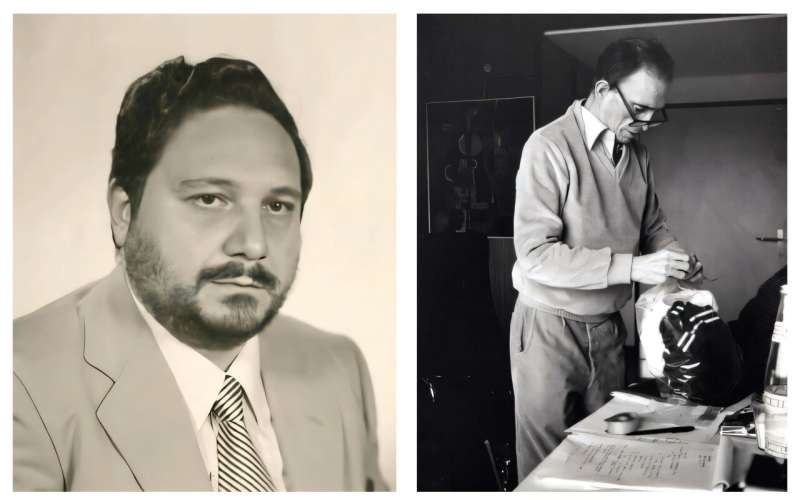
Through new research published in The European Physical Journal H, Luisa Bonolis, a historian of physics from MPIWG in Berlin, together with particle physicists Franco Buccella from INFN Roma1 and Giulia Pancheri at INFN Frascati Laboratories, tell the little-known story of how AdA’s theoretical foundations were shaped by the collaboration between Bruno Touschek and Raoul Gatto—two pioneering physicists with a deep knowledge of the properties of fundamental particles.
Built at Frascati in 1961, AdA was a ring-shaped collider about 1.3 meters in diameter that operated until 1964. Despite its short lifetime, the experiment lay vital groundwork for ADONE: an electron-positron collider 105 meters in diameter that would go on to operate until 1993.
This larger collider helped to refine the methods, which in 1974, would lead to the groundbreaking discovery of the J/psi meson. This particle was crucial in advancing our understanding of quarks and their interactions—ultimately paving the way for the discovery of the Higgs boson several decades later.
Touschek is well known for his contributions to the AdA experiment, but less is known about the crucial role played by his friend, Gatto, who he met in Rome in 1953. In their paper, the team investigate the collaboration between the pair based on a wide range of available sources: including Gatto’s personal exchanges with Touschek, and their own private communications with Gatto.
The team’s findings highlight the close friendship between the two scientists, and paint a picture of the discussions between them that would prove the feasibility of collider rings as tools for probing the world of elementary particles.
The paper also explores the duo’s friendship with Wolfgang Pauli and Gerhard Lüders, whose theoretical work was a vital basis for AdA’s success, and highlights Touschek and Gatto’s contribution in mentoring many of the great Italian physicists whose work would shape the foundations of the Standard Model.
More information: Luisa Bonolis et al, Raoul Gatto and Bruno Touschek’s joint legacy in the rise of electron–positron physics, The European Physical Journal H (2024). DOI: 10.1140/epjh/s13129-024-00086-3
Leave a Reply