
By Iqbal Pittalwala, University of California – Riverside January 12, 2025
Collected at: https://scitechdaily.com/mystery-of-the-milky-ways-stellar-streams-solved-by-dark-matter/
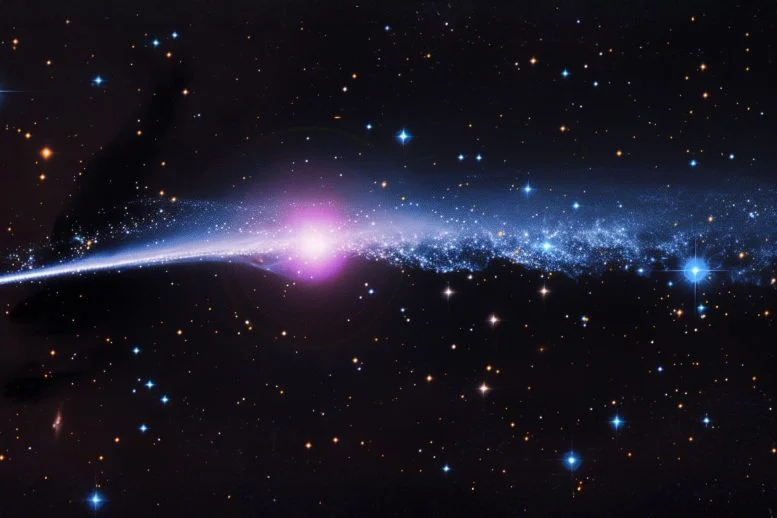
Spur and gap features seen in Milky Way’s GD-1 stellar stream could be caused by a self-interacting dark matter subhalo.
New research points to a dark matter subhalo as the architect behind the unique formations in the GD-1 stellar stream, potentially shifting paradigms about dark matter’s behavior and interaction within galaxies.
Unraveling the GD-1 Mystery
Physicists may have solved a long-standing mystery about the GD-1 stellar stream, a prominent and well-studied feature within the Milky Way’s galactic halo. Known for its long, slender structure and unusual spur and gap formations, GD-1 has puzzled researchers for years.
A team led by Hai-Bo Yu from the University of California, Riverside, suggests that these distinctive features are caused by a core-collapsing self-interacting dark matter (SIDM) subhalo. This subhalo, a dense satellite of dark matter within the galactic halo, could explain the stream’s peculiar patterns.
Dark Matter and Stellar Dynamics
The findings, published on January 3 in The Astrophysical Journal Letters, provide new insights into the behavior of dark matter and its role in shaping the universe.
A stellar stream is a group of stars moving collectively along a shared trajectory. A gap refers to a localized under-density of stars along the stream, while a spur is an over-density of stars extending outward from the main body of the stream. Since dark matter governs the motion of stellar streams, astronomers can use them to trace invisible dark matter in a galaxy.
The Milky Way’s galactic halo, a roughly spherical region surrounding the galaxy, contains dark matter and extends beyond the galaxy’s visible edge. Visualizations of well-known stellar streams in the Milky Way can be found here.
The Role of SIDM in Galactic Phenomena
Astronomers discovered that the spur and gap features of the GD-1 stellar stream cannot be easily attributed to the gravitational influence of known globular clusters or satellite galaxies of the Milky Way. These features could be explained, however, by an unknown perturbing object, such as a subhalo. But the object’s density would need to be significantly higher than what is predicted by traditional cold dark matter (CDM) subhalos.
“CDM subhalos typically lack the density needed to produce the distinctive features observed in the GD-1 stream,” explained Yu, a professor of physics and astronomy. “However, our research demonstrates that a collapsing SIDM subhalo could achieve the necessary density. Such a compact subhalo would be dense enough to exert the gravitational influence required to account for the observed perturbations in the GD-1 stream.”
Advancements in Dark Matter Research
Dark matter, which cannot be seen directly, is thought to make up 85% of matter in the universe. Its nature is not well understood. CDM, the prevailing dark matter theory, assumes dark matter particles are collisionless. SIDM, a theoretical form of dark matter, proposes dark matter particles self-interact through a new dark force.
In their study, Yu and his team used numerical simulations called N-body simulations to model the behavior of a collapsing SIDM subhalo.
“Our team’s findings offer a new explanation for the observed spur and gap features in GD-1, which have long been thought to indicate a close encounter with a dense object,” Yu said. “In our scenario, the perturber is the SIDM subhalo, which disrupts the spatial and velocity distributions of the stars in the stream and creates the distinctive features we see in the GD-1 stellar stream.”
According to Yu, the discovery also provides insights into the nature of dark matter itself.
“This work opens a promising new avenue for investigating the self-interacting properties of dark matter through stellar streams,” he said. “It marks an exciting step forward in our understanding of dark matter and the dynamics of the Milky Way.”
Reference: “The GD-1 Stellar Stream Perturber as a Core-collapsed Self-interacting Dark Matter Halo” by Xingyu Zhang, Hai-Bo Yu, Daneng Yang and Ethan O. Nadler, 3 January 2025, The Astrophysical Journal Letters.
DOI: 10.3847/2041-8213/ada02b
Yu was joined in the research by Xingyu Zhang and Daneng Yang at UCR; and Ethan O. Nadler at the University of California, San Diego.
Leave a Reply