
By Max Planck Institute for Astrophysics January 5, 2025
Collected at: https://scitechdaily.com/scientists-just-discovered-a-new-way-to-spot-hidden-supermassive-black-holes/
Scientists are diving deep into the origins of supermassive black holes, using recent gravitational wave detections as a key tool.
By leveraging signals from smaller black holes, researchers hope to detect the harder-to-catch waves from supermassive pairs, potentially unlocking the secrets of their formation and growth.
Unveiling the Mystery of Supermassive Black Holes
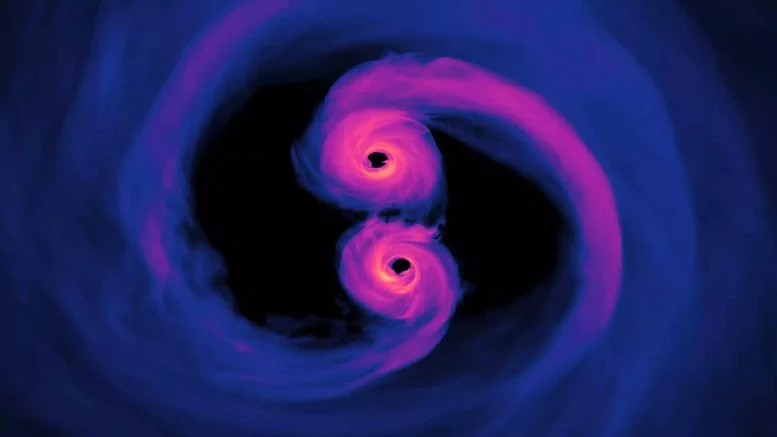
The origin of supermassive black holes at the centers of galaxies remains one of astronomy’s greatest mysteries. These colossal entities may have been born massive in the early Universe or grown over time by consuming matter and merging with other black holes. When a supermassive black hole is on the verge of merging with another massive black hole, it generates gravitational waves — ripples in spacetime that travel across the cosmos.
While gravitational waves have recently been detected, these signals have so far only come from small black holes, the remnants of collapsed stars. Detecting waves from larger black hole pairs remains out of reach for current technology because they emit at extremely low frequencies, which today’s instruments cannot detect. Future advancements, like the ESA-led space mission LISA, are expected to improve sensitivity to these low-frequency waves. However, even with such progress, identifying the signals from the most massive black hole pairs will continue to pose significant challenges.
A Novel Approach to Decode Hidden Signals
“Our idea basically works like listening to a radio channel. We propose to use the signal from pairs of small black holes similar to how radio waves carry the signal. The supermassive black holes are the music that is encoded in the frequency modulation (FM) of the detected signal.” said Jakob Stegmann, lead author of the study and postdoctoral research fellow at MPA. “The novel aspect of this idea is to utilize high frequencies that are easy to detect to probe lower frequencies that we are not sensitive to yet.”

Pioneering Methods for Future Discoveries
Recent results from pulsar timing arrays already support the existence of merging supermassive black hole binaries. This evidence is, however, indirect and comes from the collective signal of many distant binaries that effectively create background noise.
The proposed method to detect individual supermassive black hole binaries leverages the subtle changes they cause in the gravitational waves emitted by a pair of nearby small stellar-mass black holes. The small black hole binary effectively works as a beacon revealing the existence of the bigger black holes. By detecting the tiny modulations in signals from small black hole binaries, scientists could thus identify previously hidden supermassive black hole binaries with masses ranging from 10 million to 100 million times that of our Sun, even at vast distances.
Implications for Next-Generation Detectors
Lucio Mayer, who is a co-author of the study and black hole theorist at the University of Zurich, added, “As the path for the Laser Interferometer Space Antenna (LISA) is now set, after adoption by ESA last January, the community needs to evaluate the best strategy for the following generation of gravitational detectors, above all in which frequency range to focus – studies like this bring a strong motivation to prioritize a deci-Hz detector design.”
“This paper presents a very cool and clever idea, which is still Science Fiction until we have a deci-Hz detector”, says Selma E. de Mink, director at MPA who is not involved in this work, “but we really need creative and out-of-the-box ideas like this if we want a chance to solve the biggest mysteries in the Universe.”
Reference: “Imprints of massive black-hole binaries on neighbouring decihertz gravitational-wave sources” by Jakob Stegmann, Lorenz Zwick, Sander M. Vermeulen, Fabio Antonini and Lucio Mayer, 5 August 2024, Nature Astronomy.
DOI: 10.1038/s41550-024-02338-0
Leave a Reply